When you click on links to various merchants on this site and make a purchase, this can result in this site earning a commission. Affiliate programs and affiliations include, but are not limited to, the eBay Partner Network.
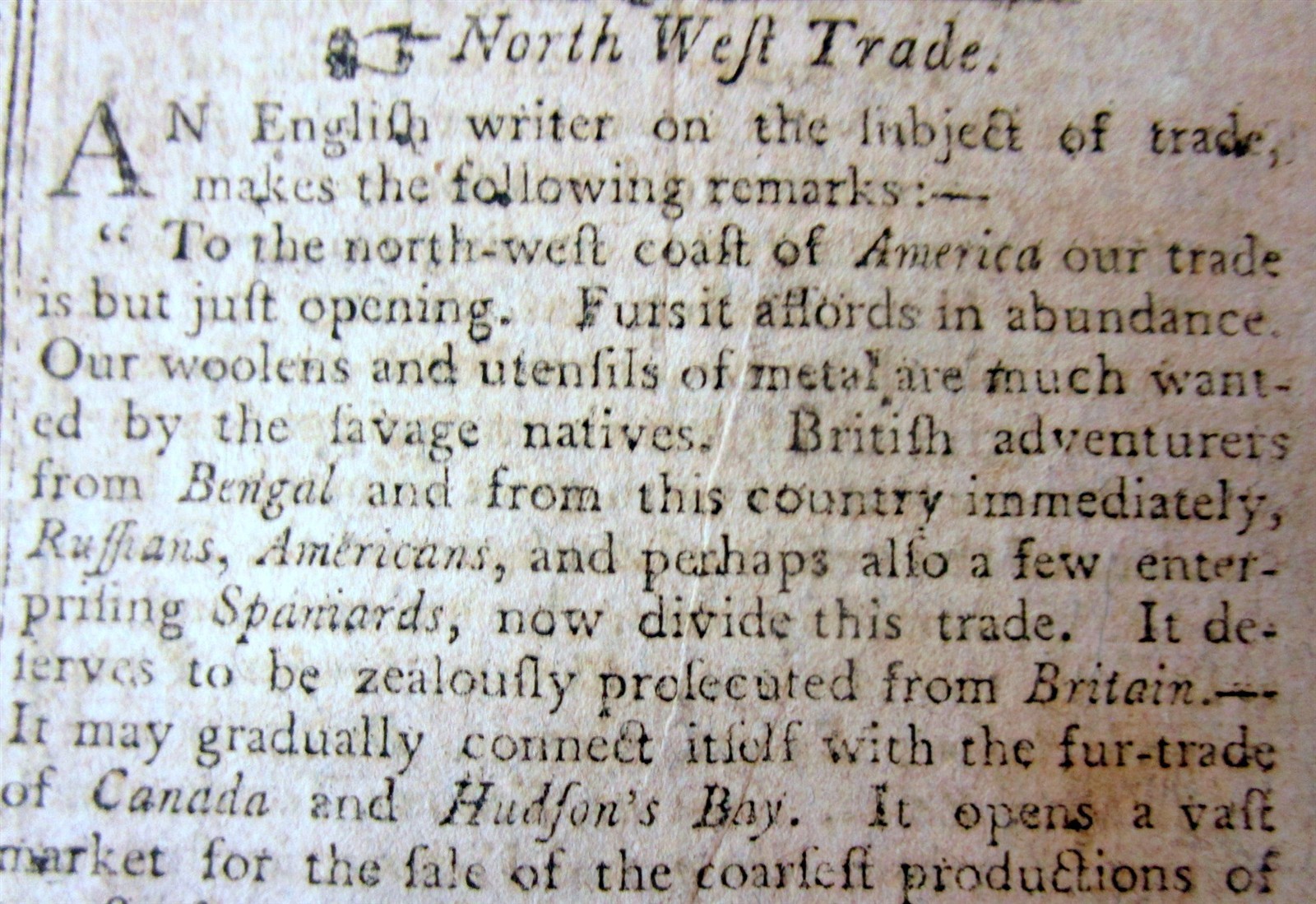
1801 newspaper with an EARLY REPORT on THE FUR TRADE in CANADA and HUDSON\'S BAY
1801 newspaper with AN EARLY REPORT on THE FUR TRADE in CANADA and HUDSON\'S BAY
- inv # 8M-509
Please visit our store for THOUSANDS MORE HISTORICAL NEWSPAPERS for SALE or at sale
SEE PHOTO(s) - COMPLETE ORIGINALNEWSPAPER,theColumbian Centinel(Boston, MA)datedOct 28, 1801.This original newspaper contains a front page headline: \"NORTH WEST TRADE\"with areport including THE FUR TRADE in CANADA and HUDSON\'S BAY.
Furs, particularly those of sea otters and fur seals, lured the first European explorers, and later Americans, to the Pacific Northwest and the Columbia River. They came by sea. In the mid to late 1700s, the thick, luxurious and water-repellent furs of sea mammals were highly valued in China as well as in Europe, where they were sewn into coats, hats and bed covers. In China, furs were traded for tea and spices.
A Russian, Semen Dezhnev, may have been the first to venture into the northern Pacific for the purpose of commerce in furs. In 1648, Dezhnev completed the first recorded voyage between the Arctic and Pacific oceans by sailing east from the mouth of the Kolyma River, which flows into the Arctic Ocean, around the northeastern tip of Siberia and south to a point near the mouth of the Anadyr River, on the Pacific Ocean. Historian Stephen Haycox of the University of Alaska calls Dezhnev’s voyage “a remarkable Russian geographical accomplishment,” a highly significant voyage like the later explorations of Vitus Bering in 1728 and 1741 that led to the colonization of Alaska by Russian fur merchants. Bering recognized the importance of Dezhnev’s accomplishment; he reported on Dezhnev’s voyage upon his return to St. Petersburg after exploring the Siberian Pacific coast. Others recognized, it, too. In August 1778, Captain James Cook named the easternmost point of Asia — the northeastern tip of Siberia — East Cape, but Russia has preferred the name Cape Dezhnev.
By leading the way into the North Pacific, Dezhnev inspired those who would follow. And it was the knowledge of Bering’s discovery of Alaska, among other concerns, that influenced the naval officers of New Spain to dispatch their own explorations north along the eastern coast of the Pacific into the Northwest in the mid-1700s and to protect and expand their empire by establishing an outpost at Nootka Sound on the west coast of present-day Vancouver Island in 1789. At the same time, stories about Russians trading Alaskan furs in China, and the continued search for the Northwest Passage, intensified European and, ultimately, American interest in the Pacific Northwest and the Columbia River.
Cook approached the Northwest coast on his third voyage to the Pacific in March 1778. He first sighted the coast near present-day Yaquina Bay, Oregon (Newport), on March 7. Because his instructions were to search for the passage farther north, he spent little time off the Oregon coast, but he did name several prominent capes — Gregory (today called Arago), Perpetua and Foulweather — then was blown out to sea in a storm and missed both the entrance of the Columbia River and the Strait of Juan de Fuca. He stopped at Nootka Sound, which he did not realize was on an island, for the purpose of repairing and rerigging his two ships, theResolutionandDiscovery. The expedition spent most of April at Nootka, where the local Indians carried on a lively trade with the crew for metal. The Indians possessed some brass and silver objects, apparently acquired from Spaniards who had visited the coast previously, and they wanted more. Cook’s crew traded practically everything metal they possessed — buttons, drawer knobs, kettles — in exchange for sea otter skins, which were needed to mend their worn clothing. The pelts also were beautiful and luxurious, and the crew “was passionately fond of” them, Cook later noted in his report of the voyage. At Canton on the return voyage to England, following Cook’s death in Hawai’i, the crew sold their surplus pelts for $100 apiece, a remarkable price at the time.
News of the fabulous value of Northwest furs sparked the interest of traders in America, England and Spain and led to the beginning of the sea-based fur trade in the Northwest. It was interest in the maritime fur trade following the publication of the official report of Cook’s voyage in 1784 that led to the discovery of the Columbia River. British interest in the maritime fur trade peaked between 1785 and 1794 and gradually declined over the next 10 years as the wars that grew out of the French Revolution diminished Britain’s manpower and investment. The country also concentrated its foreign trade activities in India. But as well, competition intensified as more Americans entered the Northwest fur trade. American merchants sought new business opportunities in the wake of the American revolution and the loss of prior trading relations with Great Britain, parts of Europe and in the West Indies. Robert Gray, who would discover the Columbia River on his second voyage to the Northwest coast, was outfitted by Boston merchants for both voyages, the first in 1787 and the second three years later. The trade grew steadily and remained active and prosperous until war with Great Britain broke out in 1812.
As Cook’s crew discovered, the prized sea otter fur initially brought $100 or more in Canton, but over time the price declined to about $22 — still a lot of money in the early 1800s. At the height of the trade, in 1801-02, 15 vessels were on the coast and 15,000 pelts were carried to Canton. Between 1790 and 1812, American traders sold an average of 12,000 sea otter pelts in Canton annually. The skins of beaver, marten and seals also were traded, but these were less valuable.
The Columbia River was not a major trading depot for sea otters, but the estuary provided a convenient place for traders to spend the winters. Vancouver\'s lieutenant, Broughton, found the American trader James Baker in the estuary when he entered in October 1792, six months after Gray discovered the river. During the winter of 1805-06, when theLewis and Clarkexpedition stayed atFort Clatsop, local Indians gave the explorers the names of 14 traders who had visited the river, but it was impossible to identify them based on the Indians’ pronunciation of their names. In the Columbia River, traders often acquired locally made leather “war dresses,” also called “clamons,” which could be traded to Indians elsewhere on the Northwest coast for furs — until the Americans started trading guns for furs and the war dresses became obsolete.
Steadily the relentless pursuit of sea otters diminished their populations in the Northwest, and traders turned to California, where the animals remained in great supply. Enterprising businessmen sought to expand the Northwest trade to embrace the Russian forts in Alaska by using Alaskan native hunters to kill sea otters in California, trade them in Hawai’i or Canton for cash and goods, and then supply the Russian forts in a sort of triangular trade route between the Northwest, Canton and Lima.. The Columbia River provided a suitable location for the Northwest headquarters of such an enterprise, and Captain Nathaniel Winship established a post about 30 miles upriver in May 1810 for that purpose. The site was on the south shore approximately across the river from present-day Oak Point, Washington. Repeated warnings by local Indians that Europeans were welcome to trade at the coast but not settle inland convinced Winship to abandon the project, but it was the first effort to build an American settlement in the Northwest. Historians Dorothy Johansen and Charles Gates say the Winship attempt at settlement also shows that East Coast business interests saw the Columbia as a vital link in Pacific commerce and as the future business center of the region.
It was the nature of the fur trade, Johansen and Gates wrote, that new fields of opportunity needed to be opened continuously to feed the voracious demand for fur. In 1807 the North West Company, a Canadian firm that employedDavid Thompson, began exploring the region west of the Rocky Mountains. In competition with the Hudson’s Bay Company, the North West Company sought to leave the drainage of Hudson’s Bay to its rival and attempt to dominate the Columbia River fur trade. At the same time New York merchant John Jacob Astor, who had made a fortune in the East Coast fur trade, sought to expand his empire to the Pacific through a succession of separate companies that ultimately would be established in succession across the country and eventually joined. One of these, which he incorporated in 1810, was the Pacific Fur Company. It was an alliance among Astor and three former North West Company principals.
Very good condition. This listing includes thecomplete entire original newspaper, NOT just a clipping or a page of it. STEPHEN A. GOLDMAN HISTORICAL NEWSPAPERS stands behind all of the items that we sell with a no questions asked, money back guarantee. Every item we sell is an original newspaper printed on the date indicated at the beginning of its description. U.S. buyers paypriority mail postage which includes waterproof plastic and a heavy cardboard flat to protect the purchased itemfrom damage in the mail. Uponrequest by the buyer, we can ship by USPS Media Mail to reduce postage cost; however, please be aware that USPS Media Mailcanbe very slow in its time of transit to the buyer.International postage is quoted when we are informed as to where the package is to be sent. We do combine postage (to reduce postage costs) for multiple purchases sent in the same package. We list thousands of rare newspapers with dates from 1570 through 2004 on each week. This is truly SIX CENTURIES OF HISTORY that YOU CAN OWN!
Stephen A. Goldman Historical Newspapers has been in the business of buying and selling historical newspapers for over 50 years. Dr. Goldman is a consultant to the Freedom Forum Newseum and a member of the American Antiquarian Society. You can buy with confidence from us, knowing that we stand behind all of our historical items with a 100% money back guarantee. Let our 50+ years of experience work for YOU ! We have hundreds of thousands of historical newspapers (and their very early precursors) for sale.
Stephen A. Goldman Historical Newspapershas been in the business of buying and selling historical newspapers for over 50 years. We are located in the charming Maryland Eastern Shore town of OXFORD, Maryland.
Dr. Goldman is a consultant to the Freedom Forum Newseum and a member of the American Antiquarian Society. You can buy with confidence from us, knowing that we stand behind all of our historical items with a 100% money back guarantee. Let our 50+ years of experience work for YOU ! We have hundreds of thousands of historical newspapers (and their very early precursors) for sale.
We invite customer requestsforhistorical newspapers that are not yetlocated in our extensive listing ofitems. With an inventory of nearlya million historical newspapers (and their early precursors) we arelikely have just the one YOU are searching for.
WE ARE ALSO ACTIVE BUYERS OF HISTORICAL NEWSPAPERS, including large and small personal collections, bound volumes, significant individual issues, or deaccessions from libraries and historical societies. IF YOU WANT TO SELL, WE WANT TO BUY !!!
Powered by SixBit\'s eCommerce Solution