When you click on links to various merchants on this site and make a purchase, this can result in this site earning a commission. Affiliate programs and affiliations include, but are not limited to, the eBay Partner Network.
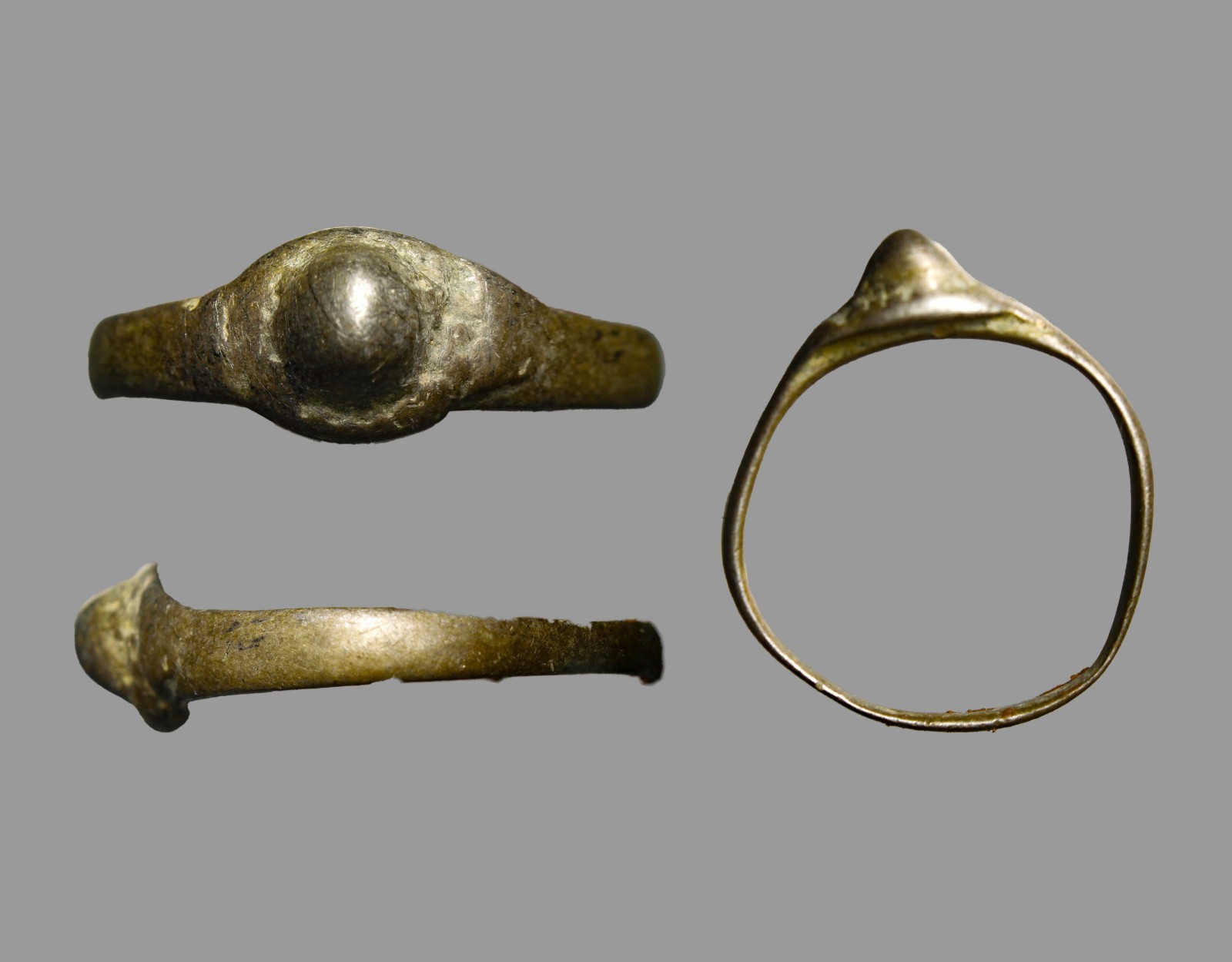
Ancient Roman Silver Stirrup Ring with Prominent Conical Bezel 3rd–4th Century AD Size 6.5–7 Authentic
Authentic ancient artifact, guaranteed genuine and accompanied by a Certificate of Authenticity. Mediterranean / European Find.
Culture: Ancient Roman (Late Imperial Era)
Date: Circa 3rd–4th Century AD
Material: Silver (High-Grade Silver Alloy)
Type: Stirrup-Style Personal Ring / Conical Projection Ring
Size: Ring Size 6.5 – 7 (Approx. 16.9 mm to 17.3 mm Inner Diameter)
Description
This is an elegant, highly collectible ancient Roman silver ring measuring a wearable US size 6.5 to 7, dating to the Late Roman Imperial period. This specimen represents a classic and visually striking Roman jewelry design known typologically as a \"stirrup ring\" due to the distinct, upward-sweeping profile of its shoulders and bezel.
The ring features a slender, comfortable hoop that gradually expands at the shoulders to support a highly prominent, solid integral bezel formed into a raised, smooth conical or hemispherical projection. In the Roman world, jewelry from the 3rd and 4th centuries moved away from classical flat surfaces toward highly architectural, three-dimensional geometric shapes that caught the light dynamically. This raised, pointed design was both an elegant fashion statement among the Roman provincial elite and a highly tactile personal adornment.
The artifact is presented in an exceptional, untouched archaeological state. The high-grade ancient silver has developed a beautiful, authentic horn-silver patina with rich olive-gold and deep charcoal-toned oxidation across the surfaces. This stable, historic tarnish is accompanied by light microcrystalline soil deposits in the protected recesses where the hoop meets the raised bezel, providing an unmistakable visual signature of centuries of undisturbed interment.
Authentication
The ring displays impeccable diagnostic indicators of genuine Roman metallurgy. The hoop exhibits the characteristic slight thickness variations and manual finishing of a hand-forged piece rather than modern uniform wire drawing or machine casting. Under magnification, the surfaces show soft, genuine ancient wear patterns along the high points of the cone and inner shank from its historic use. No modern seam lines, file marks, laser welds, or artificial chemical patinating agents are present.
Comparable Examples & References
Late Roman silver and gold stirrup-style rings with conical or pyramidal projections are well-documented in academic literature. Similar examples recovered from Roman Britain, Gaul, and the Danube frontier can be studied in the permanent antiquities collections of the British Museum in London and the Roman-Germanic Central Museum (RGZM) in Mainz. For detailed typological classification of Roman finger rings, collectors can consult Henig’s A Corpus of Roman Engraved Gemstones from British Sites and F. Marshall’s classic Catalogue of the Finger Rings in the British Museum.
Condition
Excellent archaeological condition. The silver remains entirely stable, robust, and structurally sound with no thinning, cracks, or modern repairs to the hoop. The prominent conical bezel is completely intact and retains its sharp, historic geometry. The deep, rich tone of the silver gives this piece incredible visual depth, making it an exceptionally attractive and fully wearable artifact of the Roman Empire.
10-2