When you click on links to various merchants on this site and make a purchase, this can result in this site earning a commission. Affiliate programs and affiliations include, but are not limited to, the eBay Partner Network.
What Wall Street Story Is Hiding in an Old Stock Certificate? 🦅
There's a particular kind of magic in holding a stock certificate that once passed through actual hands on the actual floor of the New York Stock Exchange — not a photocopy, not a reproduction, but the genuine paper that represented real ownership in a real company during the Depression years. This one carries an added layer of meaning most certificates don't: it was printed by a company whose entire business was printing exactly this kind of document for everyone else. When American Bank Note Company issued shares of itself, it turned its own engraving craft loose on its own stock — and the result is one of the more handsome specimens you'll find in the security-printing hobby.
📜 What This Piece Is
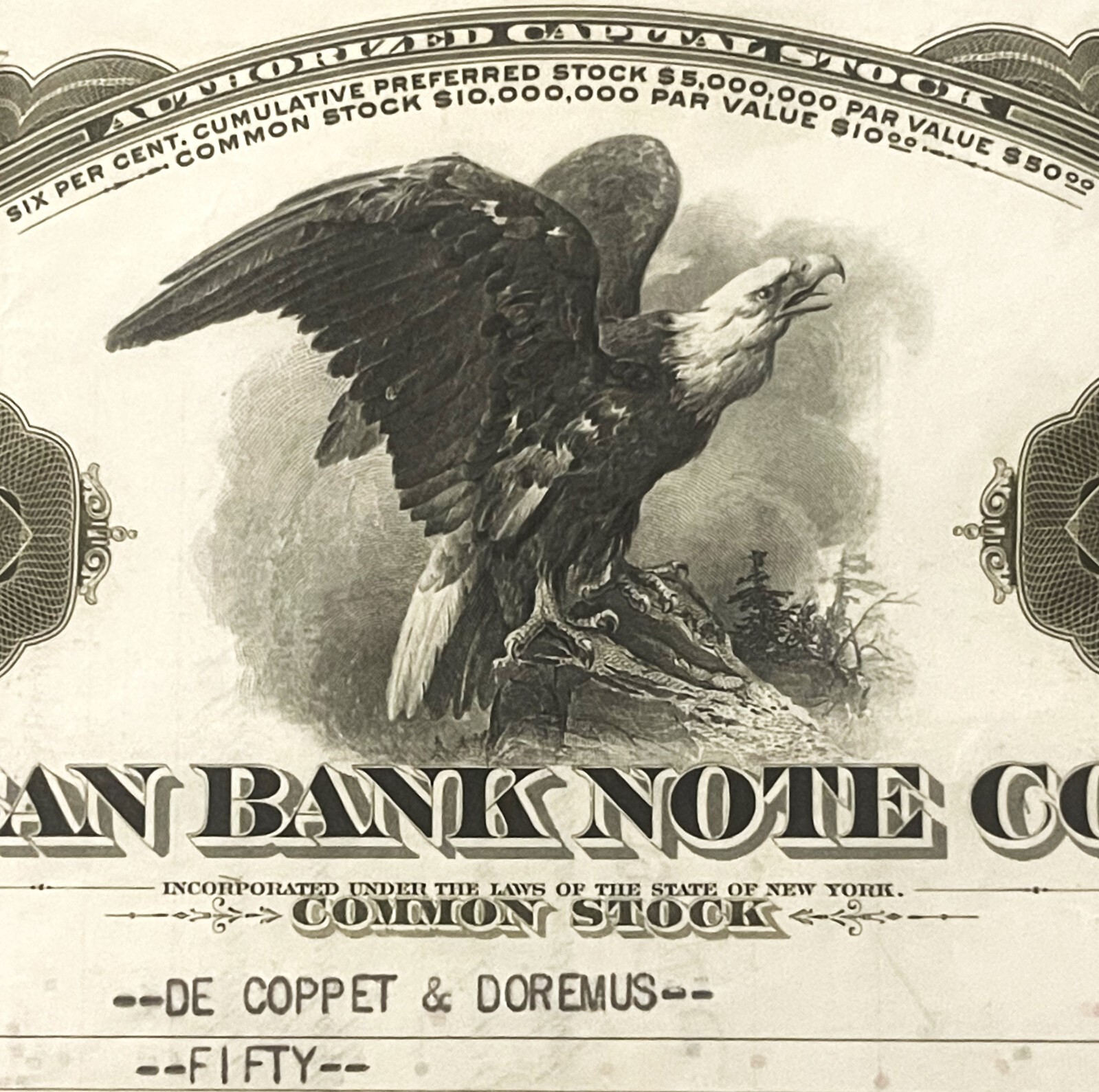
This is a Common Stock certificate issued by the American Bank Note Company, incorporated under the laws of the State of New York, for shares carrying a par value of ten dollars each. The issue's printed date reads July 13, 1937, placing it squarely in the Depression-era history of one of the country's most storied security printers. Certificates in this series went to Wall Street houses including De Coppet & Doremus, one of the Street's premier odd-lot brokerages, in the small lots — a "certificate for less than 100 shares," as the piece itself notes in its ornate corner medallions. The document measures 12 x 8 inches, the classic broadside format used for stock and bond issues of the era, and this is genuine issued financial paper that went through daily transfer traffic and came back out punch-cancelled.
The artwork is where American Bank Note Company truly showed off. Front and center sits a bald eagle, wings raised and head turned in profile, perched on a rocky outcrop above a distant tree line rendered in fine sepia-toned intaglio linework — the same steel-engraving technique the company used on currency and government bonds, giving the image a depth and crispness that photographic printing can't replicate. The eagle is framed above by an arched banner spelling out the company's authorized capital structure: six percent cumulative preferred stock at five million dollars par value, common stock at ten million. Below, the company name is rendered in bold shadowed lettering, flanked by ornate scalloped borders built from tight guilloche patterning — the same interlocking-line security work that made counterfeiting bank notes and stock certificates so difficult in this era. Corner medallions, a decorative rosette at the base for the corporate seal, and a numbered "shares" panel complete the design. On surviving examples, perforated cancellation marks read across the certificate, and ink signatures appear at bottom for the company's treasurer and president — small human touches on a document otherwise built entirely from engraved precision.
🏛️ American Bank Note Company: The Printer That Printed Money — Literally
American Bank Note Company's roots stretch back to 1795, when Robert Scot — the first Chief Engraver of the U.S. Mint — joined three partners to found Murray, Draper, Fairman & Company in Philadelphia. Through decades of mergers among rival security engravers, the firm took its modern name in 1858, and cemented its dominance in 1879 when two more competitors, National Bank Note and Continental Bank Note, folded into it, bringing federal stamp contracts along with them.For a stretch of American history, this company's presses produced the nation's actual money. During the Civil War, American Bank Note and National Bank Note printed the federally issued "Demand Notes" under contract with the U.S. Treasury. When the Bureau of Engraving and Printing eventually took currency and postage stamp production in-house, American Bank Note pivoted outward, becoming the trusted engraver of banknotes and security paper for governments around the globe — eventually serving as official printer for dozens of nations and even the United Nations, all while remaining a fixture of Wall Street itself.By the time this certificate rolled off the press in 1937, the company had weathered — in its own later telling — "almost every imaginable sort of political, economic and scientific upheaval," and it would go on to survive plenty more: a 1969 change of ownership, a 1972 rebrand to International Banknote Company, a 1990 merger creating United States Banknote Corporation (then the second-largest security printer in the world), a 1999 bankruptcy filing, and an eventual 2002 emergence under restructured footing. The company that once engraved bald eagles onto its own stock certificates continues its security-printing lineage today under the ABCorp name.
🗽 New York's Own Security Printer
American Bank Note Company's corporate address was 70 Broad Street in Manhattan's Financial District — a five-story headquarters erected in 1908 that today stands as a designated New York City landmark and a listing on the National Register of Historic Places. It's the building most closely associated with issuing certificates exactly like this one.Its actual printing muscle, though, sat further north. Between 1909 and 1911, the company built a sprawling manufacturing plant in Hunts Point, the Bronx — a building running 465 feet along Lafayette Avenue with a 91-foot tower marking its midpoint, a genuine local landmark for the neighborhood for most of the twentieth century. The plant operated until around 1984, and the building itself was later granted New York City landmark status in 2008. For generations of Bronx families, "the bank note company" wasn't an abstraction on a stock certificate — it was where a father, an uncle, or a neighbor clocked in every morning to run the presses that quietly underwrote much of the world's paper money and financial paper.
🤵 De Coppet & Doremus: The Odd-Lot Kings of Wall Street
The name on this issue belongs to one of the two firms that essentially controlled a very specific and colorful corner of the New York Stock Exchange: odd-lot trading, meaning any order for fewer than 100 shares — exactly the kind of block this certificate represents, as its engraved corner medallions announce. De Coppet & Doremus and its rival, Carlisle & Jacquelin, both traced back to a shared ancestor firm, Jacquelin & DeCoppet Brothers, which in 1875 became the first odd-lot house of its kind on the Exchange.The deCoppet family name carried real cultural weight beyond Wall Street. Edward J. deCoppet, a partner in the firm, organized the celebrated Flonzaley Quartet in 1903 — a detail collectors of Exchange history love to pass along, since it's not every brokerage partner who moonlights as a chamber-music patron. His relative André De Coppet inherited a position in the firm after his father's death in 1916, became a prominent figure in Exchange governance, and later built a serious reputation as a collector of European and American manuscripts. The firm's other name partner, Robert Doremus, chaired the Exchange's Clearing House Committee — and old-timers on the Street liked to recall that the firm fielded its own company baseball team, famously beating rival firm Post & Flagg 7 to 3 in a 1921 match billed as the "Wall Street championship."The odd-lot business itself eventually became commercially unsustainable as trading costs rose and small-share volume shrank; De Coppet & Doremus merged with Carlisle & Jacquelin on January 1, 1970. Lore passed down among collectors of Exchange ephemera holds that the odd-lot specialists were, in their heyday, some of the most recognizable characters on the floor — men whose entire livelihood depended on serving the "little guy" investor buying in blocks too small for the big houses to bother with.
🖋️ Bankers Trust and the Paper Trail
Registration and transfer for this issue ran through Bankers Trust Company of New York, named on the certificate as both registrar and guarantor — standard practice for a major Depression-era New York Stock Exchange-listed company, and a small reminder of how intertwined the city's banking and printing institutions were in this period. Every certificate carries hand ink signatures for the company's treasurer and president alongside an embossed corporate seal at the base — the final human authentication stamped atop a document otherwise entirely a product of engraved steel plates.
🖼️ Display Ideas
- 🦅 Frame it solo as a piece of American eagle folk art — the vignette alone carries the visual weight of a period print
- 🏙️ Pair it in a small grouping with other Wall Street or financial-district ephemera for a "Financial District" gallery wall
- 📚 Add it to a study or home office alongside other engraved Americana for texture and conversation
- 🎼 Hang it near sheet music or a string-instrument display, nodding to the deCoppet family's Flonzaley Quartet connection
- 💼 Give it as a gift to a collector, a broker, a retiring banker, or anyone with roots in old-line Wall Street firms
- 🖋️ Display it flat under glass to show off the guilloche border and engraving detail up close
🎁 Who Collects These
Scripophily collectors — people who collect stocks and bonds as historical documents rather than financial instruments — actively seek out American Bank Note Company's own certificates precisely because the printer of the world's money and securities rarely gets to be the star of its own show. Wall Street history buffs, fans of engraved Americana, eagle and patriotic-imagery collectors, and anyone drawn to Depression-era financial paper all find something to love here. The De Coppet & Doremus name adds another layer of appeal for collectors who follow odd-lot trading history and the personalities of the old Exchange floor.
❓ FAQ
- Is this a real stock certificate or a reproduction? It's an authentic issued American Bank Note Company certificate from its own printed issue, not a reprint or replica.
- What does the eagle vignette represent? It's a standard patriotic engraving motif American Bank Note Company used across its own corporate stock and much of the currency and security paper it printed for governments and institutions worldwide.
- Who was De Coppet & Doremus? One of Wall Street's two dominant odd-lot brokerage houses, specializing in trades of fewer than 100 shares, active from the late 1800s until its 1970 merger with rival Carlisle & Jacquelin.
- Why would a bank note printing company issue its own stock? American Bank Note Company was itself a publicly traded, New York Stock Exchange-listed corporation — so its own shares, like any company's, needed certificates, and it simply used its own engraving expertise to produce them.
- Was this certificate ever transferred or traded? Odd-lot brokerage firms like De Coppet & Doremus regularly moved small share blocks through their books as part of daily exchange business, which is the context in which certificates of this type circulated.
- Does the certificate include the company's engraved seal and signatures? Yes — an embossed corporate seal appears at the base of the certificate alongside hand ink signatures for the treasurer and president.
- What size is the certificate? 12 x 8 inches, the standard broadside format used for American stock and bond issues of this era.
These are issued instruments rather than blanks. Certificates of this type were filled in for a holder in ink, countersigned by the transfer agent and registered by the registrar, then punch- or cut-cancelled when they were redeemed and retired. Expect financial writings, markings, stamps, hole punches and staple holes as part of the life of the instrument: endorsements and signatures, transfer-agent and registrar stamps, revenue or documentary tax stamps, cancellation punches, staple holes from being bound into a transfer book, pencil ledger notations. That is the paper trail of a security that actually did its job, and it is what separates a document that lived from a blank that never did. No two are alike: share counts, holder details, serial numbers, dates, signatures, stamps and punch patterns vary from example to example, so the photographs show the type rather than the exact sheet that ships.