When you click on links to various merchants on this site and make a purchase, this can result in this site earning a commission. Affiliate programs and affiliations include, but are not limited to, the eBay Partner Network.
When the Evening Star Shone Over the San Fernando Valley 🌟 — Do You Remember When California Lemons Came Wrapped in Art?
There is a particular kind of magic that happens when you hold one of these labels. It isn't just the colors — that deep midnight blue sky, the warm cream of the mission walls, the bursting yellow and red of the lettering — it's the feeling that you are holding a window into a California that no longer exists. The lemon groves are gone. The packing house is quiet. The women who stood at those long conveyor belts, wrapping fruit by hand, have passed into history. But this label — this small, lithographed rectangle of Americana — survived. And that, to me, is something worth celebrating.
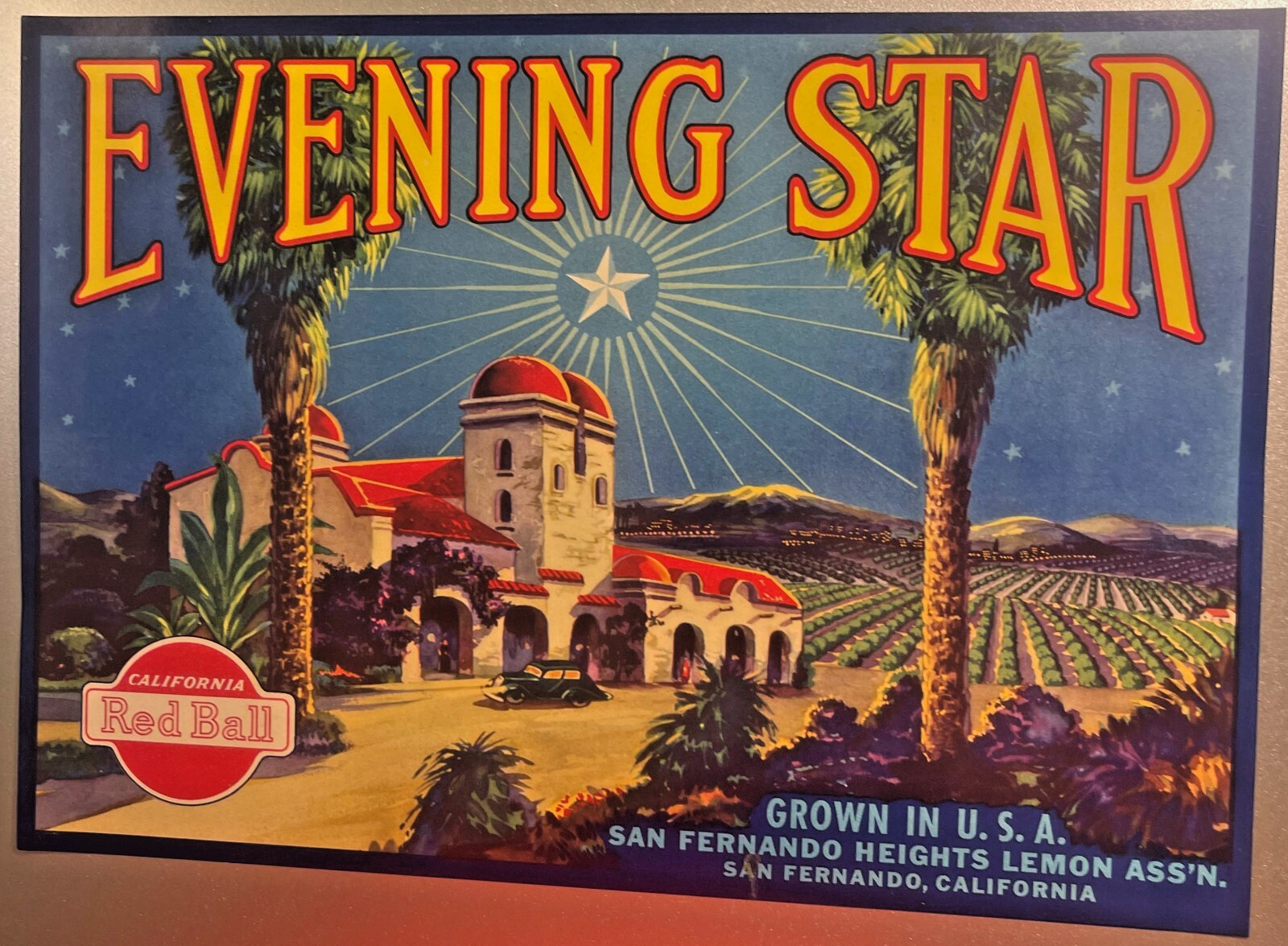
This is an original Evening Star brand lemon crate label, produced for the San Fernando Heights Lemon Association of San Fernando, California, and printed by the Western Lithograph Company of Los Angeles — one of the most respected commercial printers of the era. The label measures approximately 12½ × 8¾ inches, the standard format for California lemon crate end labels, and it is New Old Stock (NOS) — warehouse-fresh, never pasted to a crate, never glued to a wall. It came to me the way the best pieces always do: straight from old inventory, unspoiled by use, exactly as it left the press. The label's text reads, verbatim: EVENING STAR — CALIFORNIA — Red Ball — GROWN IN U.S.A. — SAN FERNANDO HEIGHTS LEMON ASS'N. — SAN FERNANDO, CALIFORNIA.
In terms of era, the best evidence places this label in the 1930s to 1940s. The Jay T. Last Collection at the Huntington Library — one of the single most authoritative archives of California citrus label history in the world — catalogs a copy of this very label dated 1931, printed by Western Lithograph Co. Dealers who have handled warehouse-fresh examples like this one typically assign the 1940s. CSUN's San Fernando Valley History Digital Library dates its institutional copy to circa 1940. The honest answer is that surviving copies span that range, and without a visible printer's date code on your specific label, the truthful range is the 1930s through the 1940s — which makes this piece, conservatively, the better part of a century old.
🎨 The Art Itself — What the Lithographer Built
Let me describe what Western Lithograph's craftsmen created here, because my photographs genuinely do not do it justice. I say that every time I list one of these, and I mean it every time.
Against a deep, star-scattered cobalt sky, a mission-style building rises between two towering California fan palms. The structure — widely understood among collectors to be a stylized evocation of the San Fernando Mission, founded in 1797 and one of the great landmarks of the Valley — glows with warm cream stone and terracotta-red domed rooftops. A vintage automobile, the kind you'd see in a 1930s newsreel, sits parked in the drive. To the right, orderly rows of lemon and citrus groves roll toward a horizon of soft purple hills. And above it all, centered perfectly between the palms, a single five-pointed white star radiates a sunburst of fine-line rays across the sky — the Evening Star itself, brilliant and unmistakable.
The color palette — midnight blue, gold-yellow, signal red, deep green, warm cream — is the full vocabulary of California citrus label art at its absolute peak. The lettering is that classic bold serif style, outlined in red and filled in yellow, that immediately reads as the golden age of American commercial printing. This is lithography at a level that, as I've said to customers many times, is genuinely unparalleled even by today's digital printing in terms of the warmth and depth it produces. Museums know it. Art institutes know it. Collectors who have handled one of these in person know it in a heartbeat.
🌟 A note on the "Red Ball" designation: the lower-left cartouche reads California Red Ball — this was a grade classification used in the California citrus industry to designate a specific pack quality. Finding it alongside the Evening Star brand name on the same label confirms this is a working commercial piece, printed to be pasted to real crates headed to real markets across America.
🍋 The Company — A Growers' Cooperative and the Water That Made It Possible
The San Fernando Heights Lemon Association did not spring from nothing. It was born from one of the defining engineering events in Southern California history: the opening of the Los Angeles Aqueduct in 1913, which carried water from the eastern Sierra Nevada all the way to the San Fernando Valley. Before that water arrived, the Valley grew wheat and some citrus, but on a modest scale. After it arrived, the landscape transformed. Orchards spread. Packing houses rose. And the citrus economy of the San Fernando Valley became, for several decades, one of the most productive in the world.
The packing plant that would become the Heights Lemon Association started life around 1911 under the Pacific Packing Company, which established a lemon facility just south of the Mission San Fernando. In 1915, Pacific sold the operation to the newly formed San Fernando Heights Lemon Association — a grower-owned cooperative model that was the backbone of California's organized citrus industry. The word "heights" in the name is, as researchers have noted, a bit of a geographical curiosity, given the generally flat terrain of that part of the Valley; but it stuck, and the association grew into something substantial.
By 1922, a new building was being erected for the association — one story plus a basement, measuring 9 × 12.5 feet, at a reported cost of $24,000. That's a serious capital investment for the era. By June 1925, the association was fetching what was reported at the time as a record price: over $14 a box for lemons shipped to Cleveland. The operation sat at the corner of Sepulveda and San Fernando Mission Boulevards, shipping fruit east via the Southern Pacific Railroad.
The celestial theme of the Evening Star label was no accident — it was part of a deliberate, branded series. When the Heights Lemon Association first acquired the operation from Pacific Packing, among the brand names transferred were Silver Moon, Blue Moon, Evening Star, and Southern Cross. Later, Morning Sun joined the family as Silver Moon was retired. Collectors who track these series know that Blue Moon is exceptionally rare — a genuine find when one surfaces. Evening Star is the most romantically named of the group, and the starfield imagery it inspired made it among the most artistically successful of the set.
👩🏭 The People — The Women Who Packed the Fruit
Behind every label like this one stood a workforce, and the workforce of the San Fernando Heights packing house was, as it was across most of California's citrus industry, predominantly Latina women. Archival photographs held by CSUN's San Fernando Valley History Digital Library show the interior of the facility: roughly eighteen women standing at conveyor belts, wrapping lemons and loading crates marked with the Sunkist brand, with a handful of men visible in the background at a counter. One woman is identified by name in the archive: Luz Mendez Calvo (1896–1982), pictured at left, packing lemons into a Sunkist crate — one face, one life, out of hundreds who passed through those doors.
Researcher Anthony Llamas of the López Adobe has documented his own family's connection to the plant: his grandfather Daniel Llamas and other family members grew up working the fields and ranches of the San Fernando Valley, and his great-grandmother Jacoba Llamas worked in the San Fernando Heights citrus packing house alongside friends and neighbors. These were not peripheral workers. They were the engine of the operation. The labels they helped pack — labels exactly like this one — traveled to dinner tables in Cleveland, Chicago, Boston, and beyond, carrying California sunshine in a wooden crate.
The picker communities that surrounded the packing houses were also making history of their own. During this era, historians note, the Latino communities that built up around the citrus economy evolved from living in labor camps to establishing some of the first suburban neighborhoods in Southern California — neighborhoods that endure to this day. The fruit industry didn't just grow lemons. It grew communities.
🎬 The Hollywood Gambit — Local Legend That Deserves to Be Remembered
Here is a story that deserves to be preserved, because the sources that documented it may not be around forever. In the difficult postwar years — roughly the late 1940s — the San Fernando Heights packing house faced a labor crisis. The lemon groves still produced, but the packing house couldn't find enough workers to wrap and sort the fruit. The solution they landed on was, by any measure, distinctly Californian: they contracted with Hollywood film studios to shoot scenes at the plant.
The reasoning was brilliantly practical. Word went out that a movie was being filmed on the grounds. Aspiring actresses and extras flooded in, hoping to be discovered while wrapping lemons in the background of a scene. The plant was suddenly inundated with new workers. The labor crisis, at least temporarily, was solved. Local historical documentation from around 1950 confirms the substance of this arrangement — the association had, for a couple of years, contracted with Hollywood studios for on-site filming. The specific film title, I'll be honest with you, has not surfaced in the verified sources I've worked through, and I won't guess at it. But the arrangement itself is documented, and it is exactly the kind of story that makes a piece like this feel less like a label and more like a portal.
⏳ The Decline — and What Remains
After World War II, the San Fernando Valley changed faster than anyone could have imagined. By the early 1940s, there had been 11,000 acres of lemon, orange, and grapefruit trees in the Valley, with ten active packing houses — and at the war's height, twenty-five percent of the citrus grown in the area was supplying Vitamin C to United States armed forces and their allies. The Heights Lemon Association was, in a very real sense, part of the Allied war effort.
But the returning veterans brought their families, and the families needed houses, and the houses needed land. Tract developments spread across orchard rows. The nearby San Fernando Lemon Association closed in 1948. By the end of that same year, the Heights plant still employed 80 packing workers and 100 field hands — but the trajectory was clear. Labor shortages became chronic, leading to increasing reliance on agricultural labor arrangements with Mexican nationals. By 1956, regional citrus acreage had fallen from 11,000 to 6,000 acres, and active packing houses had dropped from eight to five. The manager who presided over the long twilight of the operation, Herbert S. Sykes — who ran the plant for roughly three decades — maintained that mechanization and operational consolidation kept the association viable longer than most. But eventually, the orchards gave way to the suburbs entirely. The facility closed. Some of its structures, the historical record notes, continued to stand in recent years, repurposed as storage — a quiet afterlife for buildings that once hummed with the sound of citrus graders and the voices of three generations of packing house workers.
What survived? These labels. Kept in warehouses, never opened, never pasted, never lost. New Old Stock, exactly as the press delivered them — waiting for someone to care enough to keep them.
📚 Institutional Holdings — This Label in the Archives
For those who want provenance, the Evening Star brand is as well-documented as any California citrus label gets:
- 🏛️ The Jay T. Last Collection at the Huntington Library — catalogs Evening Star with printer (Western Litho. Co.) and a dated example from 1931.
- 🎨 LACMA (Los Angeles County Museum of Art) — holds an Evening Star lemon crate label attributed to the San Fernando Heights Lemon Association in its collection.
- 📁 CSUN San Fernando Valley History Digital Library — holds an Evening Star / California Red Ball label dated circa 1940, plus association annual reports, by-laws, and correspondence including the 26th Annual Report (1936–1937).
- 🗂️ Digital Commonwealth — holds an additional catalogued record of the Evening Star Red Ball label.
When LACMA and the Huntington are both collecting the same thing you're collecting, you're in good company.
🖼️ Display Ideas
- 🌙 Frame it as fine art. A deep shadowbox frame with archival mat in midnight navy or warm cream drops this directly into gallery territory — the kind of thing visitors stop and ask about.
- 🍳 Kitchen or breakfast room focal point. The citrus palette — blue, gold, red, green — plays beautifully against white subway tile, open shelving, or a farmhouse aesthetic. It reads as both vintage and effortlessly designed.
- 🏡 California or mission-style décor grouping. Pair with other California mission-era ephemera — old postcards of the San Fernando Mission, a vintage California map, a terracotta piece — for a curated Valley history corner.
- 🌟 Celestial-themed display. Evening Star pairs naturally with its series companions — Silver Moon, Morning Sun, Southern Cross — if you can find them. A complete set framed together is a serious collector's installation.
- 🍋 Office or study accent. Vintage commercial art at this scale and quality commands a wall the way a vintage travel poster does — purposeful, nostalgic, sophisticated. It signals to anyone who walks in that you know what beautiful American printing looks like.
- 🎁 Presentation-ready gift. Already a statement piece before it's framed — this is the kind of gift that comes with a story, and people remember it.
🎁 Who Collects These
California citrus crate labels have moved well beyond the garage-sale circuit. They are held in LACMA. They are catalogued at the Huntington. They are researched and written about in serious academic contexts. The collectors who seek them out tend to fall into overlapping camps, and if you're reading this far, you probably recognize yourself in at least one of them.
California history enthusiasts who understand that the San Fernando Valley's citrus era was as formative as the Gold Rush — a different kind of boom, built on water and soil and the labor of thousands of families, most of whose names history never recorded. Americana and vintage advertising collectors who appreciate that lithographic printing of this era produced commercial art that has genuinely never been surpassed in warmth and craft. Mission-era California collectors drawn to the imagery of the missions, the palms, the rolling Valley landscape before the freeways came. Labor and social historians who recognize that the women pictured in those packing house photographs — Luz Mendez Calvo, Jacoba Llamas, and hundreds unnamed — deserve to be remembered, and that keeping these labels in circulation keeps their story alive. And, honestly, interior designers and home décor enthusiasts who simply recognize that this is a beautiful, frameable piece of American art that will outlast every trend and hold its meaning in a way that a print-on-demand poster simply cannot.
❓ Frequently Asked Questions
Q: Is this an original label or a reproduction?
A: This is an original NOS (New Old Stock) label — never applied to a crate, kept in old inventory, and it came to me that way. It is not a reprint, a reproduction, or a modern copy. What you are holding is the actual lithographed piece, exactly as it left the Western Lithograph Company press.
Q: Can you pin down the exact year it was printed?
A: The best archival evidence — from the Jay T. Last Collection at the Huntington Library — dates a catalogued copy of this label to 1931. Dealers who handle warehouse-fresh NOS copies like this one typically assign the 1940s, and CSUN's institutional copy is dated circa 1940. The honest, defensible range is the 1930s through the 1940s. Without a visible printer's date code on your specific label, that range is where the evidence sits — and it makes this piece the better part of a century old either way.
Q: Who printed it, and does that matter for collectors?
A: The Jay T. Last archival record specifically attributes Evening Star to Western Lithograph Company of Los Angeles, which operated from 1908. Western Litho is one of the most respected names in California citrus label printing history — their work is well-represented in institutional collections, and attribution to a named, documented printer adds meaningful provenance for serious collectors.
Q: Was Evening Star part of a series? Are the other labels findable?
A: Yes — Evening Star was part of a celestial-themed group that included Silver Moon, Morning Sun, Southern Cross, and the exceptionally rare Blue Moon. All were brands of the San Fernando Heights Lemon Association. Blue Moon is considered particularly difficult to find; Southern Cross surfaces occasionally. A complete set displayed together is considered a significant collector's achievement in California citrus label collecting.
Q: The building on the label — is that a real place?
A: The mission-style building is widely understood among collectors and researchers to be a stylized artistic evocation of the San Fernando Mission, which was founded in 1797 and is one of the defining landmarks of the Valley. The label doesn't claim to be a photographic reproduction, and the artist (whose name, unfortunately, is not recorded in the sources I've worked through — only the lithographer is documented) took creative liberties with the composition. The orchards, the palms, and the Valley hills in the background are true to the landscape of the era.
Q: The label mentions "Red Ball" — what does that mean?
A: California Red Ball was a grade classification used in the California citrus industry, designating a specific pack quality and size standard. Finding it on this label confirms that this was a working commercial piece, printed for actual use on crates headed to wholesale markets across the country — not a promotional novelty. The dual branding (Evening Star brand + Red Ball grade) was standard practice for California citrus packing associations of this era.
Q: What size is this label, and what frame should I use?
A: The label measures approximately 12½ × 8¾ inches — the standard California lemon crate end format. A standard 12.5×9 frame with an archival mat works beautifully and gives the art room to breathe. For display quality, archival or UV-protective glazing is worth the investment to protect the lithographic inks and paper long-term.