When you click on links to various merchants on this site and make a purchase, this can result in this site earning a commission. Affiliate programs and affiliations include, but are not limited to, the eBay Partner Network.
🎩 Who Was That Dapper Little Fellow Racing Across a Drugstore Counter for a Dime? 🍬
There's a certain kind of small object that manages to hold an entire vanished world inside it, and this FIXACO tin is exactly that kind of thing. Long before blister packs and pharmacy chains, a nickel-and-dime drugstore trade thrived on tiny tins just like this one — slipped into a coat pocket or handbag, tucked behind a cash register, sold one at a time to singers with a scratchy throat, teachers who talked all day, or anyone nursing a winter cough. This is a genuinely lovely survivor of that era, and it's New Old Stock (NOS) — meaning it was never sold, never used, never emptied of whatever charm it carried the day it left the Fixaco Co.'s hands.
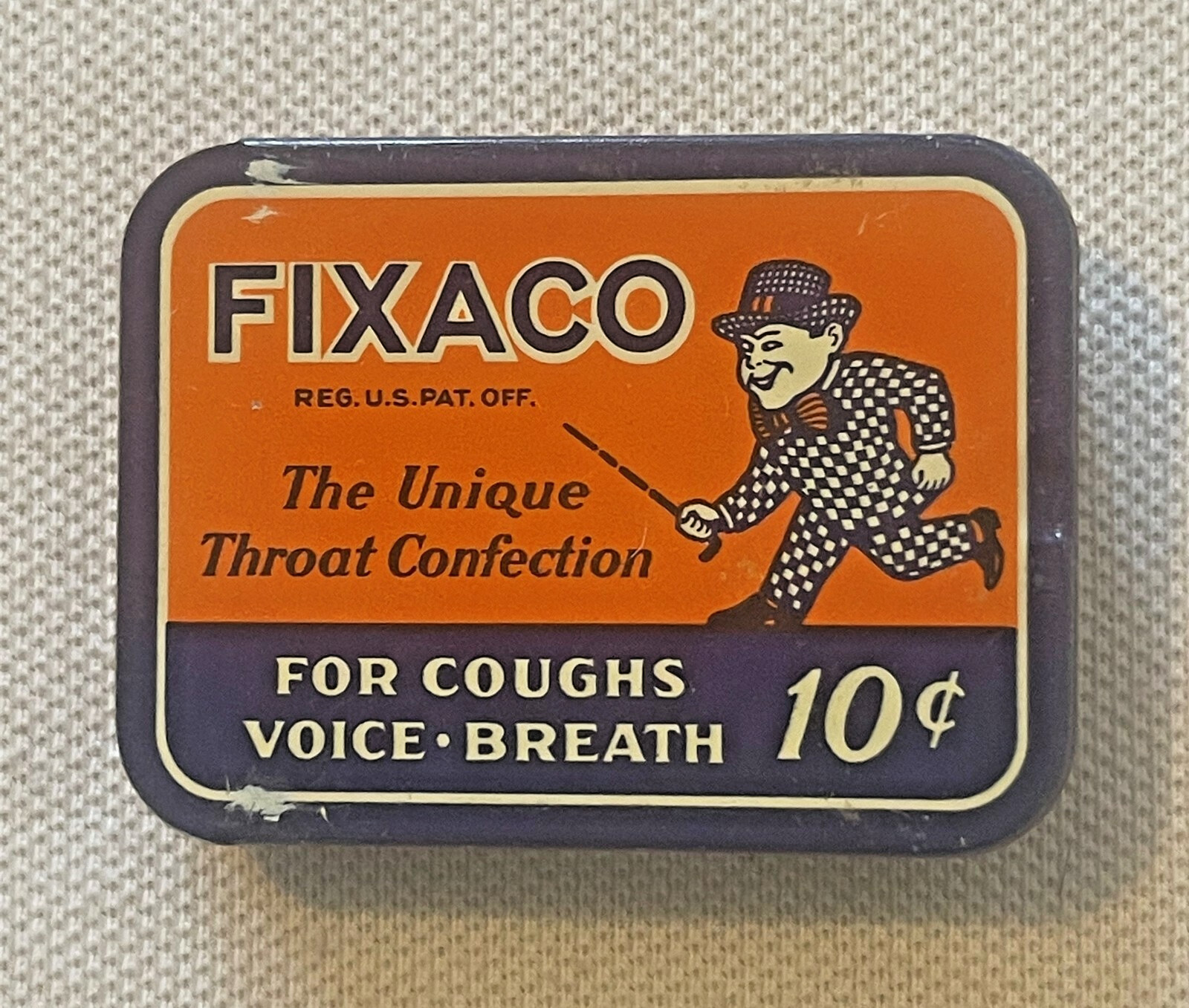
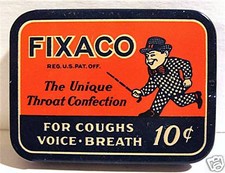
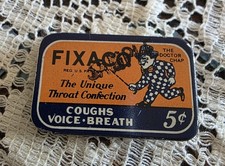
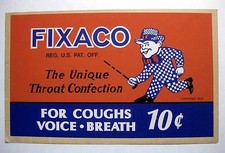
This is a slide-top advertising tin for FIXACO — "The Unique Throat Confection" — manufactured by The Fixaco Co. of St. Louis, Missouri, and sold at drugstore counters for ten cents a tin. Dated examples of this exact tin are marked 1939, and period newspaper advertising for the brand was still running as late as 1946 — so this little tin belongs to that late-1930s-through-mid-1940s stretch of American drugstore culture, a run of at least a decade for what was, at heart, a small local proprietary remedy. The artwork is bold, graphic, unmistakably of its moment: a bright orange field bordered in navy blue, with FIXACO stamped across the top in heavy block lettering, REG. U.S. PAT. OFF. beneath it, and the tagline "The Unique Throat Confection" rendered in a flowing italic script. Below that, a navy banner spells out the whole pitch in one breath: FOR COUGHS · VOICE · BREATH — 10¢. Racing across the orange field toward that banner is a grinning, checkered-suit dandy in a top hat and bow tie, cane in hand, mid-stride — a piece of pure period commercial illustration, drawn with exactly the kind of theatrical, vaudeville-stage energy that patent-medicine advertisers of the era loved to put on their packaging. He's cheerful, a little rakish, and built to catch a shopper's eye from three feet away on a crowded counter. The reverse carries the full pitch in text: FIXACO is something different, it's highly concentrated, don't chew it — hold it in the roof of the mouth until dissolved, use it freely for coughs, colds, sore throat, and hoarseness, excellent for children's coughs, ideal for singers, speakers, and teachers, and even useful after smoking to moisten the mouth and throat and sweeten the breath. It closes with a line that was practically a genre convention of the era: "Fixaco contains no harmful ingredients."
💊 A Confection Built From Licorice, Menthol, and Anise
What makes FIXACO worth pausing over is that it wasn't a pill at all — it was a confection, formulated from licorice, menthol, anise, and glycerine, meant to slowly dissolve against the roof of the mouth rather than be chewed or swallowed whole. That's the throat lozenge category in its purest early-twentieth-century form: part candy, part remedy, sold at the exact overlap between the corner drugstore and the corner candy counter. The label's insistence that it "contains no harmful ingredients" wasn't idle marketing fluff either — it echoes the language a whole generation of small proprietary remedy makers adopted after federal food and drug labeling laws tightened through the 1910s and again with the Food, Drug and Cosmetic Act of 1938, a period when manufacturers were increasingly required to list ingredients honestly and steer clear of the exaggerated cure-all claims that had defined the earlier patent-medicine boom. FIXACO's copy — concentrated, effective, dissolve-don't-chew, use freely — reads like a company trying hard to sound modern, careful, and above reproach in exactly that regulatory climate.
🏙️ Why St. Louis? Because St. Louis Was Built for This
The Fixaco Co. chose its hometown well, because St. Louis in this era sat at the exact crossroads of three industries this little tin needed. It was a wholesale drug capital — Meyer Brothers Drug Company, founded in the 1850s, had grown into one of the largest wholesale drug houses in the country and helped make the city, as one company history put it, "recognized as one of the leading drug and chemical markets in the United States." St. Louis was also, quite literally, the birthplace of one of America's most famous proprietary remedies: Listerine was first formulated there in 1879 by Dr. Joseph Lawrence and Jordan Wheat Lambert, the seed of what became the Lambert Pharmacal Company. On the confectionery side, St. Louis was home to the National Candy Company, which by the early 1900s had grown into the largest candy company in the country, and to Switzer's Licorice Company, the nation's leading licorice brand, built up from Frederick Switzer's pushcart trade along Laclede's Landing on the riverfront. A licorice-and-menthol throat confection sold in drugstores from coast to coast is exactly the product this city's overlapping drug and candy trades were built to produce and ship. And the tin itself fits a third St. Louis specialty: the city had a long-established tin-stamping and metal-container industry, anchored by firms like the St. Louis Stamping Company, mechanized as early as the 1860s and later folded into the National Enameling and Stamping Company — proof that a small local remedy maker like Fixaco had exactly the local infrastructure it needed close at hand to have its packaging printed and stamped without ever looking outside the city.
🕵️ What We Know About The Fixaco Co. — And What Remains a Mystery
Here's where honesty matters more than a tidy story: the tin itself tells us the company was "The Fixaco Co., St. Louis" and nothing more — no street address, no owner's name, no founding date stamped anywhere on it. Despite real digging, no incorporation record, founder's name, or closing date for this particular company has ever surfaced. That absence isn't unusual for a small proprietary-remedy maker of this size and era; plenty of these little drugstore brands came and went without leaving much paper trail behind, especially once wartime shortages and shifting drug regulation squeezed out the smaller players through the 1940s. Collectors and dealers who've handled these tins over the years have passed down a bit of shop lore worth preserving here as exactly that — lore: the story goes that caches of unused old stock like this were reportedly found decades later inside the Fixaco company's own former factory building in St. Louis, unsold tins that simply sat forgotten once the company quietly wound down. It's a charming, plausible story for a small remedy maker of this kind, and it's worth telling — just worth telling as passed-down trade legend rather than documented fact, since no independent record confirms it. One flag worth noting for anyone digging further: a completely unrelated "Fixaco, Inc." surfaces in 1960s St. Louis-area records tied to an amphetamine-distribution case — but given the decades-long gap and the entirely different nature of that operation, there's no evidence tying it to this 1930s–40s confection maker at all, and the two should never be confused.
🎪 That Dapper Little Mascot
The checkered-suited, top-hatted figure striding across the front of this tin, cane in hand, is pure Art Deco advertising showmanship — the kind of character illustrators of the era reached for again and again to make a small, cheap product feel lively, trustworthy, and just theatrical enough to be memorable. Some sellers over the years have informally nicknamed him after the famous board-game mascot he vaguely resembles in silhouette, but that's simply a casual visual comparison — there's no documented connection between FIXACO's running dandy and any other trademarked character. He's his own creation, built to sell a dime tin of throat confection, and he does his job well even today.
🖼️ Display Ideas
- 💊 Grouped on an open shelf alongside other vintage pharmacy and apothecary tins for an old-time drugstore vignette
- 🛁 Set out on a bathroom ledge or vanity tray as a nostalgic little conversation piece
- 📚 Tucked into a curio cabinet or glass-front case with other small Americana advertising tins
- 🎨 Displayed face-out on a small plate stand to show off the mascot artwork
- 💍 Repurposed as a tiny jewelry, pin, or trinket keeper on a dresser top
- 🎁 Given as a genuinely different gift for a collector of pharmacy, drugstore, or St. Louis memorabilia
🎁 Who Collects These
This little tin draws in several overlapping kinds of collectors: patent-medicine and apothecary specialists chasing drugstore ephemera from the golden age of proprietary remedies, St. Louis and Missouri local-history collectors building out a shelf of hometown industry, advertising-tin and Americana collectors drawn to bold Art Deco graphics and mascot characters, and pharmacy or dental professionals who like a piece of their own trade's history on display. It's also a favorite of anyone assembling a small collection of pocket-sized tins in general — cough drop, snuff, aspirin, and mint tins from this same era share a family resemblance, and a FIXACO tin like this one is a genuinely distinctive addition to that shelf.
❓ FAQ
Is this tin new old stock, or was it ever used?
This is New Old Stock (NOS) — it was never sold through and never emptied of its original contents at the time it left the maker.
How big is it?
It's a genuinely compact pocket tin, sized to be slipped into a coat pocket or handbag rather than sit on a shelf as a large display piece — a small, dime-store-era tin through and through.
What was FIXACO actually made of?
It was formulated as a licorice, menthol, anise, and glycerine confection, meant to be dissolved slowly against the roof of the mouth rather than chewed — a throat lozenge in the classic early-twentieth-century sense.
How old is this tin exactly?
Surviving dated examples of this tin are marked 1939, and the brand was still being advertised nationally as late as 1946, so it belongs to that late-1930s-through-mid-1940s stretch of drugstore history.
Who made FIXACO?
The Fixaco Co. of St. Louis, Missouri. No further corporate details — founder, address, or closing date — have ever been confirmed, despite this maker clearly having sold nationally through drugstores for years.
Is the mascot character connected to any other famous brand or game?
No documented connection exists between FIXACO's running, top-hatted mascot and any other trademarked character — any resemblance noted by collectors is purely a casual visual comparison, not an established link.
Was FIXACO a pill, a lozenge, or a candy?
It sat right at the overlap of all three — marketed as a "confection" but sold through drugstores as a remedy, exactly the hybrid category that made throat lozenges such a distinct and popular product line in this era.