When you click on links to various merchants on this site and make a purchase, this can result in this site earning a commission. Affiliate programs and affiliations include, but are not limited to, the eBay Partner Network.
- Rare
- Antique: 1870s - 1880s
- Original Label
- Quack Medicine Era
- Large 9.75" T
- Glass is shiny, bright, clean!
- No chips, no cracks, no dirt, no ghosting.
- Please note the small, white, interior, potstone (can't be felt) in the upper shoulder (see finger point pic)
- I package well and ship out daily!
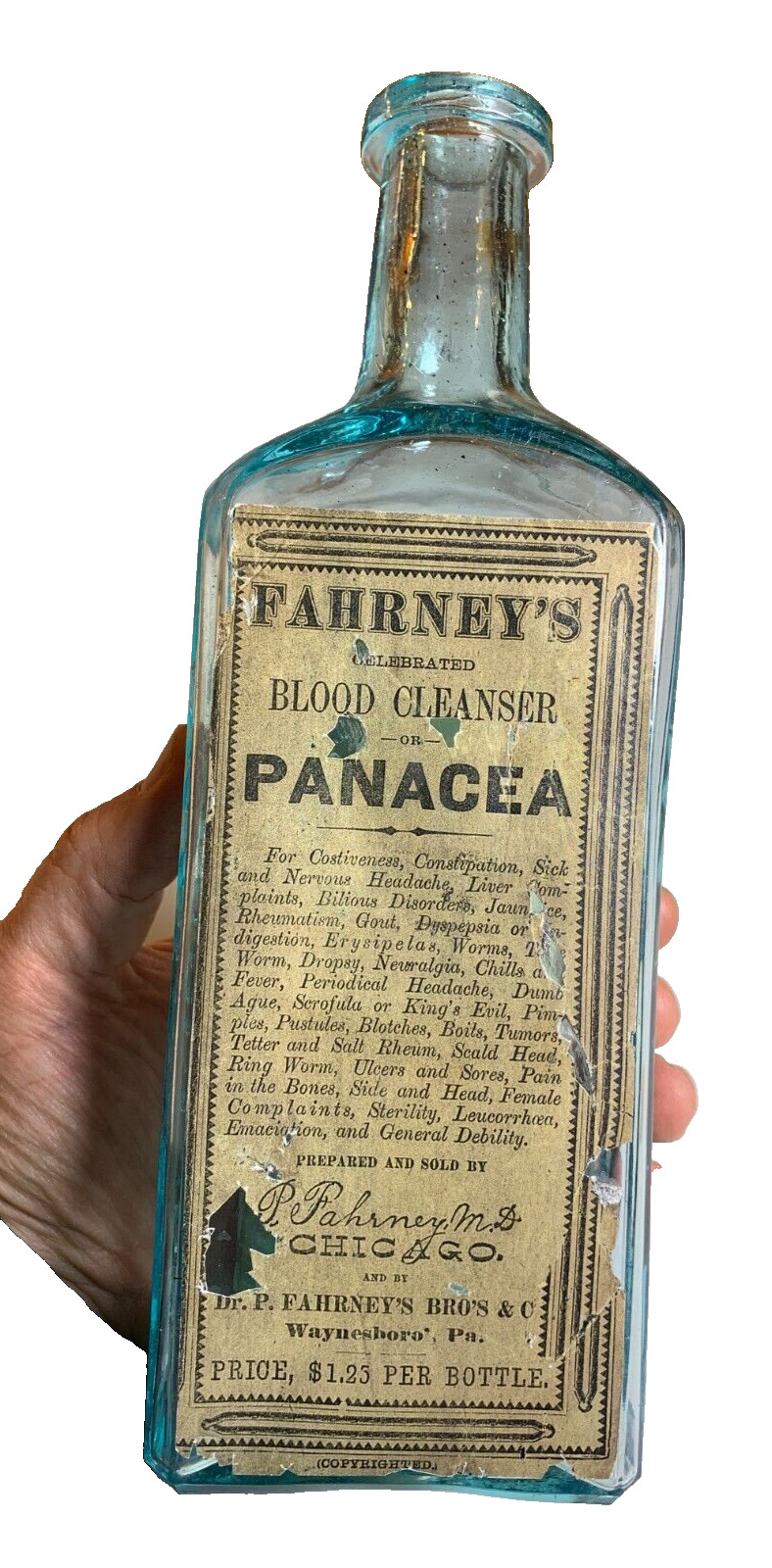
This is an antique bottle labeled "Fahrney’s Celebrated Blood Cleanser or Panacea," which was marketed as a remedy for a wide range of ailments, including constipation, headaches, liver complaints, rheumatism, skin conditions, and more. It was prepared and sold by Dr. P. Fahrney in Chicago, with an additional mention of "Dr. P. Fahrney’s Bros & Co." in Waynesboro, PA.
Dr. Peter Fahrney established his patent medicine business in Chicago in 1869. After the Great Chicago Fire of 1871 destroyed his original laboratory, he quickly rebuilt and continued operations. By the early 1890s, his sons joined the business, and in 1917, they commissioned a new manufacturing building at 2501 W. Washington Boulevard, designed by architect Nelson Max Dunning. The company operated from this location until the early 1950s, after which it moved to 4541 N. Ravenswood Avenue. In the mid-1960s, the Purdue Frederick pharmaceutical company acquired Dr. Peter Fahrney & Sons, and by the 1970s, Fahrney’s products were no longer manufactured.
Regarding Dr. P. Fahrney's Bros & Co. in Waynesboro, Pennsylvania, a newspaper from November 3, 1870, mentions that due to high demand, another laboratory and office were opened in Waynesboro, conducted by Dr. P. Fahrney's Bros & Co. This suggests the company was active in Waynesboro around 1870. Specific details about the duration of their operations in Waynesboro are limited, but it appears they were active during the late 19th century.
Front label reads:
FAHRNEY’S CELEBRATED BLOOD CLEANSER OR PANACEA
For Costiveness, Constipation, Sick and Nervous Headache, Liver Complaints, Bilious Disorders, Jaundice, Rheumatism, Gout, Dyspepsia or Indigestion, Erysipelas, Worms, Dropsy, Neuralgia, Chills and Fever, Periodical Headache, Dumb Ague, Scrofula or King’s Evil, Pimples, Pustules, Blotches, Boils, Tumors, Tetter and Salt Rheum, Scald Head, Ring Worm, Ulcers and Sores, Pain in the Bones, Side and Head, Female Complaints, Sterility, Leucorrhoea, Emaciation, and General Debility.
PREPARED AND SOLD BY
P. Fahrney, M.D.
CHICAGO
AND BY
Dr. P. Fahrney’s Bros & Co.
Waynesboro’, Pa.
PRICE, $1.25 PER BOTTLE.
Rear Label Reads:
DIRECTIONS
This medicine can be administered to infants as well as the aged, and to either sex. It is well adapted, and highly recommended, for disorders peculiar to females. It contains no poisonous substance and is perfectly harmless when judiciously administered. The medium
DOSE
Is about two tablespoonfuls every morning, or as often as will produce two operations during the day. Some persons require more than others, and when that is the case, you must carefully increase the dose until you know just how much to take. This medicine is delicious to the taste, and if taken in suitable doses, it will relieve you from any discomfort, disease, or pain that it is made to remove, without causing you any uneasiness, annoyance, or distress. If you find that it makes you feel uncomfortable, dizzy, or sick, or that it purges too much, diminish the dose. If it does not operate at all, take a little more until it does. If it sickens you, it is because your condition demands a correction and the high state of your disorder is the cause. You should not be alarmed at a temporary weakness. It acts rather than causes.
Gebrauchsanweisungen (German section for usage instructions)
Diese Medizin kann sowohl Kindern als auch erwachsenen Personen von beiden Geschlechtern eingegeben werden. Sie ist besonders für Krankheiten bei Frauen in hohem Grade nützlich und sehr empfehlenswert. Sie enthält keine giftige Substanz und ist in vollkommen harmlos, wenn man sie mit Bedacht anwendet. Die mittlere
Dose
Ist ungefähr zwei Esslöffel voll jeden Morgen oder so oft, dass zwei Entleerungen im Verlauf des Tages stattfinden. Manche Personen benötigen mehr als andere; in diesem Fall muss die Dosis behutsam erhöht werden, bis man genau weiß, wie viel zu nehmen ist. Diese Medizin ist köstlich im Geschmack, und wenn sie in angemessenen Dosen eingenommen wird, befreit sie von Unwohlsein, Krankheit oder Schmerz, ohne irgendwelche Beschwerden oder Unannehmlichkeiten zu verursachen. Falls sie Unwohlsein, Schwindel oder Übelkeit hervorruft oder zu stark wirkt, sollte die Dosis verringert werden. Falls sie überhaupt nicht wirkt, sollte man die Dosis leicht erhöhen, bis sie Wirkung zeigt. Falls sie Übelkeit hervorruft, ist dies ein Zeichen dafür, dass der Körper eine Korrektur benötigt, und zeigt an, dass die Krankheit in einem hohen Zustand ist. Man sollte sich darüber nicht beunruhigen; es ist ein Zeichen, dass die Medizin wirkt, nicht dass sie schadet.
This label provides detailed instructions in both English and German, reflecting the multilingual nature of some 19th-century American products, especially those marketed to German-speaking communities.
The label on Fahrney’s Blood Cleanser or Panacea makes bold claims about curing a wide range of ailments, many of which were common medical concerns in the 19th and early 20th centuries. Here’s a breakdown of the types of conditions it claimed to treat and what that tells us about the marketing of patent medicines of the time:
1. Digestive & Liver Disorders
Many patent medicines, including this one, focused on digestive health. At the time, it was widely believed that cleansing the body (often through purging or laxatives) could remove "impurities" and improve health.
2. Infectious Diseases & Skin Conditions
Erysipelas (a bacterial skin infection)
Pimples, Pustules, Blotches, Boils, Tumors, Tetter (a term for skin eruptions like eczema or ringworm), and Salt Rheum (another name for eczema or psoriasis)
Ulcers and Sores
Blood purifiers were often advertised as a remedy for skin conditions, under the belief that "bad blood" caused eruptions and sores. The term "blood cleanser" implied that this tonic could remove toxins and infections from the bloodstream.
3. Rheumatism & Pain Relief
Rheumatism, Gout, and Neuralgia (nerve pain)
Pain in the Bones, Side, and Head
These claims catered to people suffering from chronic pain, arthritis, and joint inflammation—common problems, especially among older populations. Since real medical treatments were limited, tonics promising pain relief were highly appealing.
4. Female Health & Fertility
Female Complaints, Sterility, and Leucorrhoea (vaginal discharge, often associated with infections or hormonal imbalances)
Many patent medicines targeted women, promising to cure menstrual problems, infertility, and general "female weakness." Given that women’s health was poorly understood and medical options were limited, products like this were widely used.
5. Fever & Infections
Chills and Fever (likely referring to malaria or other febrile illnesses)
Dumb Ague (a form of malaria with periodic fever and chills)
Scrofula or King's Evil (a tuberculous infection of the lymph nodes)
Worms (common intestinal parasites in the era)
Malaria and tuberculosis were widespread in the 19th century, and many patent medicines falsely claimed to cure them. Remedies for parasites were also common, as hygiene and sanitation were poor in many areas.
6. General Weakness & Debility
Dropsy (edema or fluid retention, often linked to heart/kidney disease)
Emaciation (severe weight loss, often due to chronic illness like tuberculosis or malnutrition)
General Debility (a vague term for weakness, exhaustion, or frailty)
Patent medicines often promised to restore strength, vigor, and vitality. "General debility" was a catch-all term used to appeal to anyone feeling tired, run-down, or chronically ill.
Were These Claims Legitimate?
No—most of these claims were exaggerated or entirely false. Like many patent medicines of its time, Fahrney’s Blood Cleanser was likely an alcohol-based tonic with herbal ingredients and possibly laxatives. It may have provided temporary relief for some symptoms (such as acting as a mild laxative or pain reliever), but it could not cure serious diseases like tuberculosis, malaria, or sterility.
In the early 20th century, the U.S. government began cracking down on false medical advertising with laws like the Pure Food and Drug Act of 1906, which required ingredient labeling and prohibited fraudulent claims. Many patent medicines, including Fahrney’s, either disappeared or had to change their marketing tactics.
Would you like to know more about how these types of medicines were regulated or what ingredients they contained?