When you click on links to various merchants on this site and make a purchase, this can result in this site earning a commission. Affiliate programs and affiliations include, but are not limited to, the eBay Partner Network.
What Does It Feel Like to Hold a Complete World in Your Hands? 🪺
There is a particular kind of stillness that settles over you the moment you pick up something that was never meant to survive this long — and did anyway. Most antique cigar labels were glued down, buried under lacquer, pressed flat against a wooden box, and eventually lost to time, humidity, and the unceremonious fate of discarded packaging. This one wasn't. It sat in warehouse darkness, untouched, unbothered, still wearing the fresh, saturated colors of its original press run, waiting — perhaps a century — for someone to find it. That someone is you. The Elsie cigar label is not a reproduction. It is not a scan. It is not a facsimile printed on aged paper to approximate authenticity. It is the real thing: a New Old Stock chromolithographic cigar label, produced in Philadelphia, Pennsylvania at the height of the golden era of American commercial lithography, and it has never been glued to a single box in its entire existence. That matters. That matters enormously.
🎨 What It Is — Brand, Maker, Era, and Format
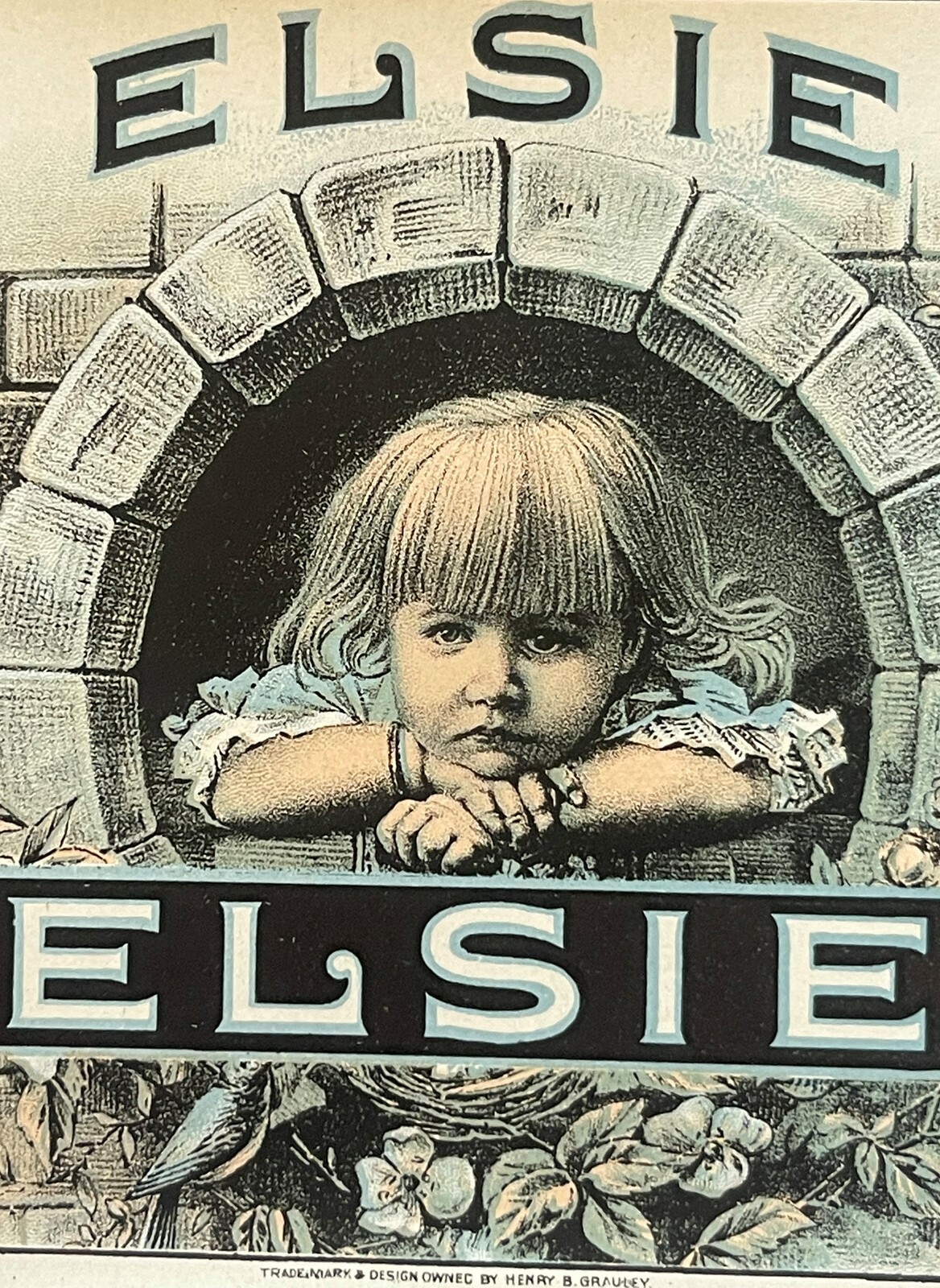
This is an original antique chromolithographic cigar label produced for the Elsie brand, attributed directly to Henry B. Grauley of the State House Cigar Mfg. Co., Factory 659, First District, Philadelphia, Pennsylvania. The label dates to approximately 1885–1910, placing it squarely in the era when Philadelphia was not merely a participant in American cigar culture — it was one of its central architects. The outer label format measures approximately 4.5 x 4.5 inches, and collectors should know that a larger inner lid label, around 10 x 6 1/4 inches, was also produced for the same Elsie brand; it is the outer label presented here.
The printing process is chromolithography — the nineteenth century's answer to the question of how to make commercial art as beautiful as fine art. Chromolithography involved transferring an image onto a lithographic stone layer by layer, one color at a time, with each pass requiring precise registration and exacting craft. A finished chromolithograph of this complexity could require a dozen or more separate stone impressions. The result was a depth of color, a richness of tone, and a luminosity that later mechanical printing methods simply could not replicate. When you hold a genuine Victorian chromolithograph up to good light, you understand immediately why collectors pursue these pieces with the same hunger they bring to oil paintings. They are, in every meaningful sense, printed paintings.
The image itself is extraordinary. A young girl — blond, solemn-faced, soft-cheeked, with the gravity that only small children and very old portraits ever manage to project — leans out from a circular stone archway, arms folded over the ledge, watching something just out of frame. Around her, the stone wall blooms with flowering branches. Bluebirds move through the composition. A nest cradling a clutch of eggs anchors the lower register with quiet, domestic tenderness. The name ELSIE arcs above the arch in bold block letters that carry the full weight of the Victorian typographic tradition. It is a complete world in 4.5 x 4.5 inches. It stops you cold the first time you see it. That reaction does not diminish with familiarity.
🏭 The Company, the Industry, and the City That Made This Possible
Henry B. Grauley and the State House Cigar Mfg. Co. were operating within one of the most robust and competitive commercial ecosystems in nineteenth-century American manufacturing. Philadelphia's cigar industry in the decades following the Civil War was not a cottage trade — it was an industrial powerhouse. The city's First District designation on factory markings like the one associated with Factory 659 reflects the federal revenue system established under post-war tax law, which required all cigar manufacturers to register with and operate under the supervision of the Internal Revenue Service's collection districts. A factory number was not decoration. It was a license, a record, a tax obligation, and a form of official identity. When you read "Factory 659, First District" on a label, you are reading the language of regulation and accountability — the federal government's fingerprint on a Victorian luxury good.
Philadelphia's place in this world was singular. The city had the infrastructure: a vast, skilled immigrant labor force — many from Germany, Bohemia, and throughout Central Europe — who brought with them deep traditions of hand-rolling and tobacco craft. It had the commercial printing industry to produce the gorgeous labels that distinguished one brand from the next on the retailer's shelf. And it had the merchant class, the distributors, the retailers, and the rail connections that moved product outward to every corner of a rapidly expanding national market. Cigars in this period were not a vice in the modern sense — they were a currency of social life, a gift, a mark of hospitality, a fixture of the gentleman's study and the shopkeeper's counter alike.
The label itself was not an afterthought in this economy. It was marketing, branding, and art direction rolled into one small rectangle. Cigar manufacturers competed fiercely on the quality and beauty of their labels, because the label was often the first — and sometimes only — thing a customer saw before making a purchasing decision. This competitive pressure drove the chromolithography industry to extraordinary heights of craft and ambition. Philadelphia's label printers were among the finest in the country, and the surviving output of that era stands today as some of the most collectible printed ephemera in American antiques.
🌿 The Legend of Elsie — What Collectors Whisper About This Brand
No formal biography of the Elsie brand has surfaced in the major reference works on Victorian cigar labels — which is, itself, part of what makes pieces like this so compelling to serious collectors. The girl in the archway has no documented backstory that has entered the official record. And yet lore passed down among collectors holds that named cigar brands featuring children — particularly young girls rendered with this degree of tenderness and portraiture specificity — were frequently named for a manufacturer's daughter, niece, or a beloved figure in the proprietor's immediate family circle. Whether Elsie was real, whether she sat for something resembling a likeness that was later handed to a lithographic artist for idealization and interpretation, no one can say with certainty. But the specificity of her face — the particular set of her expression, the quality of her gaze — has always fed that collector intuition. She does not look generic. She looks like someone.
Local legend in Philadelphia antique and ephemera circles has it that several of the Grauley-associated label runs from this era were produced in limited enough quantities that surviving NOS examples represent a genuinely small fraction of original production — most having been consumed in the normal course of business or lost in the warehouse consolidations and estate clearances that swept through the city's old manufacturing districts across the early and mid-twentieth century. Whether that legend overstates the scarcity or understates it, the practical reality for collectors is this: you do not encounter NOS Grauley-attributed outer labels in this condition on a routine basis. When one surfaces, you take note.
🖨️ Chromolithography — Why the Process Matters to Your Collection
It is worth dwelling a moment on what chromolithography actually represented in the context of its time, because understanding the process deepens your appreciation of what you are acquiring. Before chromolithography reached its commercial maturity in the 1870s and 1880s, the full-color reproduction of complex images was prohibitively expensive and technically demanding. Chromolithography democratized color — not cheaply, and not without enormous skill, but at a scale and price point that made mass commercial art possible for the first time in human history. The stones used in the process were heavy Bavarian limestone slabs. The inks were specially formulated. The registration — the precise alignment of each successive color layer — demanded a trained eye and steady hand at every stage.
What this means for the Elsie label specifically is that the bluebirds, the nest, the flowering branches, the stone arch, the girl's skin tones, the lettering, the background gradations — every element you see was built up through multiple discrete printing passes, each requiring its own stone, its own ink, its own moment of skilled human judgment. This is not a digital file rendered by a machine. It is a collaboration between technology, craft, pigment, stone, pressure, and human skill — accumulated over days or weeks of production work — compressed into a 4.5 x 4.5 inch rectangle that has now survived more than a century in original, unglued condition. That is, by any reasonable measure, extraordinary.
🖼️ Display Ideas
- 🪟 Float-frame under UV-protective glass — a simple black or gilt float frame with a cream or ivory mat allows the full chromolithographic richness to read without visual competition, while UV glass ensures the colors remain as vivid in your home as they are today.
- 🌿 Botanical and bird-themed gallery wall anchor — the bluebirds, nest, flowering branches, and garden-arch composition make this label a natural centerpiece in any gallery wall that draws on nature, Victorian botanical prints, or Audubon-adjacent imagery.
- 📚 Study or library vignette with period objects — displayed alongside antique books, a vintage tobacco tin, or other Victorian ephemera on a library shelf, this label reads as a complete period piece rather than a solitary curiosity.
- 🍃 Nursery or child's room heirloom display — the solemn young girl, the nest of eggs, the bluebirds, and the gentle spring-blossom palette give this label a tenderness that translates beautifully into a thoughtfully curated nursery or child's space, particularly for families who value antique art over mass-produced décor.
- 🗃️ Archival sleeve in a flat ephemera collection — serious collectors of Victorian printed ephemera, cigar labels, or chromolithography often preserve NOS pieces exactly as found, in acid-free archival sleeves, allowing the piece to appreciate in both condition and value without alteration.
- 🎁 Framed gift for a collector who has everything — because it is NOS, because it is attributed, because it is Philadelphia, and because the image is genuinely beautiful: this is the kind of piece that makes an extraordinary gift for the antique enthusiast in your life who has spent decades believing they've seen everything.
🎁 Who Collects These
Victorian cigar label collectors are a specific and passionate community, and they tend to overlap significantly with collectors of chromolithography, printed ephemera, Victorian trade cards, advertising art, and Americana. Within that world, Philadelphia-attributed labels carry a particular prestige — the city's manufacturing heritage and the quality of its lithographic output are well understood by serious collectors, and pieces with clear factory provenance (Factory 659, First District) are tracked and documented with care.
Beyond the dedicated cigar label world, this piece appeals strongly to bird and nature art collectors drawn to the bluebird and nest imagery; to Victorian childhood and portraiture enthusiasts captivated by the girl's face and the archway composition; to interior designers and stylists working in vintage, antique, or maximalist aesthetics who understand that an original period piece carries a room in a way that reproduction art cannot; and to Philadelphia history collectors for whom any documented artifact of the city's great manufacturing era carries local and civic significance beyond its aesthetic appeal. NOS condition is the decisive factor for the most serious buyers — a label that has never been glued, never been applied, never been altered is, in collector terms, as close to the original moment of production as you can get without owning the stone it was printed from.
❓ Frequently Asked QuestionsIs this label an original antique or a reproduction?
This is an original antique chromolithographic cigar label, not a reproduction, reprint, or facsimile. It was produced by the State House Cigar Mfg. Co. under the attribution of Henry B. Grauley in Philadelphia, Pennsylvania, and dates to approximately 1885–1910. It is New Old Stock — meaning it survived in warehouse or storage surplus, never applied to a cigar box, and has reached the present day in its original unglued condition. The colors, paper stock, and printing characteristics are consistent with period chromolithographic production, not with later offset or digital reproduction processes.
What exactly does "New Old Stock" mean for a paper label like this?
"New Old Stock" — abbreviated NOS — refers to merchandise that was manufactured and stocked but never sold into active use during its commercial lifetime. For a cigar label, NOS means the label was printed, stored, and never glued to a cigar box. It left the press run intact and remained in that condition through decades of storage. NOS labels are rarer than their used counterparts by a considerable margin, simply because the mechanics of the cigar trade consumed the overwhelming majority of labels printed.
What are the exact measurements, and is there an inner label for this brand?
The outer label presented here measures approximately 4.5 x 4.5 inches — the standard outer label format for Victorian cigar box presentation. A larger inner lid label around 10 x 6 1/4 inches was also produced for the Elsie brand, though the inner label is a separate format and a separate item. If you are building a complete Elsie brand presentation — outer and inner labels together — knowing that the inner label exists and was produced to complement this outer label is useful context for your collection records.
How should I store or display this label to preserve its condition?
For long-term storage, acid-free archival sleeves or enclosures are the gold standard — they prevent further aging from acid migration and protect the label from light, humidity fluctuation, and physical contact. For display, UV-protective glazing (glass or acrylic) is strongly recommended, as chromolithographic inks — while remarkably stable in the right conditions — are susceptible to fading under prolonged direct or indirect UV exposure. Avoid hanging in direct sunlight or in rooms with high humidity fluctuation (kitchens, bathrooms). A consistently cool, dry, stable environment is ideal. Float framing with a conservation-quality mat and UV glass is the most common display choice among serious collectors who want the piece visible and protected simultaneously.
Who was Henry B. Grauley, and why does the attribution matter?
Henry B. Grauley is the manufacturer attributed to this label through the State House Cigar Mfg. Co., Factory 659, First District, Philadelphia. In the world of Victorian cigar label collecting, manufacturer attribution matters because it anchors the piece to a documented commercial entity — a real factory, a real registration, a real place in the historical record of American tobacco manufacturing. Factory numbers issued under the federal revenue system were not decorative; they were legal identifiers. When a label carries a specific factory number and district designation, it is traceable to a specific moment in the regulatory and commercial history of its city. For Philadelphia collectors and for American ephemera collectors broadly, that documented local identity adds a layer of provenance and specificity that unlocks research potential — and that is part of what separates a documented antique from anonymous vintage paper.
Is the imagery — the birds, the nest, the girl — typical of Victorian cigar labels?
Victorian cigar labels ranged across an extraordinary spectrum of imagery: portraits of political figures, allegorical scenes, landscapes, animals, sporting subjects, and — very commonly — children and domestic scenes rendered with sentimental warmth. The combination of a young girl, bluebirds, a flowering stone arch, and a nest of eggs in the Elsie label is representative of a particular current in Victorian commercial imagery that emphasized innocence, nature, springtime, and domestic tenderness. These themes were not chosen arbitrarily — they were understood by Victorian consumers to connote quality, gentility, and a certain refinement of character that reflected well on the product inside the box. The fact that this imagery has aged into something that reads today as genuinely beautiful — rather than merely period-appropriate — is part of why cigar labels from this era command consistent collector interest more than a century after they were printed.
Can I find out more about the specific Elsie brand or its production history?
Research into specific Victorian cigar sub-brands like Elsie can be rewarding but requires patience. The major reference resources for cigar label collectors include period tobacco trade directories, Internal Revenue records documenting factory registrations, and specialized ephemera dealer archives. Philadelphia's own historical society holds significant records related to the city's manufacturing past, and its collections occasionally surface documentation of specific factories and their output. Lore passed down among collectors holds that named brands with child imagery were frequently personal in origin — named for family members — but documentary confirmation of that connection for the Elsie brand specifically has not entered the established collector literature as of this writing. The research trail is open, the name is documented, and the label itself is the most tangible piece of evidence that Elsie existed, was real enough to name a cigar brand after, and was rendered with enough care to suggest she mattered to someone in Philadelphia between 1885 and 1910.