When you click on links to various merchants on this site and make a purchase, this can result in this site earning a commission. Affiliate programs and affiliations include, but are not limited to, the eBay Partner Network.
About the item:
Dive into the charm of yesteryear with this authentic vintage document, a captivating piece of ephemera that transports you to the simpler days of handwritten ledgers and beautifully intricate lithography. These historical artifacts offer a window into a bygone era of commercial life, showcasing elegant designs, regional specialties, and everyday transactions that evoke nostalgia and cultural insight. Perfect for collectors, historians, or even decorators, they serve as unique time capsules—affordable, one-of-a-kind relics that connect us to our past, stirring memories and sparking conversations. Preserve a slice of history; add this evocative document to your collection today!
Specifics:
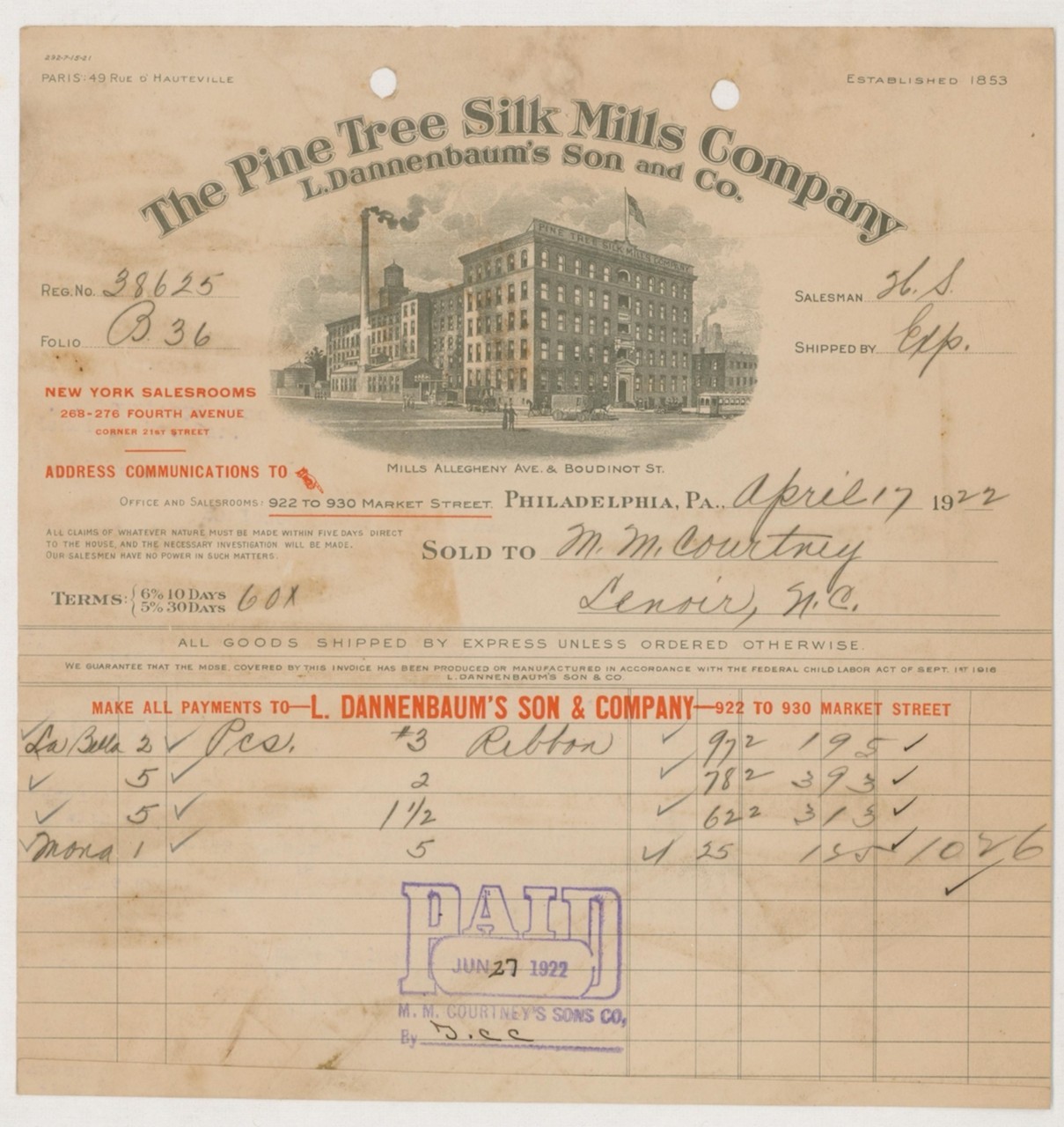
Authentic—not a reproduction—this over 100-year-old document is an L. Dannenbaum\'s Son and Co. invoice and is dated April. 17, 1922 (at this time, the US was in the early years of the Roaring Twenties, Europe was grappling with the aftermath of World War I as the Treaty of Versailles reshaped borders and economies, and the newly formed League of Nations sought to maintain global peace amid rising tensions and colonial unrest). It measures approximately 8 1/4 x 8 3/4 inches. In good condition with natural tan patina from age, enhancing its charm, though has some wear (e.g., slight creases or edge wear- it has also been folded) is present, see scans. It features pre-printed and handwritten elements. Both sides are shown in the scans.
About the company:
Established in 1853 in Philadelphia\'s vibrant textile district, L. Dannenbaum\'s Son and Co. operated as a prominent dry goods firm specializing in silk and ribbon distribution. Founded by Louis Dannenbaum, the company leveraged the city\'s industrial growth to supply high-quality imported and domestic silks to apparel manufacturers and wholesalers across the Northeast. By the 1880s, it had expanded into mill ownership, acquiring The Pine Tree Silk Mills Company—located at East Allegheny Avenue near Boudinot Street—to vertically integrate production of ribbons, satins, and novelty fabrics. Thriving amid the Gilded Age\'s fashion boom and World War I demands, the firm innovated with advanced dyeing and weaving techniques, employing hundreds at its facilities. However, the Great Depression\'s economic fallout, coupled with the rise of synthetic textiles like rayon, eroded profitability. Operations wound down in the late 1920s, with full closure by 1932, as the Dannenbaum family transitioned away from textiles.