When you click on links to various merchants on this site and make a purchase, this can result in this site earning a commission. Affiliate programs and affiliations include, but are not limited to, the eBay Partner Network.
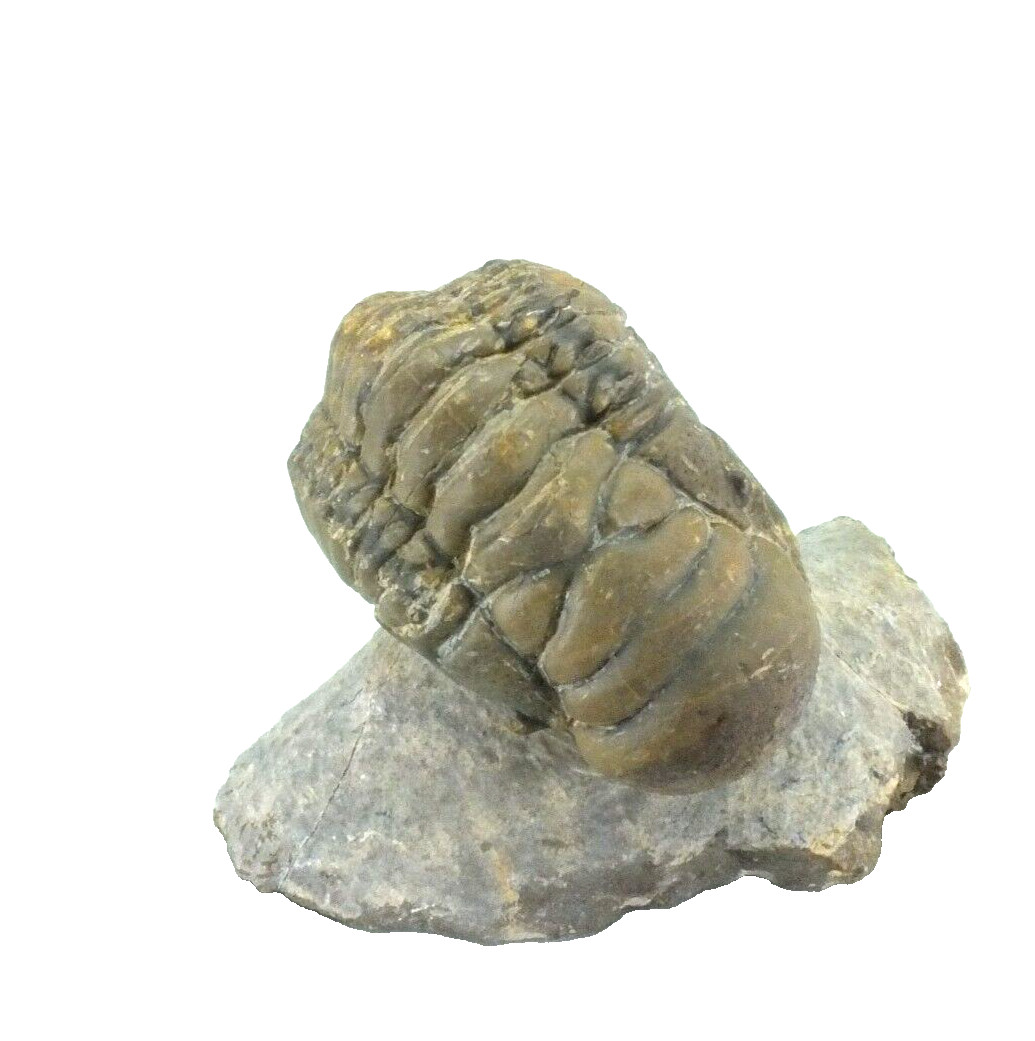
This remarkable fossil specimen features a well-preserved trilobite (Crotalocephalina (Crotacephalus) gibbis) from the Lower Devonian period (Pragian stage), dating back approximately 400+ million years. The specimen is embedded in a matrix measuring7.7 x 5.0 x 5.2cm, with the trilobite showcasing detailed features such as its segmented exoskeleton, prominent glabella, and well-defined pleural lobes, which highlight the intricate morphology of this extinct arthropod.
Collected from the Lhandar Formation near Atchan, in the Anti-Atlas Mountains of Morocco, Africa, this trilobite originates from a globally renowned fossil locality. The Lhandar Formation is known for its rich deposits of Devonian marine life, providing insight into the biodiversity and evolutionary history of this era.
Described by Beyrich in 1845, Crotalocephalina (Crotacephalus) gibbis is a significant trilobite species within Devonian paleontology, offering valuable information about the ecological roles of trilobites in ancient marine ecosystems. This fossil is scientifically significant and visually striking, making it a prized addition to any collection. Its exceptional preservation and historical context highlight the importance of Morocco as a hub for paleontological discoveries.
It has the habit of rolling up into a ball to protect itself from the predators with its hard exoskeleton.The entire trilobite is exposed, shown in its partly enrolled position with some of the original limestone in which it was fossilized in. Nice natural colour of the trilobite contrasts beautifully with the remanent lighter grey limestone rock that it was exposed from.
Trilobites were marine arthopods, from the group Trilobita, with more than 10 thousand species some growing to 2 metres.
The group Trilobita appeared in the Cambrian Period (520 million years ago) until the end of the Permian Period (250 million years ago).
The name Trilobita is derived from the three (tri-) lobed structure of the exoskeleton, which has a raised central lobe (or axis) and a pair of side lobes, called pleurae.
The trilobite body is also divided lengthwise into three regions : a head or cephalon, a middle region (thorax) composed of several to many articulated segments, and a tail plate called a pygidium, which consists of fused segments.
Arthropods are the most species-rich animal phylum living today, and have been the most diverse group of multicellular animals since the Early Cambrian.
Their main subgroups are the crustaceans (like prawns and crabs), the chelicerates (including spiders, scorpions, and mites), and the wholly terrestrial groups Insecta and Myriapoda (the latter including millipedes and centipedes).