When you click on links to various merchants on this site and make a purchase, this can result in this site earning a commission. Affiliate programs and affiliations include, but are not limited to, the eBay Partner Network.
If youneed a larger quantity of these items, please contact me and I will be happy tocreate a special order for you.
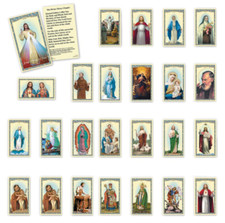
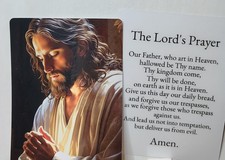
Laminated Holy Card of Saint Edward the Confessor Plus a 1\"Silver Oxidized Medal of Saint Edward
This exceptionally detailed die-cast medal, with Saint Edward on the front and Pray for Us on the back, is made in the region of Italy that produces the finest quality medals in the world. The silver oxidized finish is has been perfected for hundreds of years by the local Italian craftsmen, and remains unmatched in quality, beauty, and longevity throughout the world -a genuine silver plating with a 3-dimensional depth, and long-lasting brilliance. Measures approximately 1 inch in height - attached jump ring is included.
Edward theConfessor was among the last Anglo-Saxon kings of England. Usually consideredthe last king of the House of Wessex, he ruled from 1042 to 1066.
Edward wasthe son of Æthelred the Unready and Emma of Normandy. He succeeded Cnut theGreat\'s son – and his own half brother – Harthacnut. He restored the rule ofthe House of Wessex after the period of Danish rule since Cnut conqueredEngland in 1016. When Edward died in 1066, he was succeeded by HaroldGodwinson, who was defeated and killed in the same year by the Normans underWilliam the Conqueror at the Battle of Hastings. Edgar the Ætheling of theHouse of Wessex was proclaimed king after the Battle of Hastings in 1066 butnever ruled and was deposed after about eight weeks.
Historiansdisagree about Edward\'s fairly long (24-year) reign. His nickname reflects thetraditional image of him as unworldly and pious. Confessor reflects hisreputation as a saint who did not suffer martyrdom as opposed to his uncle,King Edward the Martyr. Some portray Edward the Confessor\'s reign as leading tothe disintegration of royal power in England and the advance in power of theHouse of Godwin, because of the infighting that began after his death with noheirs to the throne. Biographers Frank Barlow and Peter Rex, on the other hand,portray Edward as a successful king, one who was energetic, resourceful andsometimes ruthless; they argue that the Norman conquest shortly after his deathtarnished his image. However, Richard Mortimer argues that the return of theGodwins from exile in 1052 \"meant the effective end of his exercise ofpower\", citing Edward\'s reduced activity as implying \"a withdrawalfrom affairs\".
About a centurylater, in 1161, Pope Alexander III canonized the king. Saint Edward was one ofEngland\'s national saints until King Edward III adopted Saint George as thenational patron saint in about 1350. Saint Edward\'s feast day is 13 October,celebrated by both the Church of England and the Catholic Church in England andWales.