When you click on links to various merchants on this site and make a purchase, this can result in this site earning a commission. Affiliate programs and affiliations include, but are not limited to, the eBay Partner Network.
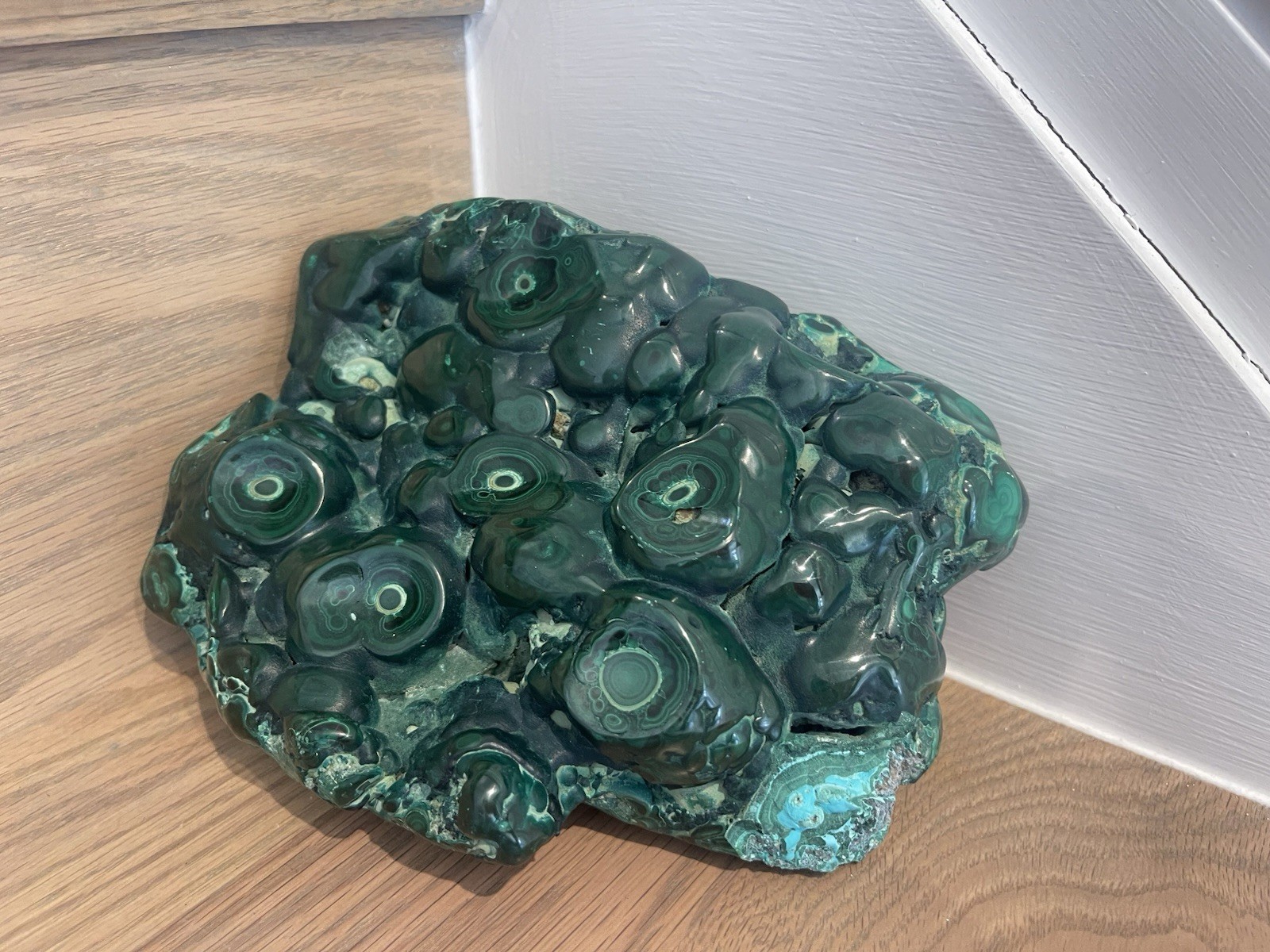
Vintage, natural Malachite Botryoidal Geode / Gemstone Rock Specimen / Mineral.
100% authentic and natural.
Amazing and intense colors! Bright and vibrant dark and light greens!
Beautiful bullseye banding!
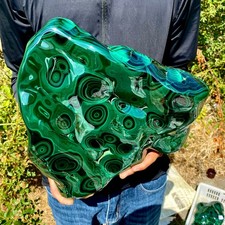
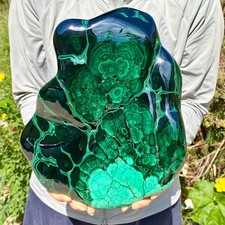
This specimen / mineral weighs 5.09 pounds. Please see picture for reference.
This specimen measures approximately 7 inches long by 5 inches wide by 3 inches high. Please see picture for reference.
Please be advised that this is a natural rock gemstone specimen and the shape is not uniform. Because of that. the measurements aren’t exact. For example: the height of the specimen varies because it’s not a uniform shape. I included pictures for reference so you can see the approximate size.
This rock specimen has one side that is polished and the other is unpolished or “rough”. The polished side has some amazing bullseye patterns throughout. Please see pictures of both sides for reference.
This specimen has been with a single owner for over 55 years.
This is obviously “used” but in good, used vintage condition.
Please be advised that I am not a rock or crystal or gemstone expert but please be advised that the specimen does have “use” throughout and does have naturally occurring “wear and tear”. Also, I’m not sure exactly what grade or level this would be considered but it’s beautiful in person with rich evergreen coloring.
Again, this is “used” and because it’s a natural rock specimen, there are some natural marks, spots, chips, etc. which is expected from age. Please view all pictures.
This is a freeform specimen and 100% natural.
An amazing addition for any fan or collector.
This is an exceptional specimen that has been well taken care of. You could also display this standing up (vertical) with the addition of a stand or display clause.
Please view all pictures for an accurate understanding as to condition.
Comes from a pet free and smoke free home.
Please be advised that all sales are final. I do not except returns. Please read the description in it’s entirety before offerding and/or purchasing this item. I am very thorough in describing each and every item and provide as many pictures and details as possible. I believe in transparency and want to make each listing crystal clear for anyone that is interested in offerding and/or purchasing. Knowing this should give you a great understanding as to the item, the condition, any flaws, etc. and to offer or purchase in confidence. Please feel free to reach out at any time for any questions. Again, just to reiterate one last time, all sales are final and I do not accept returns. I pride myself on making your shopping experience easy and stress free so thank you for your understanding.
Additional context:
Malachite (/ˈmæl.əˌkaɪt/) is a copper carbonate hydroxide mineral, with the formula Cu2CO3(OH)2. This opaque, green-banded mineral crystallizes in the monoclinic crystal system, and most often forms botryoidal, fibrous, or stalagmitic masses, in fractures and deep, underground spaces, where the water table and hydrothermal fluids provide the means for chemical precipitation. Individual crystals are rare, but occur as slender to acicular prisms. Pseudomorphs after more tabular or blocky azurite crystals also occur.
The stone's name derives (via Latin: molochītis, Middle French: melochite, and Middle English melochites) from Greek Μολοχίτης λίθος molochites lithos, "mallow-green stone", from μολόχη molochē, variant of μαλάχη malāchē, "mallow".[6] The mineral was given this name due to its resemblance to the leaves of the mallow plant.[7] Copper (Cu2+) gives malachite its green color.[8]
Malachite was mined from deposits near the Isthmus of Suez and the Sinai as early as 4000 BCE.[9]
It was extensively mined at the Great Orme Mines in Britain 3,800 years ago, using stone and bone tools. Archaeological evidence indicates that mining activity ended c. 600 BCE, with up to 1,760 tonnes of copper being produced from the mined malachite.[10][11]
Archaeological evidence indicates that the mineral has been mined and smelted to obtain copper at Timna Valley in contemporary Israel for more than 3,000 years.[12] Since then, malachite has been used as both an ornamental stone and as a gemstone.
The use of azurite and malachite as copper ore indicators led indirectly to the name of the element nickel in the English language. Nickeline, a principal ore of nickel that is also known as niccolite, weathers at the surface into a green mineral (annabergite) that resembles malachite. This resemblance resulted in occasional attempts to smelt nickeline in the belief that it was copper ore, but such attempts always ended in failure due to high smelting temperatures needed to reduce nickel. In Germany this deceptive mineral came to be known as kupfernickel, literally "copper demon." The Swedish alchemist Baron Axel Fredrik Cronstedt (who had been trained by Georg Brandt, the discoverer of the nickel-like metal cobalt) realized that there was probably a new metal hiding within the kupfernickel ore, and in 1751 he succeeded in smelting kupfernickel to produce a previously unknown (except in certain meteorites) silvery white, iron-like metal. Logically, Cronstedt named his new metal after the nickel part of kupfernickel.
Malachite often results from the supergene weathering and oxidation of primary sulfidic copper ores, and is often found with azurite (Cu3(CO3)2(OH)2), goethite, and calcite. Except for its vibrant green color, the properties of malachite are similar to those of azurite and aggregates of the two minerals occur frequently. Malachite is more common than azurite and is typically associated with copper deposits around limestones, the source of the carbonate.
Large quantities of malachite have been mined in the Urals, Russia. Ural malachite is not being mined as of 2006,[13] but G.N Vertushkova reports the possible discovery of new deposits of malachite in the Urals.[14] It is found worldwide including in the Democratic Republic of the Congo; Gabon; Zambia; Tsumeb, Namibia; Mexico; Broken Hill, New South Wales; Burra, South Australia; Lyon, France; Timna Valley, Israel; and the Southwestern United States, most notably in Arizona.[15]
Anthropogenic malachite was historically believed to be the primary component of the patina which forms on copper and copper alloy structures exposed to open-air weathering; however, atmospheric sources of sulfate and chloride (such as air pollution or sea winds) typically favour the formation of brochantite or atacamite.[16] Malachite can also be produced synthetically, in which case it is referred to as basic copper carbonate or green verditer.
Malachite was used as a mineral pigment in green paints from antiquity until c. 1800.[20] The pigment is moderately lightfast, sensitive to acids, and varying in color. This natural form of green pigment has been replaced by its synthetic form, verditer, among other synthetic greens.
Malachite is also used for decorative purposes, such as in the Malachite Room in the Hermitage Museum,[21] which features a huge malachite vase, and the Malachite Room in Castillo de Chapultepec in Mexico City.[22] Russian Tsars obtained malachite for decorating their castles, panelling the walls, and for beautiful inlaid works.[23] Another example is the Demidov Vase, part of the former Demidov family collection, and now in the Metropolitan Museum of Art.[24] "The Tazza", a large malachite vase, one of the largest pieces of malachite in North America and a gift from Tsar Nicholas II, stands as the focal point in the centre of the room of Linda Hall Library. In the time of Tsar Nicolas I decorative pieces with malachite were among the most popular diplomatic gifts.[25] It was used in China as far back as the Eastern Zhou period.[26] The base of FIFA World Cup Trophy has two layers of malachite.
A 17th-century Spanish superstition held that having a child wear a lozenge of malachite would help them sleep, and keep evil spirits at bay.[27] Marbodus recommended malachite as a talisman for young people because of its protective qualities and its ability to help with sleep.[28] It has also historically been worn for protection from lightning and contagious diseases and for health, success, and constancy in the affections.[28] During the Middle Ages it was customary to wear it engraved with a figure or symbol of the Sun to maintain health and to avert depression to which Capricorns were considered vulnerable.[28]
In ancient Egypt the colour green (wadj) was associated with death and the power of resurrection as well as new life and fertility. Ancient Egyptians believed that the afterlife contained an eternal paradise, referred to as the "Field of Malachite", which resembled their lives but with no pain or suffering.[29] During these times, the green pigment made from malachite was often used for eye preparations during the burial process. These preparations were an essential tool in the funerary equipment, even in modest burials.