When you click on links to various merchants on this site and make a purchase, this can result in this site earning a commission. Affiliate programs and affiliations include, but are not limited to, the eBay Partner Network.
1936 National Tea Company Stock - Depression-Era Grocery Chain - Frazier Jelke Signature - Chicago Retail History - 1,600+ Stores Nationwide - Illinois Corporation
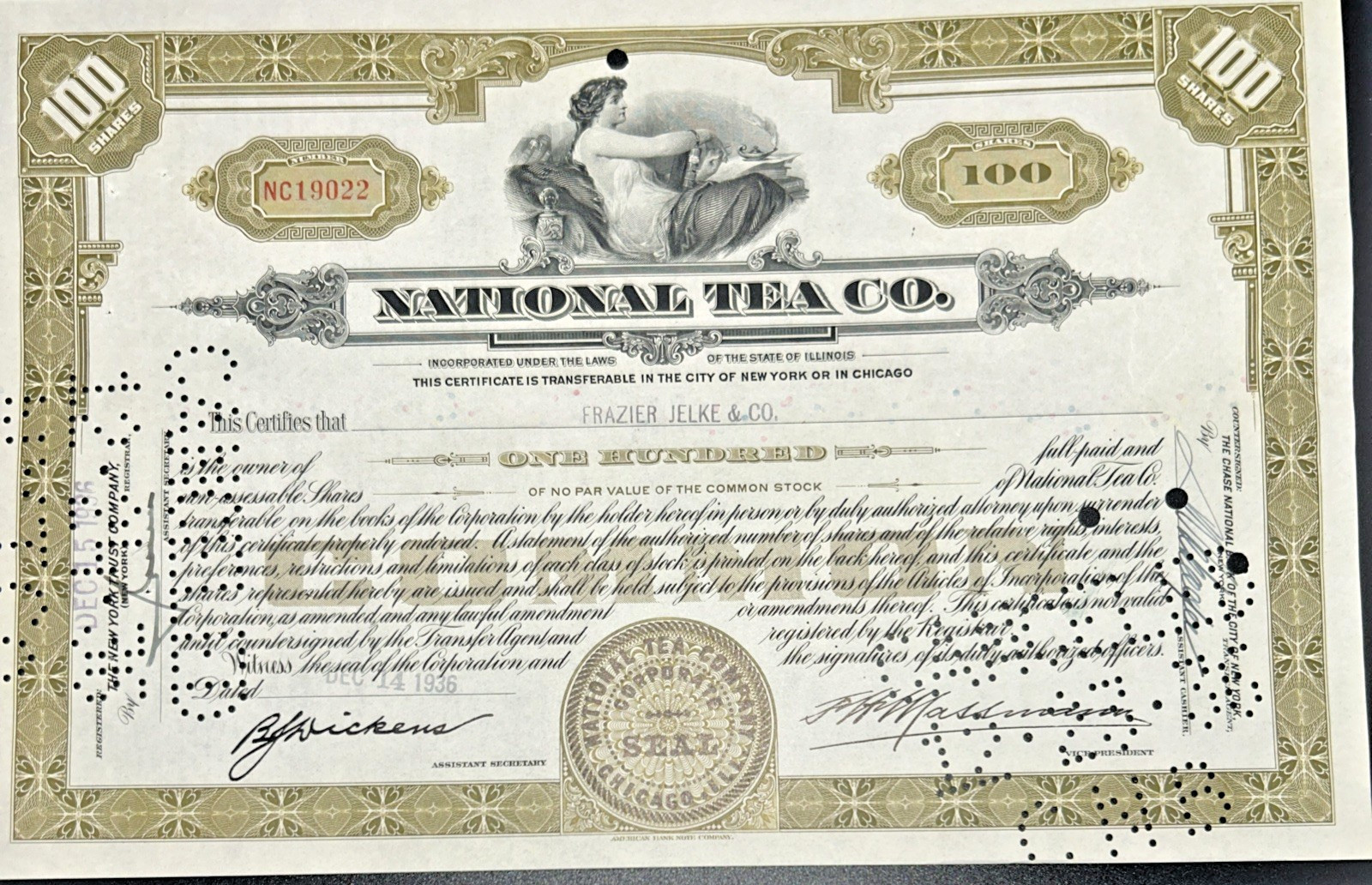
An exceptional 1936 stock certificate from the National Tea Company, one of America's largest grocery chains during the 20th century, issued to Frazier Jelke & Co. during the depths of the Great Depression. This certificate documents a retail empire that survived economic catastrophe and remained among the nation's top 10 grocery chains for decades.
The Company That Fed Mid-America:
Founded in 1899 by Danish immigrant brothers George S. and Thorvald Rasmussen in Chicago, National Tea grew from a single storefront into one of America's retail success stories. What began on North Avenue in Chicago expanded into a grocery empire that would shape Midwestern food retailing for nearly a century.
Explosive Growth - The Roaring Twenties:
- 1899: Single store in Chicago
- 1920: Approximately 160 stores, $13 million in annual sales
- 1929: Peak of 1,627 stores nationwide with over 600 locations in Chicago alone
- Sales reached $90 million annually by decade's end
At its zenith in 1929, National Tea operated more stores than nearly any other grocery chain in America, blanketing the Midwest with neighborhood markets where families could purchase affordable groceries during prosperity—a infrastructure that would prove crucial during the coming crisis.
The Depression Test - 1936 Context:
This certificate was issued in 1936, seven years into the Great Depression when unemployment still exceeded 15% and countless businesses had failed. The grocery industry faced devastating challenges: customers had little money, competition intensified, and many chains collapsed entirely.
National Tea survived by closing unprofitable locations and consolidating operations, but remarkably remained among the 10 largest grocery chains in the United States throughout the Depression. By 1936 when this certificate was issued, the company had stabilized and was positioning itself for post-Depression recovery—a testament to sound management during America's worst economic crisis.
The Frazier Jelke Connection:
This certificate is issued to "Frazier Jelke & Co.", adding a fascinating layer of financial history. The Jelke family built their fortune in the oleomargarine business (Good Luck margarine), and Frazier Jelke operated as a Wall Street broker and financier. His involvement as a shareholder reflects institutional confidence in National Tea's ability to weather the Depression and emerge stronger.
Post-War Transformation:
After surviving the Depression, National Tea flourished in the post-war era:
- 1945: Printer magnate John F. Cuneo acquired control, calling it "the worst chain-store property in the country" but seeing potential
- 1947-1954: Under CEO Joseph P. McNamara's aggressive leadership, the company acquired 358 stores from nine competing chains, closed unprofitable locations, and modernized remaining stores with air conditioning, electric-eye doors, and self-service innovations
- 1955: When annual sales topped $600 million (equivalent to $6.8 billion today) and employed nearly 20,000 workers, Canadian retail giant George Weston Ltd. (later Loblaw Companies) purchased National Tea
- Peak Operations: During the 1950s-60s, National operated across 11-12 states including Illinois, Indiana, Iowa, Louisiana, Michigan, Minnesota, Mississippi, Missouri, North and South Dakota, Wisconsin, and Ohio
Operations & Legacy:
National Tea pioneered many retail innovations including aggressive newspaper advertising (spending $5.5 million annually by 1954—more than any competitor), meat packaging techniques, extensive self-service formats, and regional management autonomy that allowed stores to respond to local preferences.
The chain operated under multiple banners including National, Loblaw, Big D, and Del Farm. It remained a dominant presence in St. Louis, Indianapolis, New Orleans, and throughout the Mississippi Valley until the 1980s-1990s when Loblaw gradually divested U.S. operations. Schnucks Markets acquired the remaining stores in 1995, ending National Tea's independent existence after 96 years.
Certificate Details:
- Date Issued: 1936 (Depression era)
- Issued To: Frazier Jelke & Co. (Wall Street broker/oleomargarine heir)
- Par Value: 100 Shares (no par value common stock)
- State: Incorporated under the Laws of the State of Illinois
- Transfer Location: New York or Chicago
- Vignette: Classical female allegorical figure reclining with cornucopia—symbolizing abundance and prosperity
- Certificate Number: NC19022
- Color: Olive/tan border with intricate guilloche security patterns
- Size: Standard certificate (approximately 12" x 8")
- Condition: Excellent—crisp, clean, vibrant colors, minimal wear
- Cancellation: Hole-cancelled, signatures intact
- Signatures: Hand-signed including Frazier Jelke signature
Why This Certificate Matters:
This certificate captures a pivotal moment in American retail history. The 1936 date places it squarely in the Depression when survival itself was an achievement. National Tea's ability to endure—and later thrive—demonstrates the resilience of companies that provided essential services during economic hardship.
The grocery business is particularly fascinating during the Depression: while people had less money, they still needed food. Successful chains like National Tea adapted by offering lower prices, efficient operations, and convenient neighborhood locations that served communities when they needed it most.
The classical vignette featuring abundance is particularly poignant—issued during scarcity, it symbolizes the hope and promise that grocery stores represented: regardless of economic conditions, food would be available and affordable for American families.
For Collectors Of:
- American retail and grocery chain history
- Great Depression-era business certificates
- Chicago commercial history
- Midwestern regional retail
- Grocery industry evolution
- Illinois corporate history
- Depression-survival success stories
- Retail consolidation and acquisition history
This certificate offers exceptional display appeal combined with compelling narrative—a premium piece documenting a company that fed millions of Americans through the nation's darkest economic hours and emerged as a retail powerhouse.
* No risk, free returns if you are not satisfied with your purchase within 30 days.
* Ships within 24 hours. Orders placed in Friday ship on the following Monday.
If you love it, we always appreciate you taking the time to leave positive response!