When you click on links to various merchants on this site and make a purchase, this can result in this site earning a commission. Affiliate programs and affiliations include, but are not limited to, the eBay Partner Network.
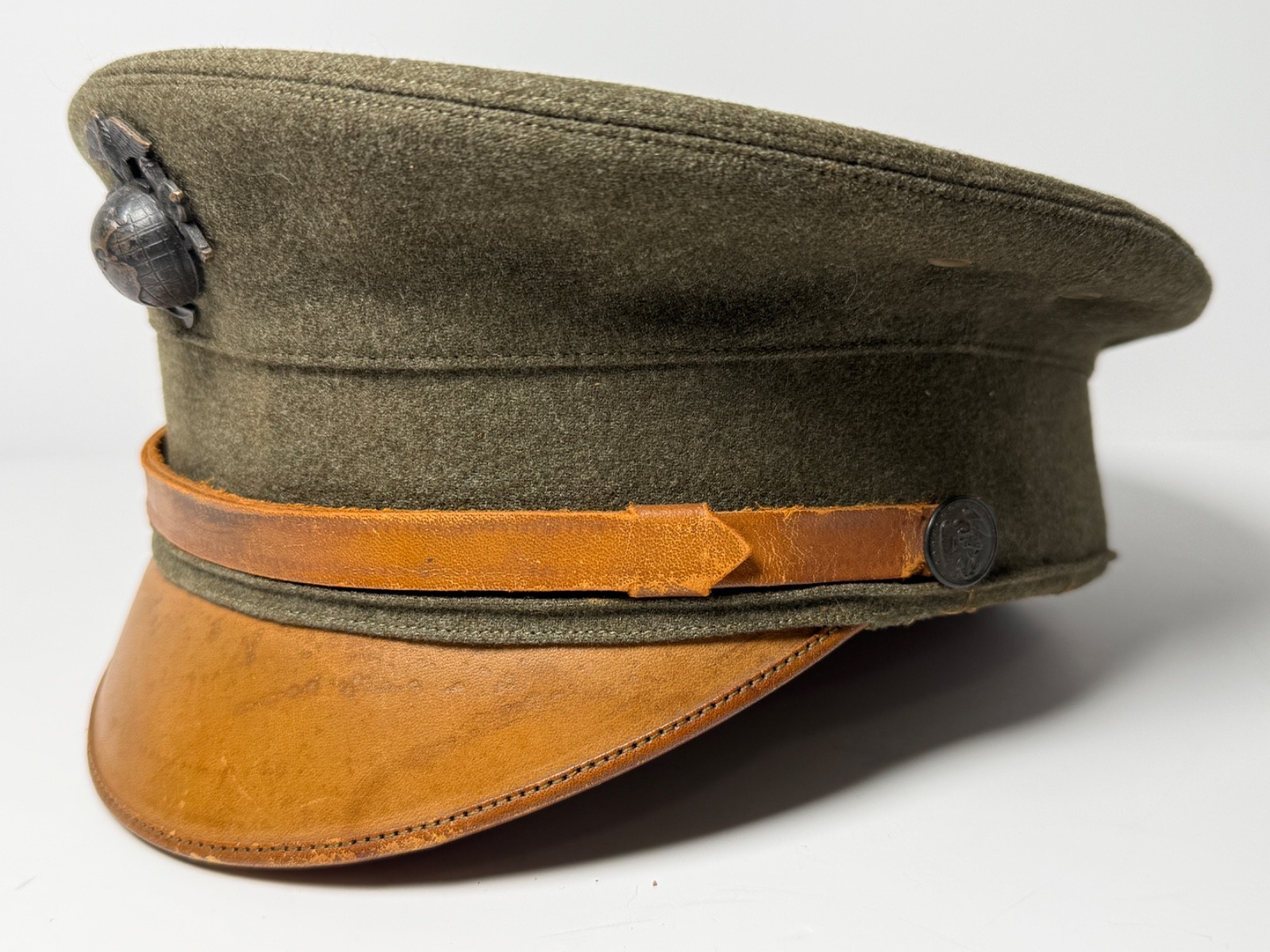
USMC, ENLISTED, P1912 WINTER ENLISTED COVER, BELL CROWN VISOR CAP, w/P1916 EGA
This style of cap saw heavy use during the "Banana Wars" (Haiti, Nicaragua, Dominican Republic) and was the primary headgear worn by Marines as they deployed to France in 1917 during World War I before transitioning to overseas caps or Brodie helmets in the trenches.
The "forest green" wool felt was the standard for the winter service uniform. The tan leather visor and chin strap are characteristic of the pre-WWI and WWI era before the Marines moved toward darker or "chocolate" leathers in later decades. This cover has wicker/cane stiffeners. This was used to maintain the "bell" shape of the crown. The wicker is remarkably intact. Usually, these frames become brittle and "crunch" if the hat is handled roughly. These are often brittle or missing in surplus items, so seeing it intact is a huge plus for its value and authenticity. The wicker frame construction was a high-tech "ventilated" innovation of the early 1900s. In 1813 (during the War of 1812), Marine hats were made of heavy felt, stiff leather, or "shakos" that looked like tall buckets. They didn't have the metal eyelet vents or the "bell crown" shape seen here.
Heavyweight "Forest Green" wool felt body, a color standard adopted by the Marine Corps in 1912 to replace the earlier olive drab and blue for winter field service. Reinforced with an intact, original internal wicker (cane) frame. This frame maintains the iconic "Bell Crown" flare typical of the pre-WWI era. Bound-edge tan (russet) leather visor and matching adjustable leather chin strap secured by two darkened USMC side buttons.
The wicker prevented collapsing of the cover. Military caps of this era needed to maintain a stiff, "bell-shaped" crown. Without a frame, the wool would sag in the humidity of the tropical environments where Marines were stationed (such as Haiti or Nicaragua). The wicker weave allowed air to circulate through the crown, passing through the metal eyelets (vents) on the sides of the wool.
The visor is solid with a "bound edge" with tight stitching around the leather rim. Leather sweat band is intact, supple and has become loose in several areas. The leather chinstrap is original to this cover. The cover does not display moth nips or pin holes, please refer to the images. The size is unmarked.
This cap is related to Max Goettler’s "Ventilated Hat”. Goettler was a prolific inventor of military headgear improvements. His patent specifically addressed the "Ventilated Hat" construction. Before this, military caps were often hot, heavy, and would lose their shape when sweaty or wet. Goettler’s design used a wicker (cane) frame—exactly what you see in this cover - to create a lightweight, "breathable" structure that maintained the "bell" shape even under harsh field conditions.
Maker’s Mark:
The makers stamp located on the inside of the leather sweat band is difficult to read, (left-front side). This is an authentic USMC Quartermaster Depot stamp, typically applied to the leather sweatbands of enlisted service caps (bell crowns or barracks covers) from the World War I era through the 1920s.
Even though the ink has bled into the porous, textured grain of the leather, the classic block-boxed layout used by the Marine Corps Depot inspectors is recognizable. Here is a breakdown of what the text layout reads:
Line 1: The top line shows the faint but distinct letters "U. S. M. C." centered at the top.
Line 2 & 3: The heavy, horizontal ink line below the branch name separates it from the department. The middle block reads "QUARTERMASTER" on the upper line and "DEPOT" underneath it. You can see the distinct vertical strokes of the "M" and "R" in Quartermaster, and the "D" and "P" of Depot directly underneath.
Line 4 (Bottom Left): There is a distinct "4" or "1/4" format stamped separately on the lower left. This represents the cap's size fraction (most likely part of 7 1/4), which was standard practice to stamp alongside or just below the depot box.
Bottom Right: There are faint traces of a date or a contract stamp (such as a 1917 or 1918 contract year), which is typical for these Philadelphia or San Francisco Quartermaster Depot markings.
Over decades, the natural oils from the leather combined with sweat can cause the ink to expand into the fibers, leaving this exact kind of blurred, ghosted impression. It's a fantastic, genuine fingerprint of early 20th-century Marine Corps issue gear.
While "Bell Crown" caps were produced in large numbers, the Winter Service (Forest Green) versions are significantly rarer than the Blue Dress versions. Because the green caps were worn in the field, most were worked to death, rotted in the rain, or were eaten by moths over the last 110 years.
According to the 1912 Uniform Regulations for the U.S. Marine Corps, this cap followed very specific rules:
The "Bell Crown" Shape: The cap was designed to be "centered and straight," with the top crown pulled tight over that wicker frame to create a crisp, flared "bell" appearance.
The Visor: It was required to be worn so the tip of the visor was in line with the eyebrows.
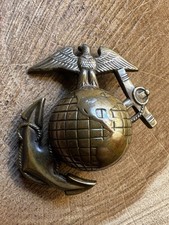
The Insignia: The bronze Eagle, Globe, and Anchor (EGA) had to be centered vertically in the eyelet provided. The "wing tips" of the eagle were required to be parallel to the visor.
The Chinstrap: For enlisted men, the strap was typically tan/russet leather. It was rarely worn under the chin unless in high winds or during a parade; usually, it rested flat against the front of the cap band.
Because the 1912 regulations were essentially overhauled in 1917 for World War I (when they moved toward removable covers and darker leathers), this cap represents a very narrow 5-year window of Marine Corps history. It is the "transitional" look between the old 19th-century styles and the modern "Forest Green" look that Marines still use for their service uniforms today. Finding a USMC M1912 Winter Enlisted Cap in this condition, with both the “Meyers Military Shops” stamp and the “1913” patent label, puts this in a high tier of military collectability.
The story of "Forest Green" is actually one of the most unique chapters in American military fashion. While the Army and Navy stuck to blues, tans, and olives, the Marines fought for a color that would make them stand out as a distinct "Soldier and Sailor too." Prior to 1912, Marines wore a mix of Army-style Olive Drab (OD) and traditional Blue. However, the Marine Corps wanted a uniform that was practical for field service but distinct from the U.S. Army. Major General Commandant William P. offerdle oversaw the change. They chose a specific wool blend that used a mix of blue and yellow fibers to create a deep, dusky green.
When the Marines arrived in France in 1917, they were wearing the very same Forest Green wool that this cover is made of. This caused an immediate stir. General Pershing and the U.S. Army weren't fans of the Marines looking different. They eventually forced the Marines to adopt standard Army Olive Drab uniforms once their Forest Green gear wore out in the trenches. For the Marines, wearing the "Forest Green" (and the M1912 cap) became a mark of being an "Old Timer" or a "Professional" who was in the Corps before the massive wartime draft. The color was so successful and beloved that it returned after WWI and remains the basis for the Marine Corps Service Alpha uniform today. If you hold a modern Marine’s service tunic next to your 1912 cap, the color match is strikingly similar—a 114-year-old tradition.
Preservation:If you are planning on displaying this, avoid using a standard Styrofoam head. The chemicals in the foam can degrade the wool and leather over time. A pH-neutral acid-free tissue stuffing or a specialized archival hat support is best to keep that wicker frame from snapping. Since the "Forest Green" was a specific mix of dyed fibers, it can be prone to "acid spotting" if stored in old wooden trunks (the tannins in the wood react with the dye). If you are storing this, it’s best to keep it in an acid-free archival box.
Reference:
Equipping The Corps, Volume 1: Webgear; Weapons; Headgear, Alec S. Tulkoff
Shipping: This will be shipped via United Parcel Service (UPS) with tracking, insurance, and adult signature required upon delivery. UPS will not ship to Post Office Box. We will not ship this to a Post Office Box. We listed the shipping cost at $35.00. If the shipping cost is lower than the $35.00, will issue you a refund. If the cost is above $35 we will absorb the extra cost for shipping.
International Buyers Please Note: We do not ship outside of the United States! No Exceptions. In addition, we will not ship to third party shippers or any other international shipping hubs such as International Shipping (EIS), EIS 110 INTERNATIONALE BLVD, GLENDALE HEIGHTS IL 60139-2080, or ACI Express Shipping. No buying agents such as Intercommerce America. No international buyers, no freight forwarding companies, no gift addresses, no non U.S. citizen buyers, and no non U.S. based forms of payment. If you place a offer, or make a purchase, we will cancel your offer, and or cancel your purchase! If you wish to make a purchase, you will have to find someone located within the United States to make the purchase for you. They would be responsible to send the package to you. We do ship to APO and FPO addresses.