When you click on links to various merchants on this site and make a purchase, this can result in this site earning a commission. Affiliate programs and affiliations include, but are not limited to, the eBay Partner Network.
What Would It Feel Like to Hold a Piece of "The Standard Railroad of the World"?🚂
There's a particular hush that comes over you unfolding one of these old railroad bonds — heavy cotton-rag paper, deep engraved blue borders, and right at the top, rendered in careful intaglio detail, a grand colonnaded building that hundreds of thousands of travelers once passed through every single week.This is a General Mortgage 3⅛% Bond, Series F, issued by The Pennsylvania Railroad Company — the company that, for the better part of a century, called itself the "Standard Railroad of the World" and largely meant it. It isn't a reproduction, and it isn't a modern print pretending at age. It's a genuine period financial instrument from one of the largest and most consequential corporations in American industrial history, and it comes to you complete with its full attached strip of dated interest coupons still intact.
📜 What You're Holding
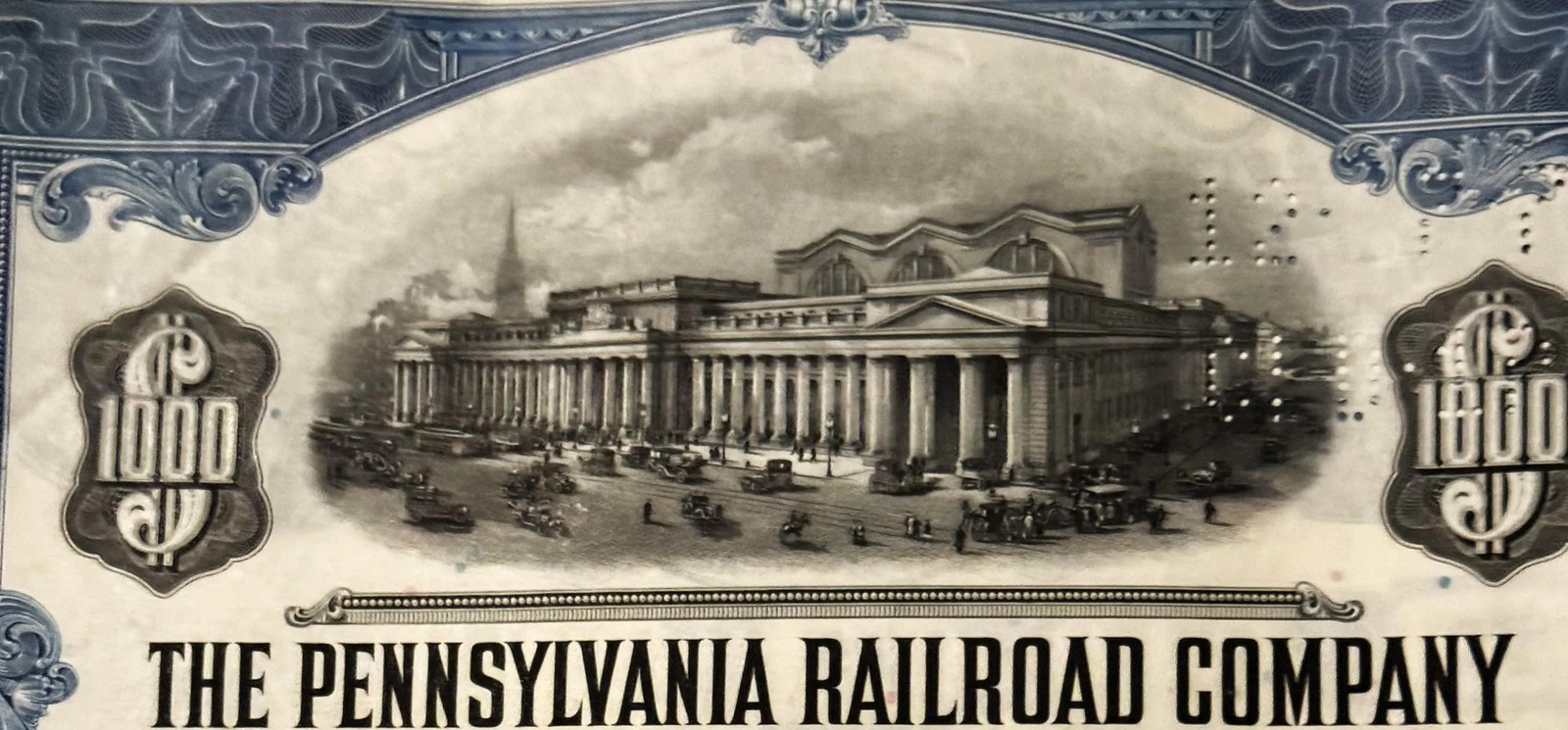
This is a $1,000 General Mortgage 3⅛% Bond, Series F, issued by The Pennsylvania Railroad Company, due January 1, 1985.The engraving carries a facsimile treasurer's signature dated January 1, 1945, which marks this printing to that year — a mid-century financial instrument, printed at the height of the Pennsylvania Railroad's postwar operating years. The certificate measures 15 x 10 inches, printed by the American Bank Note Company, the premier security engraving house of the era, in the same tradition of fine-line intaglio work used for U.S. currency and government securities.Ornate blue scrollwork borders frame the document top to bottom, bracketing a black-and-white engraved vignette of Pennsylvania Station in New York City — period automobiles, streetcars, and pedestrians crowding the plaza in front of its colonnaded facade. The bond carries the printed obligation for one thousand dollars, principal and interest payable at the Railroad Company's office in Philadelphia or its agency in the Borough of Manhattan, with the Trustee's Certificate of Girard Trust Company printed below, and the bond is signed for president and attested by assistant secretary.A diagonal PENNA R.R. protective overprint runs across the face, and small cancellation perforations sit near the vignette — the marks of a bond that was issued, paid on, and finally retired. Attached along the side is the strip of engraved semi-annual interest coupons, payable each January and July and running toward the January 1985 maturity — the ones already clipped were cashed as the interest came due, which is exactly what a working bond looks like.
🚂 The Pennsy: When One Railroad Was America's Largest Corporation
The Pennsylvania Railroad Company was chartered by the Pennsylvania state legislature in 1846, born out of pure civic anxiety in Philadelphia.The Baltimore & Ohio Railroad was creeping west toward Pittsburgh, and Philadelphia's merchants feared watching their inland trade routes get siphoned off to Baltimore's port. The legislature rushed the charter through, Samuel Vaughan Merrick took the reins as founding president, and the railroad began pushing rail westward through the Allegheny Mountains — an engineering feat that would eventually produce the legendary Horseshoe Curve near Altoona, still one of the most photographed stretches of railroad in the country.By the 1850s the line connected Philadelphia to Pittsburgh, and from there the company grew outward in every direction, acquiring, leasing, and building until it controlled thousands of miles of track stretching from the Atlantic seaboard into the Midwest.
By the turn of the twentieth century, the Pennsylvania Railroad had become, by some measures, the largest corporation on Earth — the largest single employer in the United States for decades, and the largest private enterprise most Americans had ever seen."The Standard Railroad of the World" wasn't idle boasting; it was the company's own slogan, printed on timetables and advertising for generations, and old-timers along its lines will tell you the PRR earned the swagger. It moved freight, moved soldiers in two world wars, and moved the everyday commerce of an industrializing nation on rails bearing its keystone herald.
🏛️ The Building in the Vignette: Pennsylvania Station
The structure engraved at the top of this bond is Pennsylvania Station in New York City — the original Penn Station, opened in 1910 under company president Alexander Cassatt, whose vision it was to tunnel the railroad directly under the Hudson and East Rivers so PRR trains could finally reach Manhattan without a ferry transfer.The station itself, designed by the celebrated architectural firm McKim, Mead & White, was modeled after the grand Roman Baths of Caracalla — a soaring, colonnaded temple to travel, with a vaulted glass-and-steel concourse that made ordinary commuters feel, if only for a moment, like they were passing through something monumental.
Local legend and architectural lore both hold that the demolition of that original Penn Station in the early 1960s — torn down to make way for Madison Square Garden while the railroad's fortunes declined — remains one of the most mourned losses in American architectural history.It's often cited as the single event that galvanized the modern historic preservation movement in the United States, directly credited with pushing New York City to pass its Landmarks Preservation Law in 1965. Vintage financial paper like this bond, engraved with the station in its full original glory, is one of the few tangible ways that lost building survives at all — a small paper monument to an architectural landmark that exists today only in photographs, memory, and pieces exactly like this one.
🏦 Girard Trust Company: The Bank Behind the Mortgage
The Trustee's Certificate on this bond bears the name of Girard Trust Company, the venerable Philadelphia banking institution named for Stephen Girard, the French-born financier and philanthropist whose personal fortune once helped bail out the United States government during the War of 1812.By the time this bond was printed, Girard Trust had long been one of Philadelphia's most established financial houses, serving as trustee for the mortgage securing this very series — meaning the bank stood behind the railroad's property as collateral, a role banks like Girard Trust routinely played in financing the great American rail networks of the era.Girard's own domed marble headquarters on Broad Street, itself a Philadelphia architectural landmark, would have been a familiar sight to any bondholder who walked in to collect an interest payment in person.
🖋️ American Bank Note Company: Engraving as Fine Art
The American Bank Note Company, whose imprint runs quietly along the base of this certificate, was the dominant security engraver in the United States for well over a century — the same firm responsible for engraving currency, postage stamps, and stock and bond certificates for railroads, mining companies, and industrial giants across the country.Their engravers worked in the same exacting intaglio tradition used to thwart counterfeiters on paper money: fine crosshatched lines, elaborate guilloché borders, and richly detailed vignettes that turned a financial obligation into something closer to a miniature print. The Penn Station vignette on this bond is a textbook example of that craft — architectural detail, period vehicles, and pedestrian life all rendered in a space just a few inches wide.
💵 What a General Mortgage Bond Actually Represented
Bonds like this one were how great American railroads financed themselves in the era before easy corporate borrowing — a General Mortgage Bond meant the company had pledged its physical property, its rails and rolling stock and real estate, as collateral behind the promise to repay.Series F, due January 1, 1985, paying interest each January and July at 3⅛ percent, represents forty years of promised payments stamped right into the paper — the coupon strip attached here is the physical mechanism by which a bondholder would have clipped a coupon twice a year and presented it for payment, either in Philadelphia or at the company's Manhattan office.That the Pennsylvania Railroad Company would not survive to see this bond's own maturity is one of the quieter ironies collectors of this material often note: by the mid-1970s the company had merged into Penn Central, which collapsed into the largest corporate bankruptcy the country had yet seen, its remaining freight operations eventually folded into Conrail and its passenger service absorbed by the newly formed Amtrak — which still runs trains through a station called Penn Station today, buried beneath the site where Cassatt's original temple to travel once stood.
🖼️ Display Ideas
- 🚉 Frame it alongside a vintage railroad timetable or map for a rail-history focal wall.
- 🖋️ Matte and frame it solo to let the Penn Station engraving and blue scrollwork borders stand as the centerpiece.
- 🎓 Gift it to a retired railroad worker, engineer, or lifelong train enthusiast as a tangible piece of industrial history.
- 🏙️ Pair it with architectural prints or photographs of the original Pennsylvania Station for a "lost landmarks" display.
- 💼 Display it in a home office or study alongside other vintage financial ephemera — stock certificates, ledgers, old currency.
- 📚 Use it as a teaching piece for railroad history, American finance, or architectural preservation discussions.
🎁 Who Collects These
Railroadiana collectors chase Pennsylvania Railroad material specifically because the PRR looms so large in American rail history — anything bearing the keystone herald or the Penn Station vignette tends to move quickly in that hobby.Scripophily collectors — those who collect antique stocks and bonds as an art and history niche in its own right — prize this bond for its engraving quality, its Girard Trust and American Bank Note Company pedigree, and the visual punch of the Penn Station vignette itself. Architecture and preservation enthusiasts seek out anything depicting the lost original Penn Station, since so little of that building survives outside of photographs and paper.And because so many families have their own connection to the railroads — a grandfather who worked the lines, a childhood memory of a station long since demolished — pieces like this one make deeply personal gifts for anyone with a thread tying them back to the golden age of American rail.
❓ FAQIs this a real Pennsylvania Railroad bond?
Yes — this is a genuine period bond certificate issued under The Pennsylvania Railroad Company's General Mortgage program, Series F, engraved and printed by the American Bank Note Company.
What does the diagonal overprint across the face mean?
It is the railroad's own protective tint, printed across the face as a security device.The small cancellation perforations near the vignette are a separate mark, and they show where the bond was formally retired at the end of its life.
Is this bond still financially payable today?
No — it is offered strictly as a historical and collectible document, not as a negotiable financial instrument.
What building is shown in the engraving?
The vignette depicts the original Pennsylvania Station in New York City, the McKim, Mead & White-designed landmark that opened in 1910 and was demolished in the early 1960s.
What are the coupons attached to the side?
Those are the bond's semi-annual interest coupons, each printed with a January or July payment date, meant to be clipped and presented for interest payment as they came due.
How large is the certificate?
It measures 15 x 10 inches, printed on heavy banknote-style stock in the engraved intaglio tradition.
Who was Girard Trust Company?
A long-established Philadelphia banking institution named for financier Stephen Girard, serving here as the trustee guaranteeing the mortgage that secured this bond issue.
These are issued instruments rather than blanks. Bonds and debentures of this type were registered to a holder, authenticated by the trustee, and punch- or cut-cancelled when they were finally redeemed. Expect financial writings, markings, stamps, hole punches and staple holes as part of the life of the instrument: endorsements and signatures, trustee and registrar stamps, revenue or documentary tax stamps, cancellation punches, staple holes from being bound into a transfer book, pencil ledger notations. That is the paper trail of a security that actually did its job, and it is what separates a document that lived from a blank that never did. No two are alike: holder details, serial numbers, dates, signatures, stamps and punch patterns vary from example to example, so the photographs show the type rather than the exact sheet that ships. The coupon count can run a few more or a few fewer than pictured.