When you click on links to various merchants on this site and make a purchase, this can result in this site earning a commission. Affiliate programs and affiliations include, but are not limited to, the eBay Partner Network.
Still Hear That Voice Coming Before the Cup Does? 🥊😄
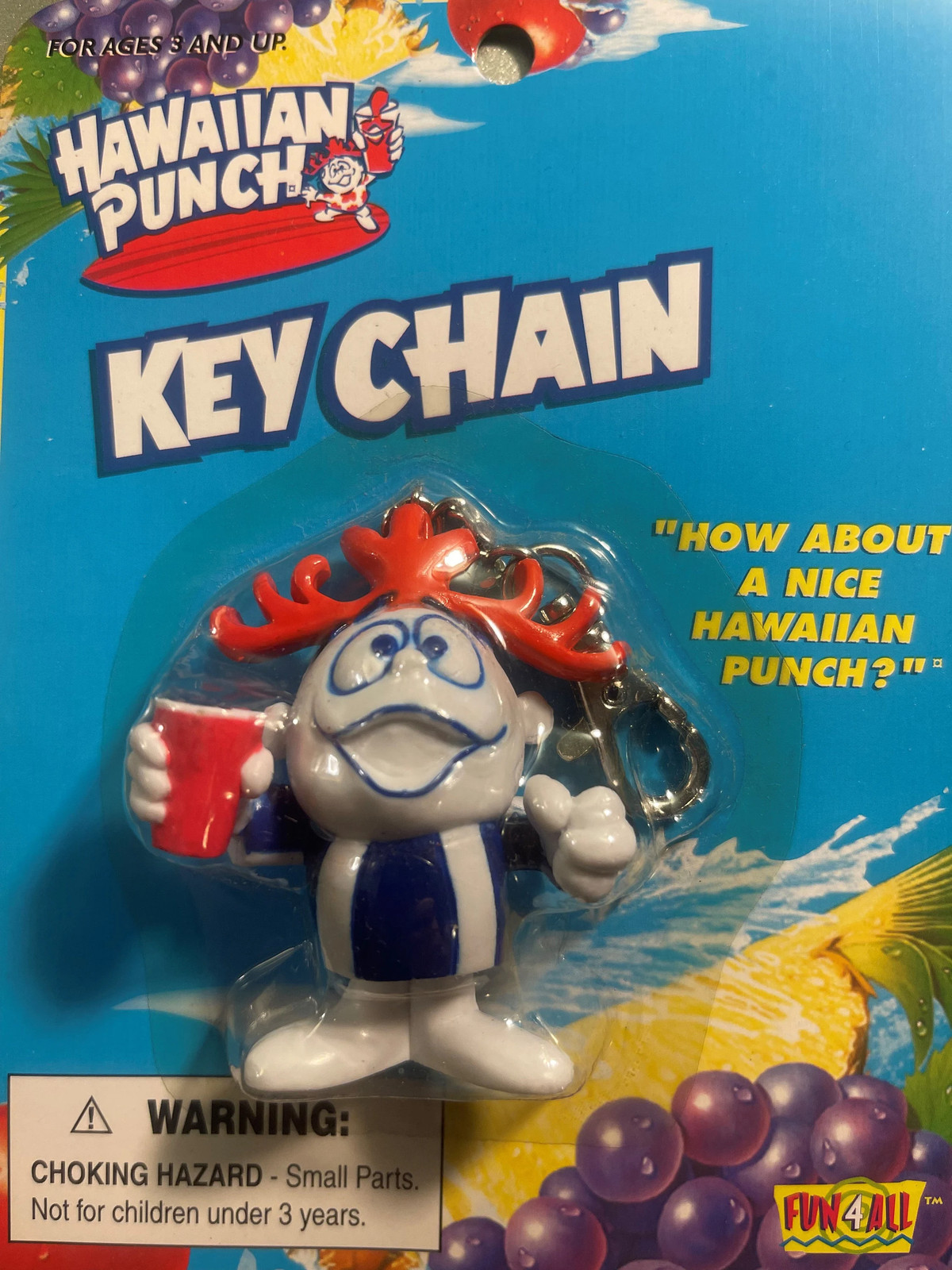
You know the sound before you even see him — that bright, sunny "Hey! How about a nice Hawaiian Punch?" — and then, a half-beat later, the haymaker nobody ever sees coming. Punchy has been ambushing that poor guy in the straw hat across generations of Saturday-morning commercial breaks, and if you grew up anywhere near a TV set, that grinning, red-haired troublemaker is wired straight into your childhood right alongside cereal jingles and cartoon theme songs. This little sealed keychain freezes him mid-grin, red cup raised, exactly as he rolled off the card line — never opened, never clipped to a set of keys, never handled at all. 🔑
This is a Hawaiian Punch "Punchy" keychain — a small molded PVC figure of the brand's mascot mounted on metal keyring hardware and sealed, still on its original blister card, by the Fun-4-All Corporation of New York, NY, manufactured under license from Sundor Brands Inc., "a Procter & Gamble Company" of Cincinnati, Ohio. The card is printed in offset lithography across a full tropical palette of blue, white, red, yellow, and silver, with grapes, pineapple, and splashing punch surrounding Punchy's own likeness on the header art — the same figure repeated in molded form below, in his signature red antler-shaped hair, blue-and-white striped shirt, tiny red cup in one hand and a thumbs-up in the other. It's a genuinely pocket-scaled charm, measuring 0.5 inches (about 1.3cm), carrying Style #84400 and its original UPC right on the packaging. This example remains New Old Stock — sealed exactly as it left the factory, never opened, never carried.
🍹 The Brand: From a Fullerton Ice Cream Garage to a National Sensation
Hawaiian Punch didn't start life as a drink at all — it started as an ice cream topping. The brand was founded in 1934, when A.W. Leo, Tom Yeats, and Ralph Harrison developed the first Hawaiian Punch recipe under the name Pacific Citrus Products Company, selling their tropical-tasting syrup to restaurants, soda fountains, and ice cream makers as "Leo's Hawaiian Punch." Soda jerks started mixing the syrup with water for a quick drink, and the "Leo's" eventually dropped off entirely once the punch itself became the star. The brand's popularity even landed it in court — in 1940, a competitor called LaVida Bottling Company was enjoined from using the Hawaiian Punch name on a rival soft drink after a judge found it was unfairly trading on the trademark.
Reuben P. Hughes purchased the company with other investors in 1946 and renamed it Pacific Hawaiian Products Co., steering it into the packaged-drink business that made it a household name: ready-to-serve 46-ounce cans arrived in 1950, frozen concentrate in 1955, and a second flavor — "Sunshine Yellow" alongside the original "Rosy Red" — rounded out the lineup as the brand went national. From there, ownership changed hands more than once, tracing a path collectors love to follow: R.J. Reynolds Tobacco Company acquired Pacific Hawaiian in 1962 as tobacco companies diversified into packaged foods, later folding it into its Del Monte subsidiary in 1981. Procter & Gamble bought the brand in 1990, Cadbury Schweppes bought it from P&G in 1999, Dr Pepper Snapple was spun off from Cadbury Schweppes in 2008, and the brand landed with Keurig Dr Pepper after the 2018 Keurig merger — its home today.
🥤 The License Line Printed Right On the Card
The fine print naming "Sundor Brands Inc., a Procter & Gamble Company, Cincinnati Ohio 45202" isn't just flavor text — it's a real corporate entity with a documented, narrow window in P&G's history. P&G entered the juice-drink category in 1989 by acquiring Sundor Brands (the maker of Sunny Delight), and folded Hawaiian Punch into that same portfolio in 1990 after buying the brand outright. That means merchandise carrying this exact license credit could only have been produced somewhere between 1990, when P&G first paired Sundor Brands with Hawaiian Punch, and 1999, when P&G sold the brand to Cadbury Schweppes — after which any accurately licensed piece would have to cite a different owner entirely. It's a genuinely useful little clue for dating a piece like this one, hiding in plain sight on the card.
🏭 The Maker: Fun-4-All Corporation of New York
Fun-4-All Corp. was founded in 1995 as a New York novelty and character-merchandise house, and it built a real footprint licensing popular properties into plush toys, PVC figures, dolls, and keychains rather than any single brand. Trademark filings from 1997 show the breadth of the operation — plush and stuffed toys, dolls, toy chests, action figures, balloons, bath toys, board games — and the company's best-remembered line came a bit later, when it started producing South Park plush toys and figures in 1998, continuing production into the mid-2000s. Fun-4-All also held licenses for Sonic Adventure plush beginning in 2000 and produced celebrity dolls of the Osbourne family tied to their MTV reality show that ran from 2002 to 2005 — a company that clearly had its hand in a lot of 1990s and early-2000s pop culture beyond soda mascots.
No manufacture date appears legibly anywhere on this piece, so its exact age can't be stated as confirmed fact — but between the license text (only accurate 1990–1999) and Fun-4-All's own 1995 founding, the overlap points collectors toward the mid-to-late 1990s as the likely production window for this particular keychain, even without a stamped date to prove it outright.
🎨 Punchy Himself — Ad Legend, and the Ad World's Favorite Dispute
Punchy's origin story is told a few different ways depending on which old ad-industry account you trust, and it's worth preserving the disagreement rather than pretending it's settled. The brand's own history credits the Atherton-Privett agency with creating him in December 1961, with artist Martin Mandelblatt named as designer and a February 1962 television debut. Other advertising histories instead credit John Urie and Associates of Hollywood, with Jean Guy Jacques directing, Bob Guidi and John Urie designing both Punchy and his long-suffering target — remembered by fans as "Oaf" or "Opie" — Ross Martin supplying Punchy's voice, and Rod Scribner handling the animation. Still other retrospectives name cartoonist Joe Malerba for the design, animator Jan Svochak for two decades of the character's motion, and Len Maxwell for the voice. Old-timers in the ad business still argue over which account is the "real" one — a genuine point of dispute across otherwise reputable sources, and one worth keeping alive as unresolved lore rather than flattened into a single tidy story.
What everyone agrees on is the impact: the "How about a nice Hawaiian Punch?" line was copyrighted in 1964, and the commercial's Tonight Show debut reportedly landed so well that host Jack Paar asked to see it replayed on the spot. Punchy kept his classic Hanna-Barbera-style look — the same straw-hat, striped-shirt design molded into this keychain — for decades before getting a full redesign in 2003 aimed at a more modern, "Pixar world" style, which makes this piece's classic look a nice marker of the character's earlier era.
🌴 Fullerton, California — Where It All Began
Though this keychain itself was made in China and distributed out of New York, the brand's true hometown is Fullerton, California, and local history there has kept the founding story alive in its own colorful way. Local legend places A.W. Leo's original syrup operation in a converted garage at 120 W. Amerige — though Fullerton's own local historians note a wrinkle worth passing along: a Fullerton resident placed a plaque on his own garage on Frances Ave. in 2007 claiming the formula was invented there in 1934, while library records show Leo didn't actually move to that address until 1936. It's the kind of small-town rival-claim dispute that collectors love, and it's preserved here as the legend it is rather than settled fact. Fullerton locals count Hawaiian Punch as one of the town's two most nationally famous homegrown companies — the other being Fender Guitars — and local news even chronicled the brand's Fullerton plant making headlines for vandalism troubles reported in the Fullerton News-Tribune back in 1978, a small, human footnote to a very big brand's very local beginnings.
💥 Why Punchy Still Lands Today
Advertising mascots come and go, but few stuck the landing quite like Punchy — a character built entirely around one gag, repeated for decades, that never stopped working. He's one of the rare vintage soda-and-snack mascots (think Reddy Kettle, the Kool-Aid Man, Mr. Peanut) who crossed from commercial character into genuine pop-culture shorthand, recognizable even to people who've never tasted the punch itself. Pieces like this keychain sat on store racks as pure impulse-buy nostalgia even when they were new, and today they function as small, honest artifacts of mid-century-to-late-20th-century American advertising and licensed novelty manufacturing — a little bit of Fullerton, a little bit of Madison Avenue, and a little bit of 1990s New York novelty-toy hustle, all molded into one grinning inch of plastic.
🖼️ Display Ideas
- 🔑 Clip him to a genuine set of keys and let Punchy do what he was made for
- 🥤 Group him with other vintage soda and beverage advertising mascots on a shelf
- 🎨 Display the sealed card flat or upright as a piece of tropical-themed advertising art
- 🧃 Pair with vintage Hawaiian Punch cans, bottles, or print ads for a themed collection
- 🎁 Keep sealed as a gift for a Hawaiian Punch or advertising-mascot collector
- 📺 Set alongside other 1990s licensed character keychains and figures for a nostalgia wall
🎁 Who Collects These
This is a natural fit for advertising-mascot collectors, vintage soda and beverage memorabilia collectors, keychain and novelty-figure collectors, and anyone chasing 1990s licensed toy and premium history — especially Fun-4-All completists tracking the company's run of character merchandise. It also draws in Hawaiian Punch superfans and Fullerton, California local-history collectors who like tracing a national brand back to its literal hometown roots.
❓ FAQ
Is this keychain sealed or opened?
It's New Old Stock — sealed on its original blister card exactly as it left the factory, never opened or carried.
How old is this piece exactly?
There's no legible manufacture date on the piece itself, so an exact year can't be confirmed. What can be said with confidence: the license text on the card ("Sundor Brands Inc., a Procter & Gamble Company") was only accurate between 1990 and 1999, and Fun-4-All Corp. was founded in 1995 — together pointing collectors toward the mid-to-late 1990s as the likely window.
Who made this keychain?
Fun-4-All Corporation of New York, NY, under license from Sundor Brands Inc., a Procter & Gamble Company of Cincinnati, Ohio.
Why does the card say "Procter & Gamble" when Hawaiian Punch is owned by Keurig Dr Pepper today?
P&G owned Hawaiian Punch from 1990 to 1999 before selling it to Cadbury Schweppes; the brand later passed to Dr Pepper Snapple and then Keurig Dr Pepper, so the P&G credit on this card reflects that earlier chapter of ownership.
Who created Punchy?
Accounts genuinely differ — some credit the Atherton-Privett agency and artist Martin Mandelblatt, others credit John Urie and Associates with director Jean Guy Jacques and designers Bob Guidi and John Urie, and still others name Joe Malerba, Jan Svochak, and Len Maxwell. It's a real, long-running dispute among advertising historians rather than a settled fact.
How big is the figure?
It's a true pocket-scale keychain charm, measuring 0.5 inches (about 1.3cm).
Is this the original Punchy design or the modern one?
The character's classic look — straw hat, striped shirt — was used for decades before a redesign arrived in 2003 for a more updated style; given this piece's licensing window falls before that redesign, it reflects the earlier, classic Punchy.