When you click on links to various merchants on this site and make a purchase, this can result in this site earning a commission. Affiliate programs and affiliations include, but are not limited to, the eBay Partner Network.
🎟️ What Did It Feel Like to Hold a Ticket to Buffalo Bill's Own Hometown Show?
There's something about an unused ticket that a used one can never give you — it's still full of anticipation, still waiting for a seat that was never filled, a gate that was never punched. I've handled a lot of vintage paper over the years, but this little set of Buffalo Bill's Wild West stubs out of North Platte, Nebraska stops me every time. These weren't printed for some traveling carnival passing through a random county fair — they were printed for the one town on earth that Buffalo Bill Cody himself called home.
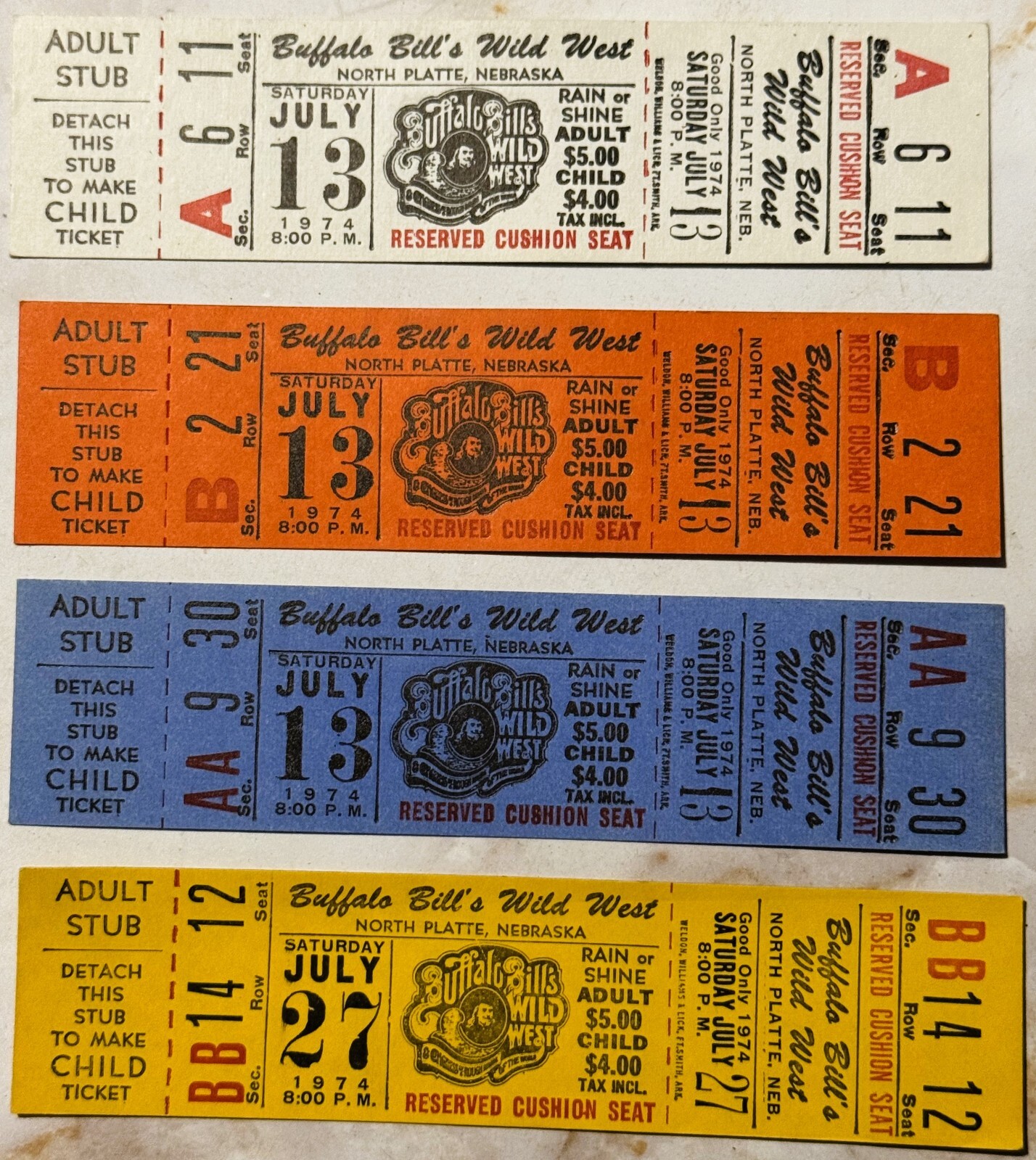
This lot is a set of four Buffalo Bill's Wild West adult stub tickets, each a full stub-and-ticket pair measuring 5.5" x 1.5", issued for reserved-seat performances in North Platte, Nebraska, printed by Weldon, Williams & Lick of Fort Smith, Arkansas — a name that matters a great deal in the ticket-printing world, as I'll get into below. Each one is New Old Stock (NOS), never torn, never used at the gate. The four are printed in four different colors — cream/white, orange, blue, and yellow — with a "Sec./Row/Seat" combination unique to each (A6/11, B2/21, AA9/30, BB14/12), and three carry the date Saturday, July 13, 1974, while the fourth is dated Saturday, July 27, 1974, both for an 8:00 P.M. show, "Rain or Shine." Adult admission ran $5.00, child $4.00, tax included, for a "Reserved Cushion Seat." Each ticket features a central circular portrait logo of Buffalo Bill himself, rendered in bold black ink, with the ornate "Buffalo Bill's Wild West" script banner above it — classic carnival-and-circus letterpress styling, with the mirrored text repeated across the stub so that when the stub was detached, both halves still carried the show name, date, and seat information. The left-hand stub bears the charming little instruction "DETACH THIS STUB TO MAKE CHILD TICKET" — a nod to the fact that reserved-seat tickets of this era did double duty, letting a single stock design serve both an adult and child fare depending on where it was torn.
🖨️ The Printer: Weldon, Williams & Lick, Fort Smith, Arkansas
That small maker's mark tucked along the ticket's edge — "Weldon, Williams & Lick, Ft. Smith, Ark." — is not filler. It's the signature of one of the most important reserved-seat ticket printers in American entertainment history. The firm traces back to 1898, when a young journeyman printer named Chauncey A. Lick, who'd arrived in Fort Smith with little more than a watch and a pocketful of change, partnered with O.D. Weldon and George T. Williams. Lick had an idea early on that would define the company for the next century: steer the business toward numbered printing — reserved-seat tickets, coupon books, the exact kind of stock this lot represents. It worked. Weldon, Williams & Lick went on to print roughly 95% of all tickets for Ringling Bros. and Barnum & Bailey Circus, picked up a contract with the St. Louis Cardinals in the 1920s, and decades later printed millions of tickets for the 2012 London Olympics. The Fort Smith plant Lick built in 1906 is still the company's home today, having grown from 21,000 square feet to nearly 200,000. Knowing that history, a humble North Platte rodeo ticket from 1974 suddenly sits in some very good company — the same presses that ticketed the greatest show on earth cut these stubs too.
🤠 The Town: North Platte and Buffalo Bill's Real Hometown
North Platte, Nebraska isn't borrowing the Buffalo Bill name the way so many towns and attractions across the country have over the decades — this was genuinely his home. Cody began buying land there in 1878, eventually building it into the 4,000-acre Scout's Rest Ranch, with "Scout's Rest Ranch" painted across the roof of his big barn in letters large enough to read from the passing Union Pacific tracks a mile off. The fortune from his Wild West show paid for "The Mansion on the Prairie," the grand Second Empire home that was, for a time, the largest house in town — Cody's residence from 1886 until 1913, when financial pressure forced him to quietly sell the ranch to his old show partner, Gordon "Pawnee Bill" Lillie. That mansion and ranch survive today as a historical site, which local folks will proudly point you toward if you ever pass through.
Long before the Wild West Arena of the 1970s ever printed a ticket, North Platte was already staging the real thing. Local legend and rodeo history alike trace the town's cowboy pageantry back to July 4, 1882, when Cody himself staged the "Old Glory Blowout" at a North Platte racetrack — bronc riding, roping, buffalo riding, the whole spectacle — an event many rodeo historians credit as America's very first true spectator rodeo, and the true seed of everything that became Buffalo Bill's Wild West the following year. That tradition never really left town; it just kept getting reborn, decade after decade, in one form or another, right through to the Wild West Arena these 1974 tickets were printed for — a fairgrounds venue built new in 1972, barely two seasons old when these particular stubs went to the box office window.
🐎 The Man Behind the Name
William F. "Buffalo Bill" Cody started working at eleven years old after his father's death, rode for the Pony Express at fifteen, served the Union through the Civil War, and scouted for the Army during the Indian Wars before he ever thought of show business. He founded Buffalo Bill's Wild West in 1883, and it toured the country — and Europe, beginning in 1887 — as the prototype for every "Wild West show" that followed, blending sharpshooting, trick riding, rodeo stunts, and staged frontier reenactments into a single evening's spectacle. The original show didn't last forever; financial trouble caught up with Cody by 1913, and the show itself was seized and saleed off in Denver that year after he fell behind on a loan. Cody died in 1917. So it's worth being honest about what this ticket is and isn't: it's a genuine 1974 print from Cody's own hometown, carrying his name and portrait proudly forward — not a surviving ticket from his original 1883–1913 touring show, which had been gone for six decades by the time these were printed.
One honest note for fellow collectors: the well-documented flagship "Buffalo Bill Rodeo," part of North Platte's Nebraskaland Days celebration, is consistently recorded as a June event historically. These tickets are dated in July — two Saturdays a fortnight apart — so whether this particular booking was a special summer performance, a touring engagement at the Wild West Arena, or simply an off-cycle date that year, I can't say with certainty, and I'd rather tell you that plainly than dress up a guess as settled fact. What is certain is the venue, the town, the printer, and the year — all sourced and solid.
🖼️ Display Ideas
- 🎨 Frame all four colors together in a shadow box — the cream, orange, blue, and yellow side by side make a striking little rainbow of vintage letterpress.
- 🤠 Pair one ticket with a small Western or rodeo-themed shelf display for an instant conversation piece.
- 📚 Slip one into a scrapbook or memory album page dedicated to American showmanship and traveling exhibitions.
- 🏠 Mount a single stub in a small frame near a home office or den for understated Americana wall décor.
- 🎁 Gift one ticket to a Buffalo Bill, Nebraska history, or rodeo enthusiast as a genuinely unusual keepsake.
🎁 Who Collects These
This little set draws interest from several directions at once — Western Americana and Buffalo Bill Cody collectors chasing anything tied to his name and legacy; ticket and ephemera specialists who value the printing craft of houses like Weldon, Williams & Lick; rodeo and Nebraskaland history buffs with a soft spot for North Platte's fairgrounds heritage; and everyday nostalgia lovers who just love the idea of an unused ticket to a show that never got torn at the gate. It's the kind of small paper artifact that rewards a collector who already knows to look past the surface for the printer's mark and the story behind the town.
❓ FAQIs this an original ticket from Buffalo Bill Cody's own 1883–1913 Wild West show?
No — these are dated 1974, decades after Cody's original touring show ended in 1913 and after his death in 1917. They're genuine 1974 tickets printed under the Buffalo Bill's Wild West name in his real hometown of North Platte, Nebraska.
What does "NOS" mean here, and what condition is it in?
NOS means New Old Stock — these tickets were printed for the 1974 event but never used or torn at the gate. They're being offered as genuine unused period tickets; photos show exactly what you'll receive.
Why are the four tickets different colors?
Different colors typically corresponded to different seating sections and rows for reserved-seat events of this kind — you can see each ticket's own Sec./Row/Seat combination printed directly on it.
Why do three say July 13 and one say July 27, 1974?
They represent two separate Saturday evening performance dates, two weeks apart, both at 8:00 P.M. in North Platte.
Who was Weldon, Williams & Lick?
A Fort Smith, Arkansas printing house founded in 1898 that became one of the country's leading reserved-seat ticket printers, with a client list that included Ringling Bros. and Barnum & Bailey Circus.
What's the connection between North Platte and Buffalo Bill Cody?
Cody considered North Platte his real hometown, building his Scout's Rest Ranch and Mansion on the Prairie there, and the town has staged Cody-linked Wild West and rodeo events going back to his own 1882 "Old Glory Blowout."
Is this a single ticket or a set?
This listing is for the set of four ticket/stub pairs described above, each a complete, uncut adult stub ticket measuring 5.5" x 1.5".