When you click on links to various merchants on this site and make a purchase, this can result in this site earning a commission. Affiliate programs and affiliations include, but are not limited to, the eBay Partner Network.
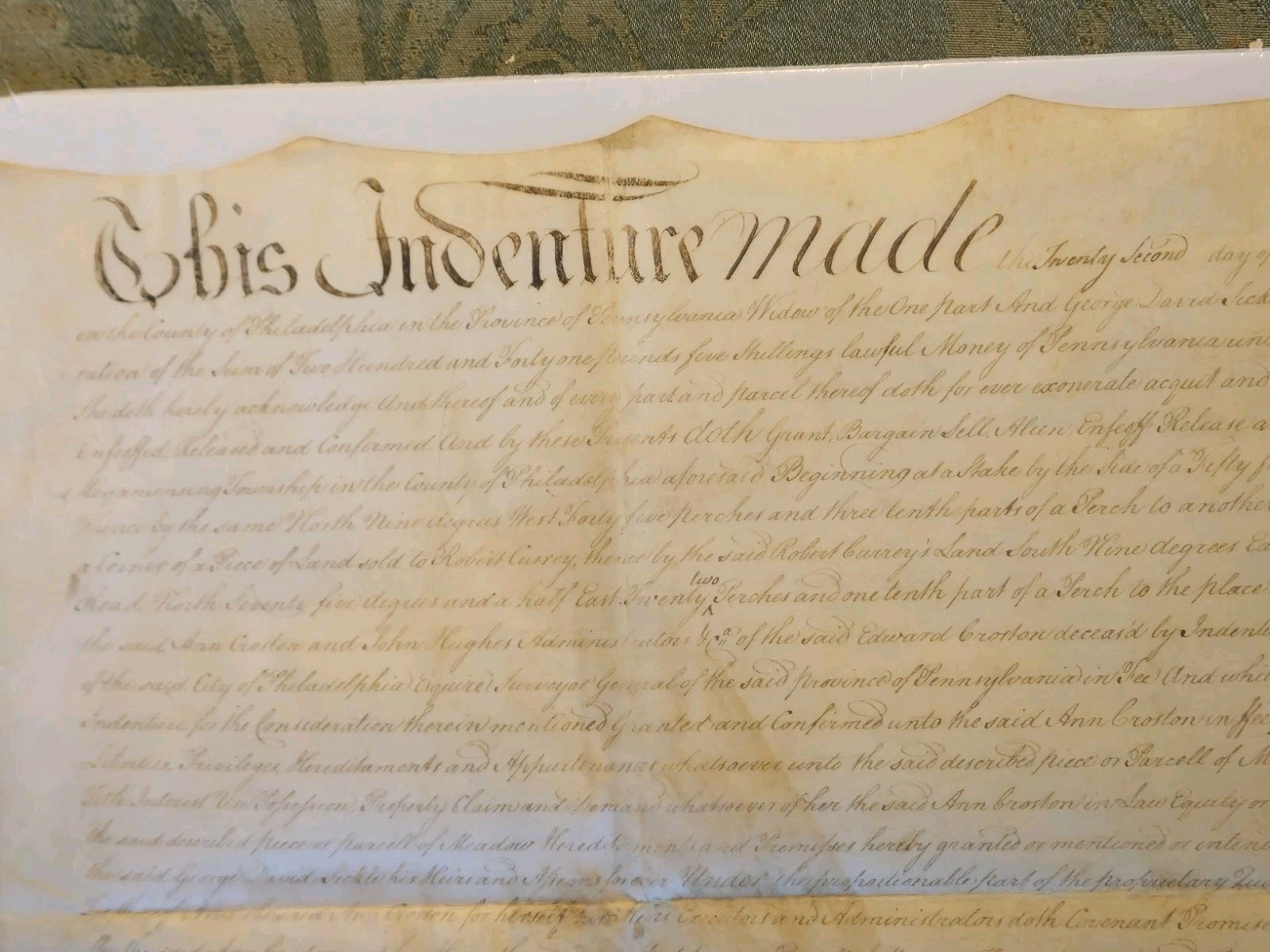
Very scarce city of Philadelphia indenture dated December 22nd, 1769 between Ann Forbes Croston, widow, of the Northern Liberties, and George David Sickle, Victualler, of the city of Philadelphia. In it, Ann Croston sells multiple acres of her land in the Moyamensing District of Philadelphia County to George Sickle for 250 pounds sterling. Ann Croston owned sizeable lands both in the Northern Liberties and Moyamensing sections of Philadelphia at that time.
The land described bordered lands owned by William Jones, Edward Croston, Robert Currey, and John Hughes. This is amounted to hundreds of what were then called Purches.
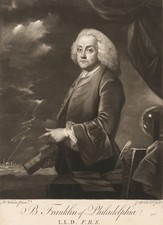
The indenture goes on to state that John Lukens, the Crown Surveyor General of Pennsylvania surveyed and endorsed this same parcel of land in an indenture dated December the 7th of the same year. John Lukens is quite an interesting figure, being a writer, friend of Benjamin Franklin, Astronomer, and Surveyor. He was one of the few people to keep his job as Surveyor General both before and after the Revolutionary War. The deed is witnessed by Ashton(?) Humphreys, and William Clare, and certified and signed by \"one of His Majesty\'s Justices \", James Humphreys, Esq.
It is on vellum, and in excellent condition behind shrink wrap. It is impressively sized at 28 by 15.5 inches. It looks like the other side of it is stamped with the Seal of Pennsylvania, see last photograph. The wax seals are nicely intact.
Deeds from Colonial Philadelphia before the Revolution are very desirable and hard to come by. John Lukens was in a very important figure in Pennsylvania history, making the indenture all the more exciting.
A little more research has divulged that Anne Croston was awarded 121 pounds sterling in 1782 for property damages caused by British troops in 1778 and 1779, during their occupation of Philadelphia. British troops had taking over over 10,000 homes in the city of Philadelphia at the time, and it is likely that her home was one of the properties occupied.
She also turns up in the 1769 newspaper ad, announcing herself as \"Widow for her late husband, having beer for exportation, I and can and deliver it to any part of the town.\" (Source: \"Women Shopkeepers, Tavern Keepers, and Artisans in Colonial Philadelphia\" by Frances Manges, 1958). It is interesting that the person she sold this land to, David Sickle was a \"Victualer, \" or licensed Tavern keeper, and it is possible that the two were in business together.