When you click on links to various merchants on this site and make a purchase, this can result in this site earning a commission. Affiliate programs and affiliations include, but are not limited to, the eBay Partner Network.
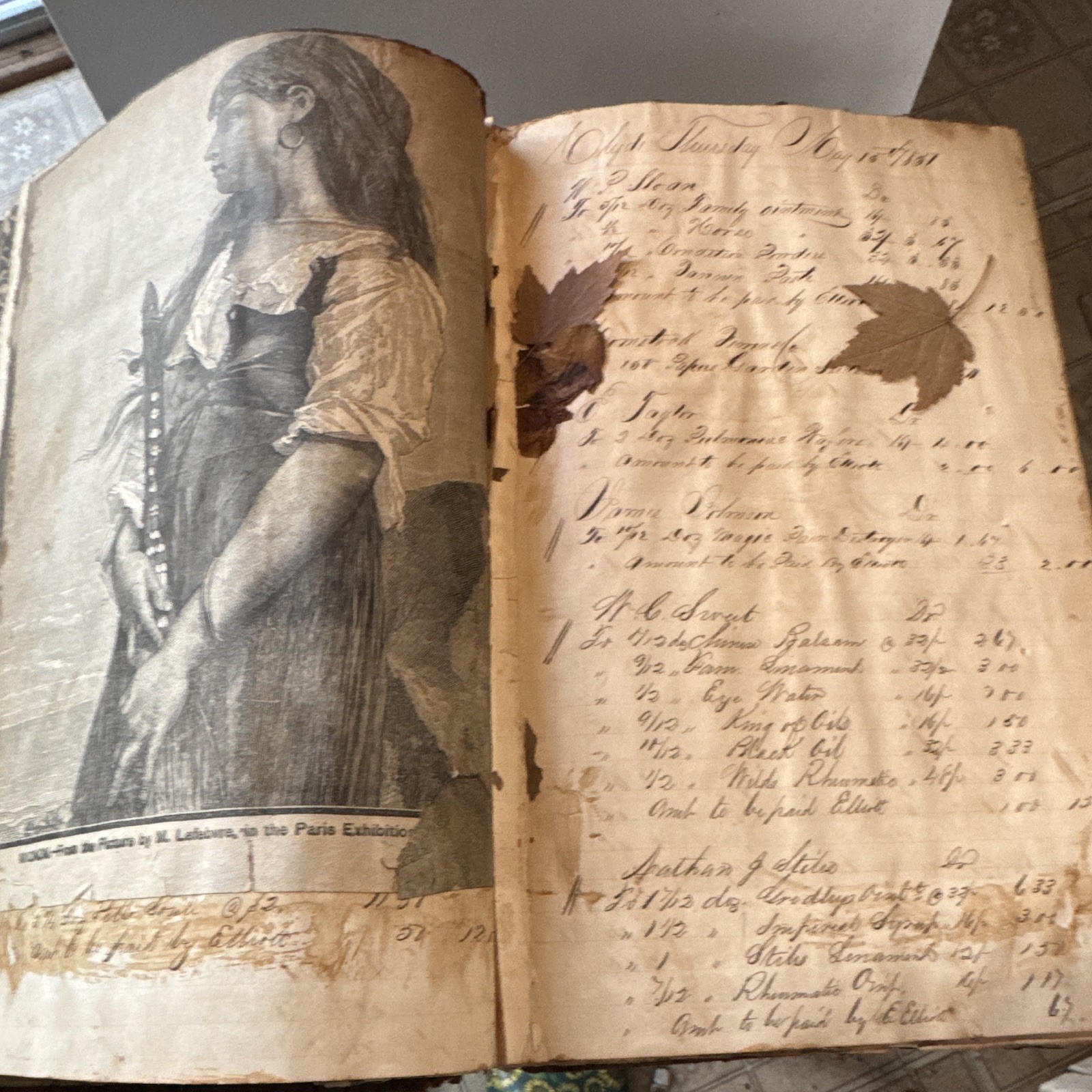
Originally a mid-19th-century commercial day book, later repurposed in the late 1870s or afterward as a personal Victorian scrapbook containing newspaper and magazine clippings, engravings, poetry, music, art reproductions, political material, and pressed botanical specimens.I would say 1/8 of the book has been converted to a scrapbook while the remaining pages are the day book entries. The spine is detached from the book. No gorilla glue must touch this treasure. The accounting entries underneath are older than much of the pasted material, which means this book had at least two distinct lives. Business first. Memory cabinet second.The clearest dating clue is “The Orphan” by J. Parker. I found that exact image listed in The Illustrated London News for March 23, 1878. * engraved art reproductions
* poems and moral verses
* songs and sheet music
* serialized or illustrated stories
* sentimental domestic scenes
* theatrical or art-exhibition images
* political and humorous newspaper material
* even pressed leavesThe sheet music page is especially good. It’s not just a clipped lyric. They preserved the actual printed score, and the visible text has that Victorian parlor-song quality. Then right beside it are illustrated narrative pieces like “Auntie’s Birthday.” That juxtaposition feels very personal, almost like somebody was collecting things they enjoyed rather than documenting one subject.And then we get “The Orphan”, which is wonderful because the source is traceable. The Illustrated London News was publishing art engravings from current exhibitions, so whoever pasted this in was essentially saving an art print from a major illustrated periodical. The page with “MIGNON — From the Picture by M. Lefebvre, in the Paris Exhibition” is another art-world clipping, not filler. It points toward the same appetite for reproduced paintings and exhibition imagery.