When you click on links to various merchants on this site and make a purchase, this can result in this site earning a commission. Affiliate programs and affiliations include, but are not limited to, the eBay Partner Network.
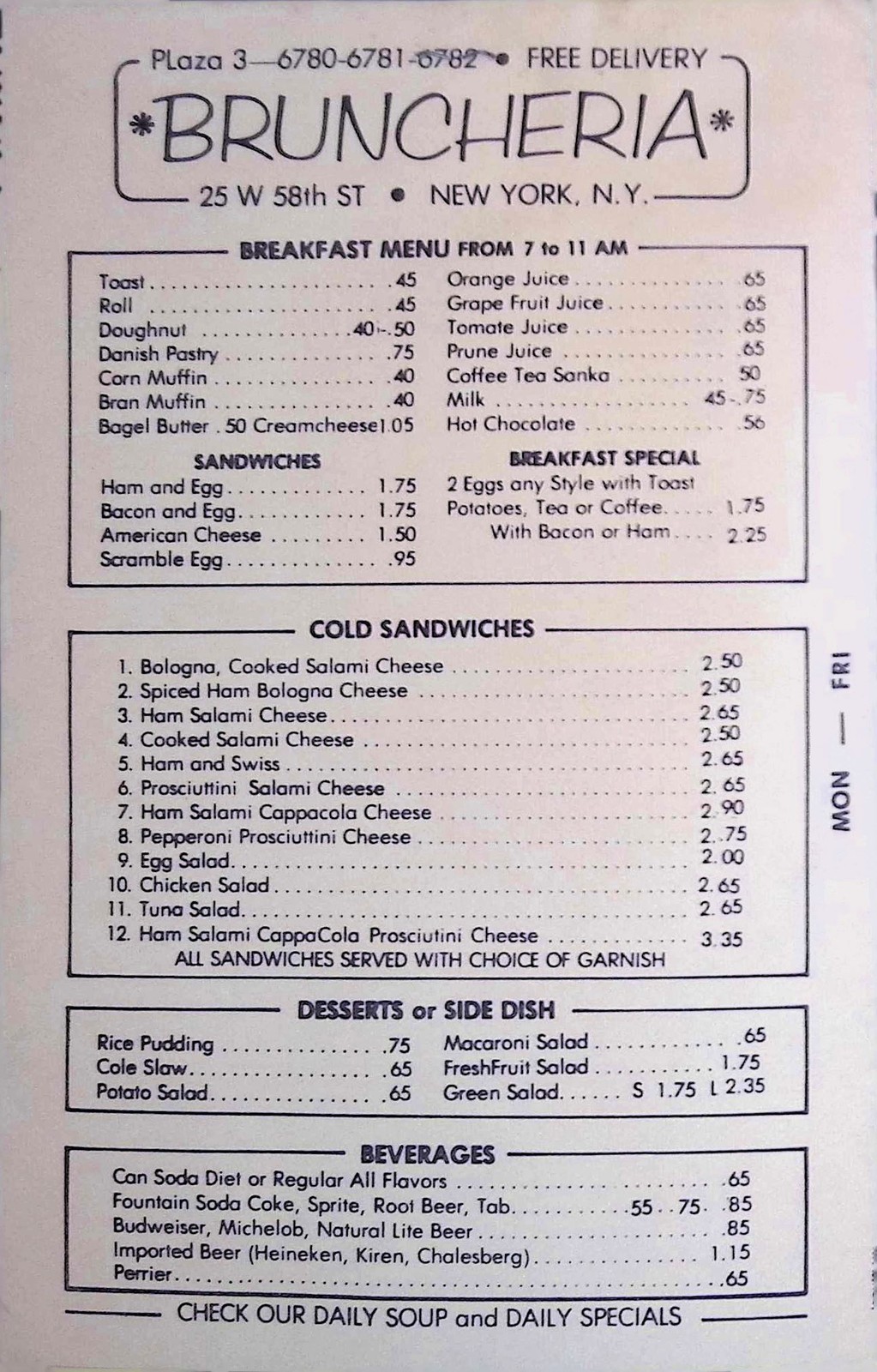
This single-sheet menu from the Bruncheria, a restaurant operating in the mid-20th century, offers a vivid snapshot of American casual dining culture and commercial printing practices of the era. The menu is designed as a bifold, intended for take-out or counter service, and its layout is a composite of a pre-printed main menu and a handwritten insert listing daily or weekly specials. The typography is a mix of bold, large-format sans-serif fonts for the restaurant name and category headers, contrasted with smaller serif typefaces for the item descriptions and prices, a common hierarchy in mid-century commercial printing. The design employs a simple, functional aesthetic, with the primary illustration being a stylized, line-drawn depiction of a cheerful chef, rendered in a single color, likely a brown or rust tone, which is repeated on the front cover. The overall paper stock is a lightweight card, showing signs of age with minor edge wear and toning, but the printed text and handwritten additions remain legible.The Bruncheria’s menu is a curated list of American comfort food classics, with a notable emphasis on eggs, omelets, and sandwiches. A transcription of the main menu reveals a structure starting with “Eggs & Omelets,” priced from $0.65 to $0.85, including items like “Western Omelet” and “Ham Omelet.” The “Sandwiches” section features staples such as “Grilled Cheese” at $0.45, “Ham & Cheese” at $0.60, and “BLT” at $0.55. A section for “Beverages” lists coffee at $0.10, milk at $0.15, and a selection of fountain drinks like “Coca-Cola” and “Root Beer” at $0.10. The handwritten specials, likely added by a server or manager, include “Roast Beef Dinner” at $1.50 and “Meat Loaf” at $1.25, offering insight into the daily operations and pricing flexibility of a small, independent restaurant. The prices, ranging from ten cents for a coffee to a dollar fifty for a dinner plate, firmly date the menu to the late 1940s or early 1950s, a period of post-war economic expansion and the golden age of the American diner and luncheonette. The absence of a specific geographic location on the menu suggests it was a local establishment, possibly in a small town or a suburban strip, where such details were known to the regular clientele. This menu is a tangible artifact of the mid-century American restaurant industry, documenting the menu architecture, pricing strategies, and graphic design conventions of a bygone era of casual dining.