When you click on links to various merchants on this site and make a purchase, this can result in this site earning a commission. Affiliate programs and affiliations include, but are not limited to, the eBay Partner Network.
Ever Wonder What a 19th-Century Peace Treaty Looked Like on Paper? 🚂
Somewhere in the autumn of 1885, on a private yacht anchored in the middle of the Hudson River, one of the most consequential deals in American railroad history was struck between men who could not afford to be seen shaking hands on land. What came out of that meeting is the reason this bond exists at all — and the reason it carries a promise so extraordinary that you'll want to read it twice: a maturity date more than four and a half centuries in the future. This is not a decorative reproduction. It is an original, engraved financial instrument from the West Shore Railroad Company, born out of one of the fiercest corporate rivalries the Gilded Age ever produced.
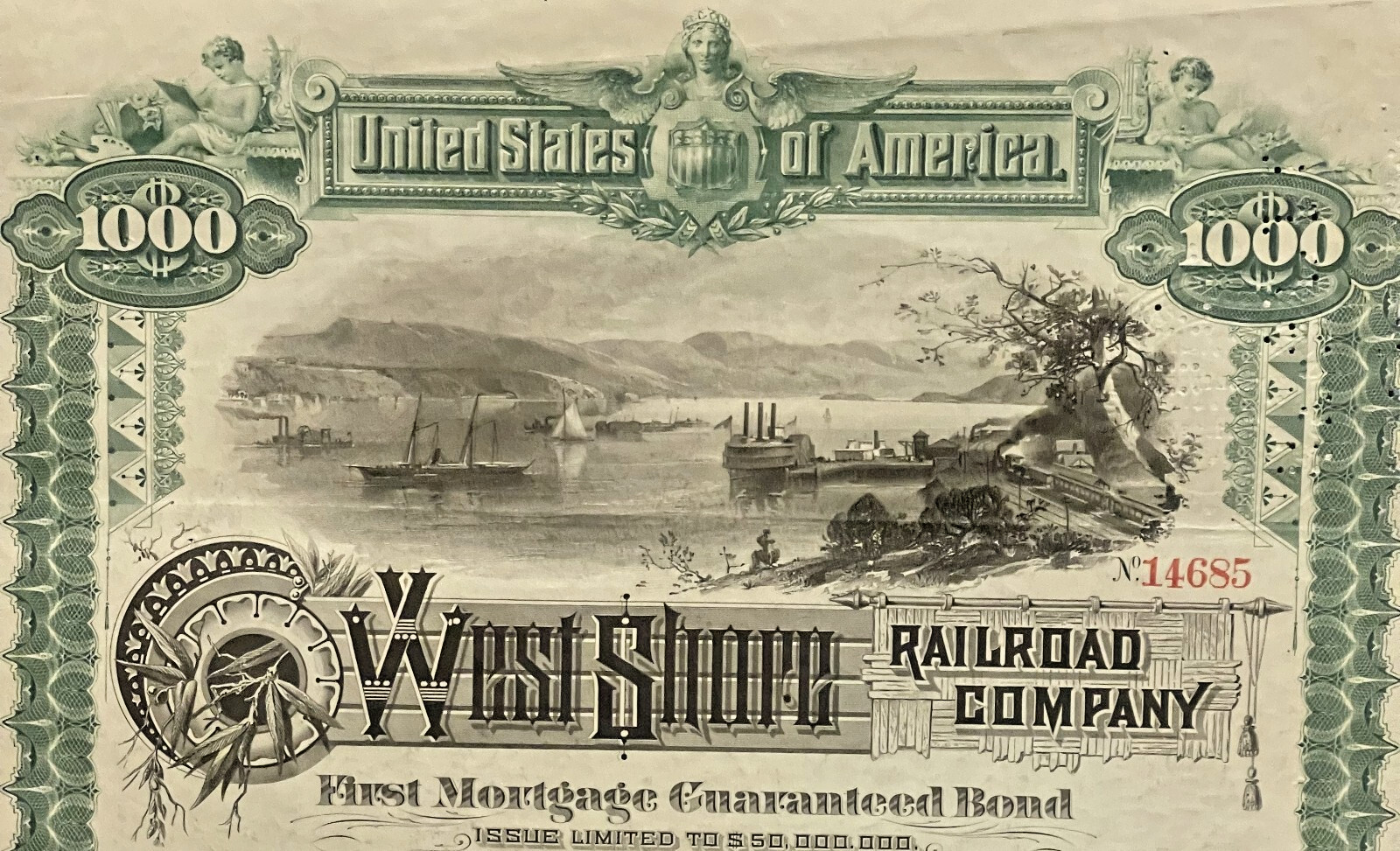
This is a genuine 1885-dated $1,000 First Mortgage Guaranteed Bond issued by the West Shore Railroad Company, part of an issue capped at $50,000,000 and printed by the American Bank Note Company of New York — the same firm entrusted with engraving U.S. currency and the most important corporate securities of the era. The certificate is a study in Gilded Age craftsmanship: a banner reading "United States of America" crowned by a winged allegorical figure flanked by cherubs, deep green guilloche scrollwork bordering the entire sheet, and $1,000 medallions anchoring each corner. Center stage is a hand-engraved vignette of the Hudson River — steamboats and a lone sailboat drifting past mountain bluffs, paddle-wheelers docked along the shore, and a steam locomotive threading its way along the water's edge with smoke trailing behind it, evoking the very stretch of river this railroad was built to conquer. Below the vignette, ornate lettering spells out "West Shore Railroad Company, First Mortgage Guaranteed Bond," and the certificate's printed text is set inside an engraved rosette so intricate it borders on lacework. A second, smaller locomotive vignette — a wood-burning engine with cowcatcher, headlamp, and bell, workers loading baggage at trackside — appears elsewhere on the document, and the original semi-annual interest coupons, each engraved for twenty dollars in gold, remain attached along the top of the sheet, each one printed with its own due date and bearing the same allegorical figure motif in miniature.
🛤️ The Railroad Built to Start a War
The West Shore Railroad Company was not conceived as a humble regional line. It was conceived as a weapon. Chartered to run along the west bank of the Hudson River from Weehawken, New Jersey — directly across the water from Manhattan — north through the river valley to Albany and then west through Utica, Syracuse, Rochester, and on to Buffalo, the West Shore was laid out to run parallel, mile for mile, with William Henry Vanderbilt's New York Central Railroad on the river's eastern shore. Its entire purpose was competitive pressure: undercut Vanderbilt's rates, threaten his freight monopoly along the Hudson corridor, and force a reckoning.
The reckoning came fast, and it came for both sides. The rate war the West Shore ignited was brutal enough that fares between New York and Buffalo were said to have collapsed to a dollar or two during the worst of it — a bloodletting that hollowed out revenues for every railroad involved. The West Shore itself, weighed down by construction costs for track, tunnels, and bridges through some of the most difficult terrain in the Hudson Valley, slid into bankruptcy and receivership within just a few years of its founding. It had won the fight and lost the war in the same stroke.
⚓ The Corsair Agreement: A Treaty Signed on the Water
What happened next is the stuff of Wall Street legend. J. Pierpont Morgan, already the era's most powerful financier, invited the presidents of the New York Central and the Pennsylvania Railroad aboard his steam yacht Corsair for a meeting conducted quite literally above the fray — anchored on the Hudson River itself. The terms that emerged, remembered ever since as the Corsair Agreement, called for the New York Central to absorb the failed West Shore Railroad rather than let it fall into rival hands, while the Pennsylvania Railroad in turn agreed to abandon its own competing South Pennsylvania Railroad project, which threatened New York Central territory from the other direction. It was industrial peace, brokered not in a boardroom but on the water, and it set the template for the kind of banker-mediated consolidation that would define Morgan's career for decades to come.
This bond is a direct artifact of that settlement. Under the terms of the reorganization, the New York Central and Hudson River Railroad Company took over the West Shore's operations under an extraordinarily long lease and guaranteed the interest and principal on its mortgage bonds — which is exactly why this certificate reads "Payable at the Office of the New York Central and Hudson River Railroad Company" and carries a "Guarantee" endorsement rather than standing on the credit of the West Shore alone. And that lease term explains the single detail that stops every collector cold: the printed maturity date of January 1, A.D. 2361. It was not a typo or a flourish. It reflected a lease running so far into the future that, for all practical purposes, the obligation was treated as perpetual — a number so audacious it turned a routine mortgage bond into a genuine curiosity of American finance.
🌄 The Hudson River Route
The vignette engraved across the top of this bond is not generic scenery — it's a tribute to the very river the West Shore was chartered to run beside. In the 1880s, the Hudson River corridor north of New York City was already famous, sometimes called America's Rhine for its steep bluffs, river towns, and steamboat traffic, decades after Robert Fulton had proven steam navigation on these same waters. The West Shore's rails followed that river north through towns like West Haverstraw, Cornwall, Newburgh, Kingston, and Catskill before angling west toward Albany and the long run to Buffalo — engineering work that included tunnels blasted through the Palisades at Weehawken and bridgework across some of the valley's toughest crossings. The bond's engraved scene of paddle-wheelers, a lone sailboat, and a train winding along a rocky shoreline captures exactly the world this railroad was chasing: river commerce and rail commerce competing for the same narrow strip of land.
🎩 The People Behind the Rivalry
The names tied to this story read like a roll call of Gilded Age power. William Henry Vanderbilt, son of Cornelius Vanderbilt and steward of the New York Central empire, saw the West Shore as an existential threat to the railroad his family had built into the dominant force along the Hudson. J. Pierpont Morgan, the deal's architect, used the Corsair Agreement to cement his reputation as the man who could force even the most stubborn industrial titans to the table — a role he would repeat again and again in the decades that followed. General Horace Porter, a Union Army veteran and one of Ulysses S. Grant's wartime aides, lent his considerable public standing to the West Shore's leadership during its formative years. And Chauncey Depew, the New York Central's longtime president and later a U.S. Senator, was deeply involved in the negotiations that folded the rival line into Vanderbilt's system. Every signature and seal on this certificate sits downstream of that boardroom drama.
✂️ Clipping Coupons: A Vanished Ritual
The small twenty-dollar gold coupons still attached to this bond are a physical relic of a financial ritual that has all but disappeared. Twice a year — January and July — bondholders in the 19th century would literally clip a coupon free from the sheet and present it at the designated office, in this case the New York Central and Hudson River Railroad Company's offices in New York City, to collect their semi-annual interest payment in cash. It's where the modern phrase "clipping coupons," still used today to describe passive income, comes from — and holding a sheet where that ritual was built into the paper itself is about as tangible a connection to 19th-century finance as a collector can get.
🏛️ The Legacy Today
The West Shore Railroad's independence didn't survive the rate war, but its rails did. Absorbed into the New York Central system under the terms born aboard the Corsair, the West Shore line continued hauling freight and passengers along the Hudson's western bank for generations, eventually passing through Penn Central and into the modern era under later successor railroads. Bonds like this one were the financial backbone that made that construction possible in the first place, and because so many were redeemed and destroyed once their obligations were settled, surviving examples — especially ones still carrying their original coupon sheets — offer a genuinely tactile link to one of the defining boardroom dramas of the American railroad age.
📜 The Coupon Sheet, and What the Marks Mean
A bond that still has its coupon sheet is the complete instrument rather than the pretty half of it. Most surviving railroad bonds were stripped of their coupons decade by decade, one clipping at a time, until only the certificate was left, so a sheet that came through that attrition is a survivor of a century of small subtractions. The coupon count can be a few more or a few fewer than pictured. When a road went under, holders very often taped the last clipped coupon back onto the sheet and put the bond away, still hoping to collect what they were owed — families had been living on those payments, and a bond that still carries that taped-back coupon is the better one to end up with.
Stock and bond certificates carry financial writings, markings, stamps, hole punches and staples as part of the life of the instrument. Endorsements and signatures, transfer-agent and registrar stamps, revenue or documentary tax stamps, punch or cut cancellations applied at redemption, staple holes from being bound into a transfer book, pencil ledger notations — that is the paper trail of a working financial instrument, not a list of flaws. A clipped coupon run is a positive: it is the proof that the bond paid its holder, year after year, before the road failed.
These are held as a group, and no two are alike. Serial numbers, the exact run of coupon dates, the placement and pattern of punch cancellations and stamps, a clerk's pencil marks, the folds and toning of decades in a bank file — all of it changes from one example to the next. Treat the photographs as an example of the type rather than a portrait of one specific sheet. What ships is its own document, individuated by a century of handling that happened to it and to nothing else. That is the appeal of the class, not a caveat.
🖼️ Display Ideas
- 🖋️ Frame it flat under glass to showcase the full engraved vignette and coupon sheet together
- 📚 Set it on a library or study shelf alongside other Gilded Age financial ephemera
- 🏢 Hang it in a home office or den as a conversation piece about American business history
- 🚂 Pair it with other railroad memorabilia for a themed transportation history display
- 🎓 Use it as a teaching artifact for lessons on Gilded Age finance and the railroad wars
- 🖼️ Display it near a map of the Hudson Valley to trace the original route it financed
🎁 Who Collects These
Scripophily collectors — those who gather antique stocks and bonds as historical art — seek out West Shore Railroad certificates specifically because of the Corsair Agreement story behind them. Railroad history enthusiasts and Hudson Valley history buffs value the engraved river vignette and the tangible tie to the region. Gilded Age and Wall Street history collectors are drawn to the connection with Vanderbilt, Morgan, and Depew. Engraving and security-printing collectors appreciate the American Bank Note Company craftsmanship on display here. And because this piece works equally well framed for an office, a study, or a railroad-themed collection, it draws gift buyers looking for something with genuine historical weight behind it.
❓ FAQ
Is this an original bond or a reproduction?
This is an original, period-engraved 1885 First Mortgage Guaranteed Bond issued as part of the West Shore Railroad Company's $50,000,000 authorized issue, printed by the American Bank Note Company.
Why does the bond say it's due in the year 2361?
That maturity date is printed on every certificate in this issue and reflects the extraordinarily long lease term the New York Central and Hudson River Railroad Company assumed when it took over the West Shore's obligations following the Corsair Agreement — effectively treating the bond as a near-perpetual instrument.
What is a "gold bond"?
In the 19th century, gold bonds specified that principal and interest be paid in gold coin rather than paper currency, offering investors protection against currency fluctuation — a common and reassuring feature on major railroad mortgage bonds of this era.
What are the small coupons attached to the certificate?
Those are the original semi-annual interest coupons, each redeemable for a set dollar amount at the designated railroad office on its printed due date — the literal source of the phrase "clipping coupons."
What is the Corsair Agreement, and why does it matter here?
It was the 1885 settlement, brokered by J.P. Morgan aboard his yacht Corsair, in which the New York Central absorbed the financially struggling West Shore Railroad while the Pennsylvania Railroad abandoned a competing line — the deal that gave rise to this bond's guarantee by the New York Central and Hudson River Railroad Company.
Who printed this certificate?
The American Bank Note Company of New York, the premier security engraving firm of the era, responsible for the fine detail work seen across the vignettes, borders, and lettering.
What does the river scene on the certificate depict?
It's an engraved view of the Hudson River corridor — steamboats, a sailboat, and a train along the shoreline with mountains behind — evoking the very stretch of river the West Shore Railroad was built to run alongside.