When you click on links to various merchants on this site and make a purchase, this can result in this site earning a commission. Affiliate programs and affiliations include, but are not limited to, the eBay Partner Network.
Kates Lower Permian – Boskovice, Czech Republic
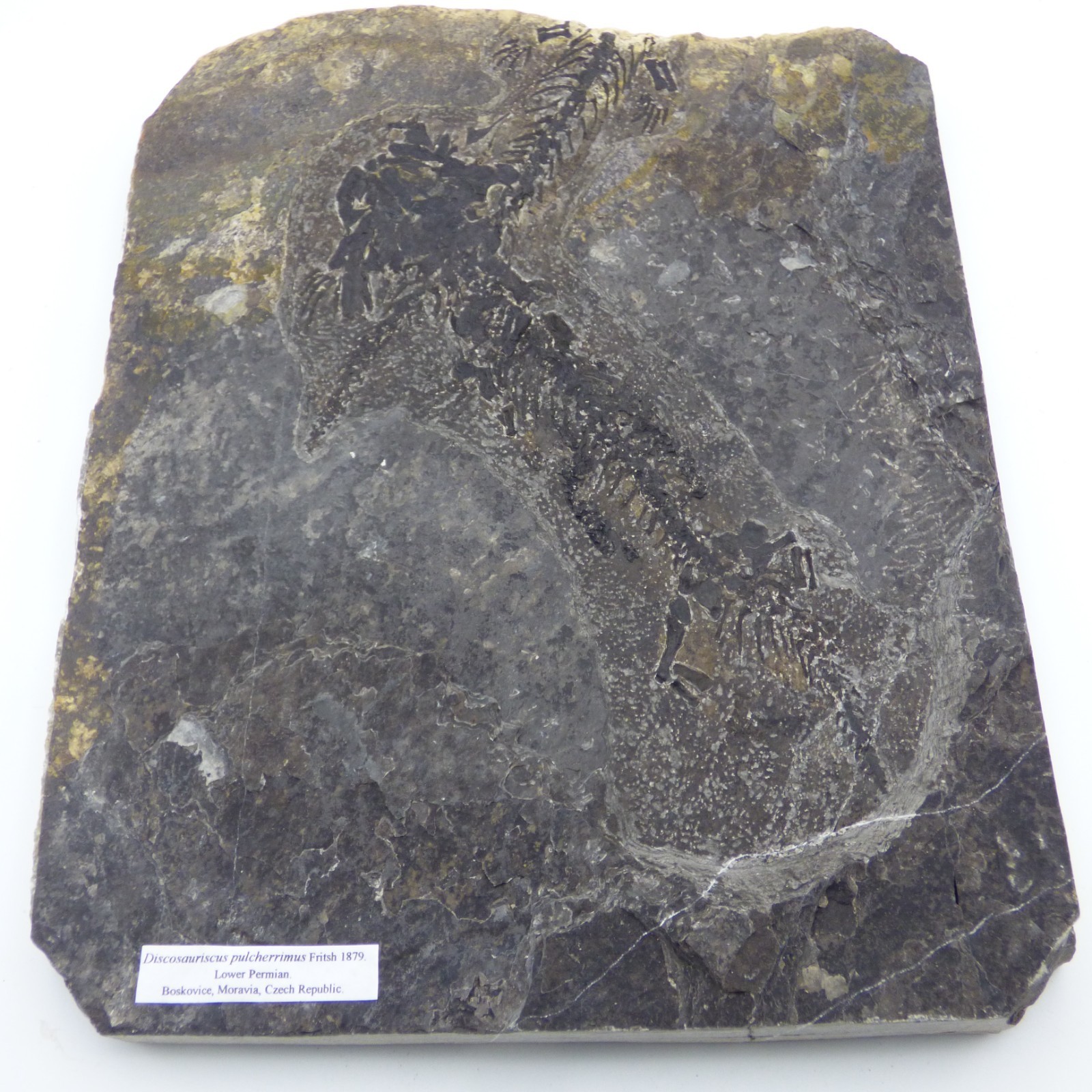
Species:Discosauriscus pulcherrimus Fritsch, 1879
Age: Lower / Early Permian
Location: Boskovice Basin, Moravia, Czech Republic
Formation: Limnic deposits
Slab size:approximately 24 × 18.5 cm
Weight: approximately 1.8 kg
Aninteresting Lower Permian fossil slab containing the remains of Discosauriscus,a small seymouriamorph tetrapod from Central Europe.
The slabcontains one virtually complete articulated specimen, with much of the skeletonclearly visible, including the skull, vertebral column, ribs, limbs and longtail. There are also additional remains from a second individual, including thetail/rear portion, making this an especially interesting association.
Discosauriscus was a relatively small earlytetrapod which lived during the Lower Permian. Juvenile individuals wereaquatic and are known to have possessed external gills and a lateral-linesystem, while more mature animals became increasingly adapted to life on land.They are generally placed among the seymouriamorphs, an important group ofearly tetrapods showing a mixture of features associated with amphibian andmore terrestrial forms.
TheBoskovice Basin in Moravia is particularly well known for fossils of Discosauriscus.The animals were preserved within fine sediment deposited in freshwaterenvironments. Over geological time, burial and compression flattened theremains into the thin dark layers in which they are now found.
The skeletalmaterial has undergone carbonisation, producing the dark fossil remains visibleagainst the surrounding rock.
This is asizeable display specimen at 24 × 18.5 cm and weighing approximately 1.8 kg.
Condition: Pleasestudy the photographs carefully, as they form an important part of thedescription. The slab has natural cracks, edges and surface features consistentwith a fossil of this age and type. There is a diagonal repaired crack on reverse which you can see in the photograph.
Comes with a large acrylic display stand.
code 100-1010
What is a Fossil?
Fossils give fascinating prehistorical evidence of past life on our planet.
Usually, fossilization starts once the animal or plant has died. Most animals and plants are eaten or simply recycled back into the earth. The best fossils occur when this process happens rapidly, shortly after death has occurred. Conditions have to be exactly right for a fossil to be produced. Most commonly, this is below water. Decay and deterioration are slowed down because the specimen is covered or entombed in either sediment, muds, sands or volcanic ash or other material, layer upon layer, and over a period that is hard to imagine, usually thousands to millions of years.
Preservation takes place very gradually, as it compacts, it slowly turns to rock. Over time, the plant or animal is replaced by minerals and with chemical changes, leaving an extraordinary replica of the original. In some cases, the pressure and temperature increase, caused by sedimentation, can result in the release of hydrogen and oxygen, leaving a carbon impression of the specimen in sedimentary rock. This process is called carbonization.
Fossils can become preserved in various different ways. For example, wood can become petrified by a process of minerals seeping into the saturated wood, resulting in a gradual process of the wood becoming hard, and resembling stone, often with extraordinary colours. In perimineralization or petrification, after the soft structures have decayed, the hard parts, in particular bones, remain. In some cases, the other minerals completely replace the original specimen. Generally, most fossils represent the hard parts such as bones, shells, leaves, seeds or woody parts of plants.
Fossils can be internal or external moulds of the original specimen. They can also be the some of the original matter, impregnated with chemicals such as silica or calcite.
Fossils can also be indirect, such as in animal foot prints or burrows. These are known as trace fossils.