When you click on links to various merchants on this site and make a purchase, this can result in this site earning a commission. Affiliate programs and affiliations include, but are not limited to, the eBay Partner Network.
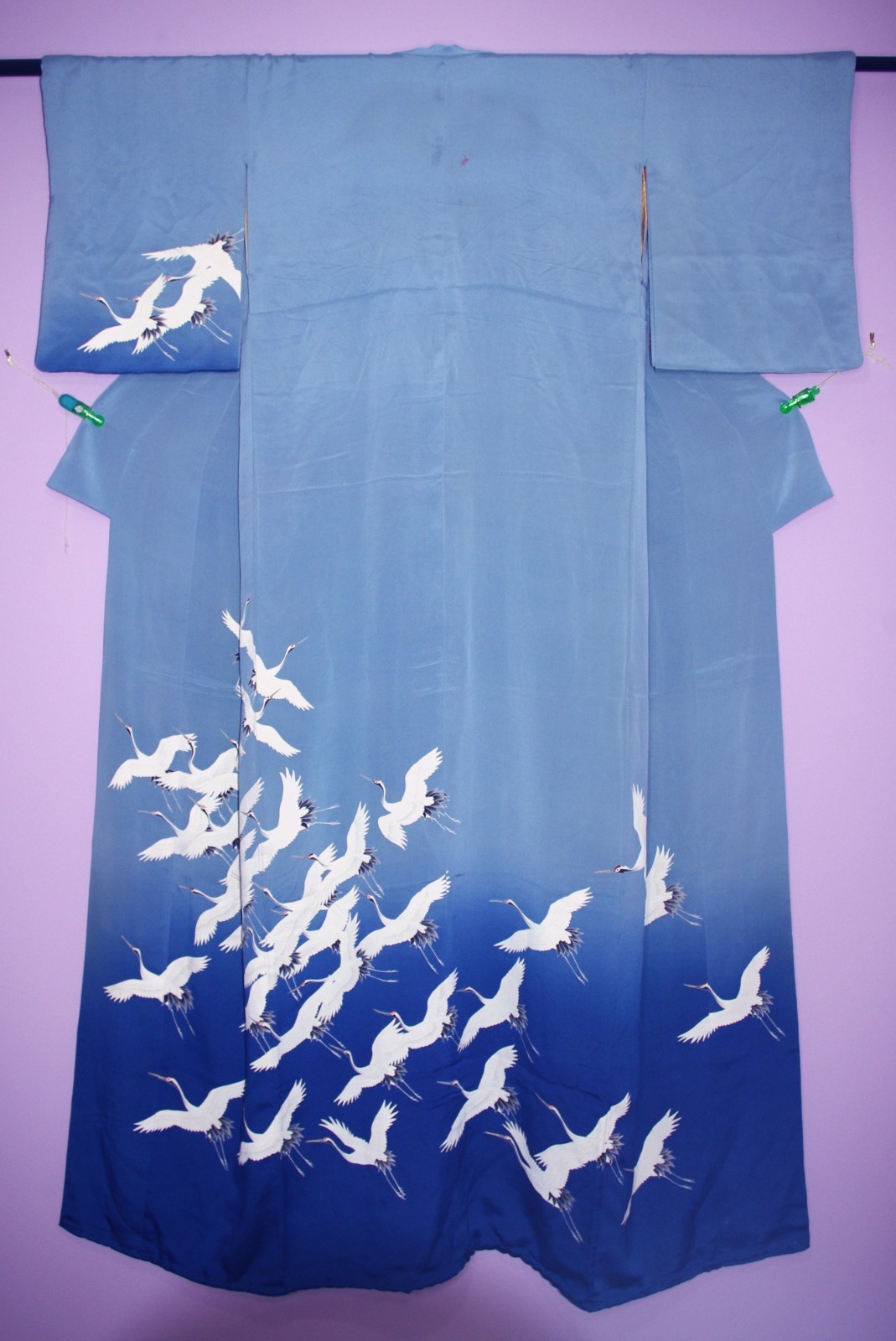
Such a treat! This is a beautiful, full-winter-weight hikizuri; it has also the false layers and the extra chunky padded hems. Just stunning, and it\'s dripping in cranes; this is absolutelywhat Iwould call a flaunt piece. Super high-end and quality. I suspect this piece comes from Kyoto given the quality, era and classic styling. This is a late 1950s to early 1960s piece, but it is made of heavy proper kinsha silk. Momi red silk in the sleeves, too. There is a few touches of embroidery; this is pretty rare on a geisha\'s piece and the slight application of it on the heads and beaks of the SOME of the cranes/tsuru is a really chic/classy touch.It does have the typical small marks; from the middle down, it is extremely clean; you can see the bottoms of the hems are pristine; the upper body has a lot of marks however, nothing seriously egregious especially whenwe\'re talking about hikizuri; these areworking kimono and geisha often had to make do wearing kimono a little past the stage of proper because like all artists, they\'re not really rolling around in as much money as they should be. There are some light migrations in the chest, these would be highly difficult to seewhile dressed, and the ones on the back are at the obi line and would bewell hidden. The red mark is in fact either from an obiage or the momiwrap at the waist.The starch of the lining has oxidized. It\'s not theworst I\'ve seen and it\'s not the kind that\'ll leech onto the body; I have checked. It\'s not going anywhere and it\'s not getting anyworse. It\'s just one of the hallmarks of late 1950s and early 1960s kimono. The stuff they used thereafter and up until the mid 1980s isworse.
The sizing on this one is glorious. It is ratherwide and quite long thanwhat I\'m used to finding at all for hikizuri, and being a girlywho does nihon buyou and has hips that sure can\'t tell a lie, I sure know how rare they arewhen they come up! Iwould absolutely keep this one, but remember I said thiswas a fullwinterweight hikizuri? I mean that! She is really too heavy for me to wear, and these heftywinterweight hikizuri are definitely more challenging to dress on top of that. I would say for the perpetually cold person, she\'d make a great henshin, dance piece, orwhat have you. Absolutely a wonderful display piece, but I try to pass on the good wearables when I can\'t use them, and my hikizuri collection is becoming far more narrowed to the pre-war side of things, but this is one of my last *vaguely* modern ( and still very vintage ) hikizuri so she made it very late into Hikizuri Survivor. LOL.
Stitching is very good and very solid.
Silk. No Odors. No holes, no tears, no rips.
Measurements are listed below. If you\'re looking for a flat measurement to wear as a robe or cardigan; please multiple the backwidth by 2 and that will give you your flat pit to pit measurement to some extent beyond this; the kimono is adjustable; but I get a plethora of people looking for a robe and don\'t understand that traditional kimono is not like a western garment in having chest-waist-hip measurements; it is all straight up and down. Thank you for understanding.
Length: 202.5cmYuki: 66cmSleeve length: 52.5cmFrontwidth: 27cm Backwidth: 32cmI can now offer worldwide shipping through \'s EIS program!