When you click on links to various merchants on this site and make a purchase, this can result in this site earning a commission. Affiliate programs and affiliations include, but are not limited to, the eBay Partner Network.
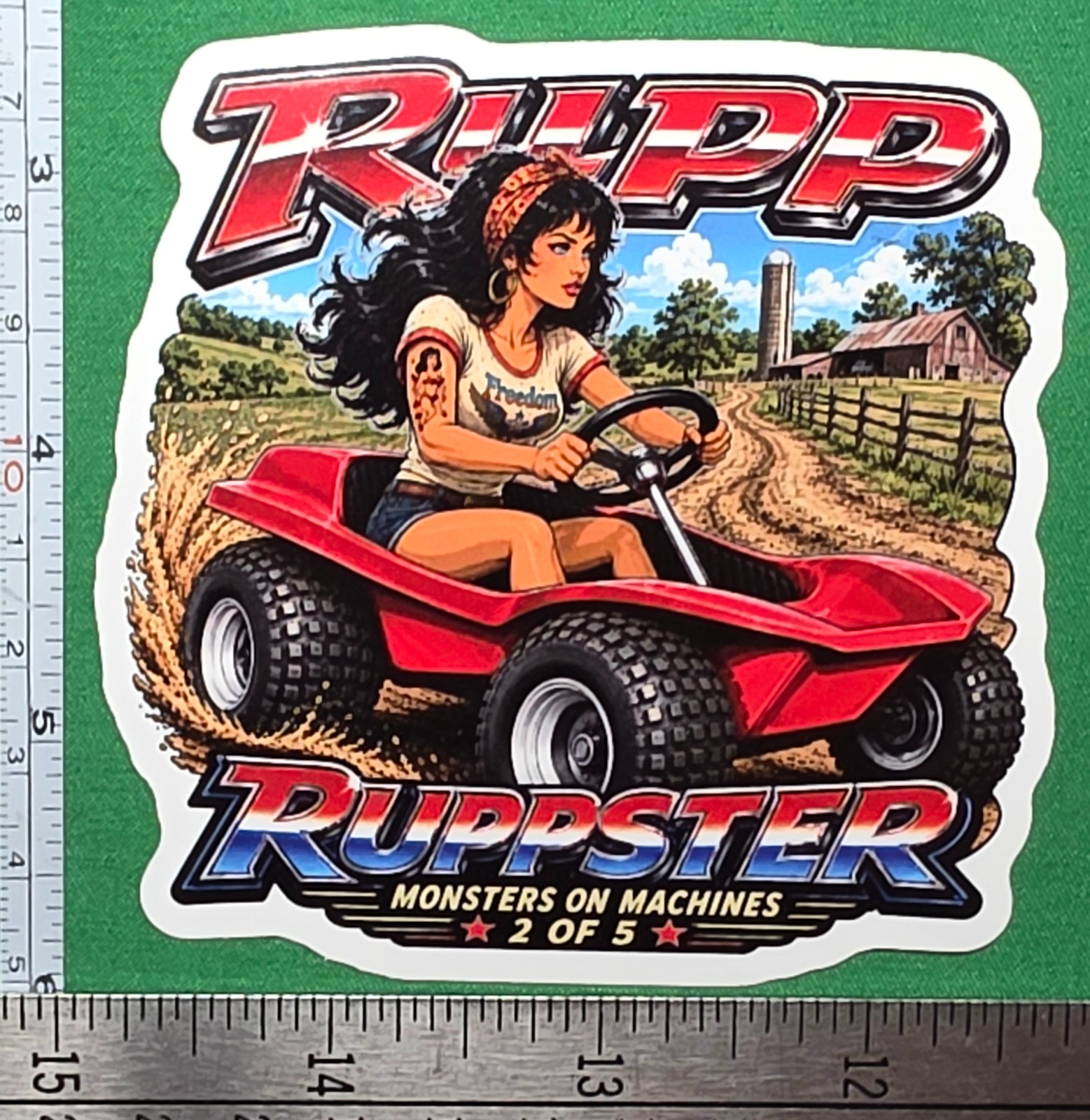
A colorful tribute to the Rupp Ruppster, one of Rupp's distinctive vintage four-wheel recreational machines.
This Monsters on Machines design features a red Ruppster kicking up dirt on a country farm road, combining classic vintage powersports with original illustrated artwork.
Details:Approx. 9 x 9 cm (3.5 x 3.5 in)Durable die-cut vinyl stickerFull-color illustrated artworkFeatures the Rupp RuppsterVintage four-wheel recreational vehicleRural farm action sceneMonsters on Machines 2 of 5Great for Rupp collectors, toolboxes, garage cabinets, coolers, laptops and trailers
Item SpecificsBrand: Monsters on MachinesType: Sticker / DecalTheme: Vintage PowersportsManufacturer Featured: RuppModel: RuppsterVehicle Type: Vintage ATV / Recreational VehicleMaterial: VinylSize: 9 x 9 cmFeatures: Die-CutColor: MulticolorSeries: Monsters on MachinesNumber in Series: 2 of 5
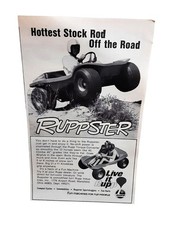
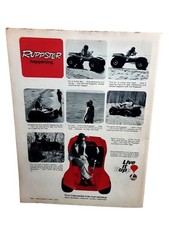
Rupp Ruppster — basic Industries, Inc.BrandRuppModelRuppsterAlso advertised asRuppster Mini-DuneBuggy / Mini Dune BuggyLater designationRuppster Baja 230Introduced1971Production eraApproximately 1971–1972CountryUnited StatesManufacturing baseMansfield, OhioVehicle type4-wheel recreational off-road vehicle / mini dune buggyCategory for our databaseATV / Mini Dune Buggy / Recreational 4-WheelerSeating2DriveRear-wheel driveBodyMolded red body; period references variously describe it as fiberglass/ABSTiresLarge 21 × 11 balloon-type knobby tiresTransmissionAutomatic variable-ratio drive using a Rupp torque converterClaimed grade ability45°Advertised top speed40+ mphOriginal priceAbout $1,000–$1,095
What exactly was the Ruppster?
Think of it as a grown-up off-road go-kart with a dune-buggy body.
Unlike an Amphicat, Attex, Argo or Terra Tiger, it wasn't a skid-steer amphibious AATV. And unlike the later Honda ATC-style machines, it wasn't motorcycle-derived.
Instead, Rupp built a compact four-wheel recreational machine around the company's considerable experience with go-karts, minibikes, snowmobiles and torque-converter drives. Contemporary descriptions call it a mini dune buggy, and Rupp literature used the wonderfully 1970s spelling “Mini-DuneBuggy.
Engine — here's where it gets interesting
You'll find conflicting Ruppsters online because apparently more than one engine configuration existed or surviving machines have frequently been repowered.
The particularly noteworthy version is:
Ruppster Baja 230
It used a:
- JLO 230 cc
- single-cylinder
- 2-stroke
- approximately 12 hp
- automatic Rupp torque-converter drive
The “230” in Baja 230 refers to the approximately 230 cc JLO engine.
Period aftermarket documentation independently identifies a Ruppster Mini-Dune Buggy with JLO 230 engine, which is useful corroboration that the JLO-powered version wasn't merely something restorers later created.
Some general Rupp histories simply describe the original Ruppster as having a 12-hp engine, Rupp torque converter, 40+ mph capability and the ability to climb a 45-degree grade.
Chassis and design
The Ruppster had a distinctly different layout from the typical AATV.
The driver and passenger sat side-by-side behind a small steering wheel rather than straddling a saddle. A tubular chassis supported the molded body, with the engine and drivetrain mounted toward the rear.
Those enormous 21 × 11 tires provided much of the machine's off-road capability.
Why Rupp built it
The Ruppster makes much more sense when you look at what Rupp was doing around 1970.
H. E. “Mickey” Rupp started Rupp Manufacturing in Mansfield, Ohio, in 1959, initially producing Dart go-karts. The company expanded into minibikes and then snowmobiles, becoming a major American recreational-vehicle manufacturer. By 1970, reported sales exceeded $30 million.
Rupp wasn't afraid of weird vehicles.
Besides the familiar:
Go-karts → minibikes → snowmobiles
they experimented with:
Ruppster → Go-Joe → Mini Go-Joe → Centaur → Rat → other prototypes
The Ruppster therefore wasn't an isolated experiment. It was part of a deliberate push to find new recreational vehicle categories.
Ruppster → Go-Joe connection
Rupp subsequently produced the Go-Joe, a much more ATV-looking machine using the same general concept of huge low-pressure tires and molded bodywork. General Rupp histories place the Go-Joe around 1973 and describe it with an 8-hp engine, while a smaller Mini Go-Joe used approximately 3½ hp.
Performance
For something that looks like a carnival ride today, it was pretty damn quick.
Rupp advertised:
40+ mph
and:
45-degree climbing ability.
Forty miles per hour in a tiny 1971 buggy sitting on four balloon tires with essentially nothing around you would have felt considerably faster than 40 mph.
Why the Ruppster matters
The Ruppster appeared roughly a decade before the four-wheel ATV market exploded. It wasn't a modern quad in the motorcycle-derived sense, but it combined several ingredients that later became commonplace:
four wheels + balloon off-road tires + compact dimensions + automatic variable drive + dedicated recreational off-road design.
It's basically one of those evolutionary dead-end machines that was nevertheless pointing in the right direction.