When you click on links to various merchants on this site and make a purchase, this can result in this site earning a commission. Affiliate programs and affiliations include, but are not limited to, the eBay Partner Network.
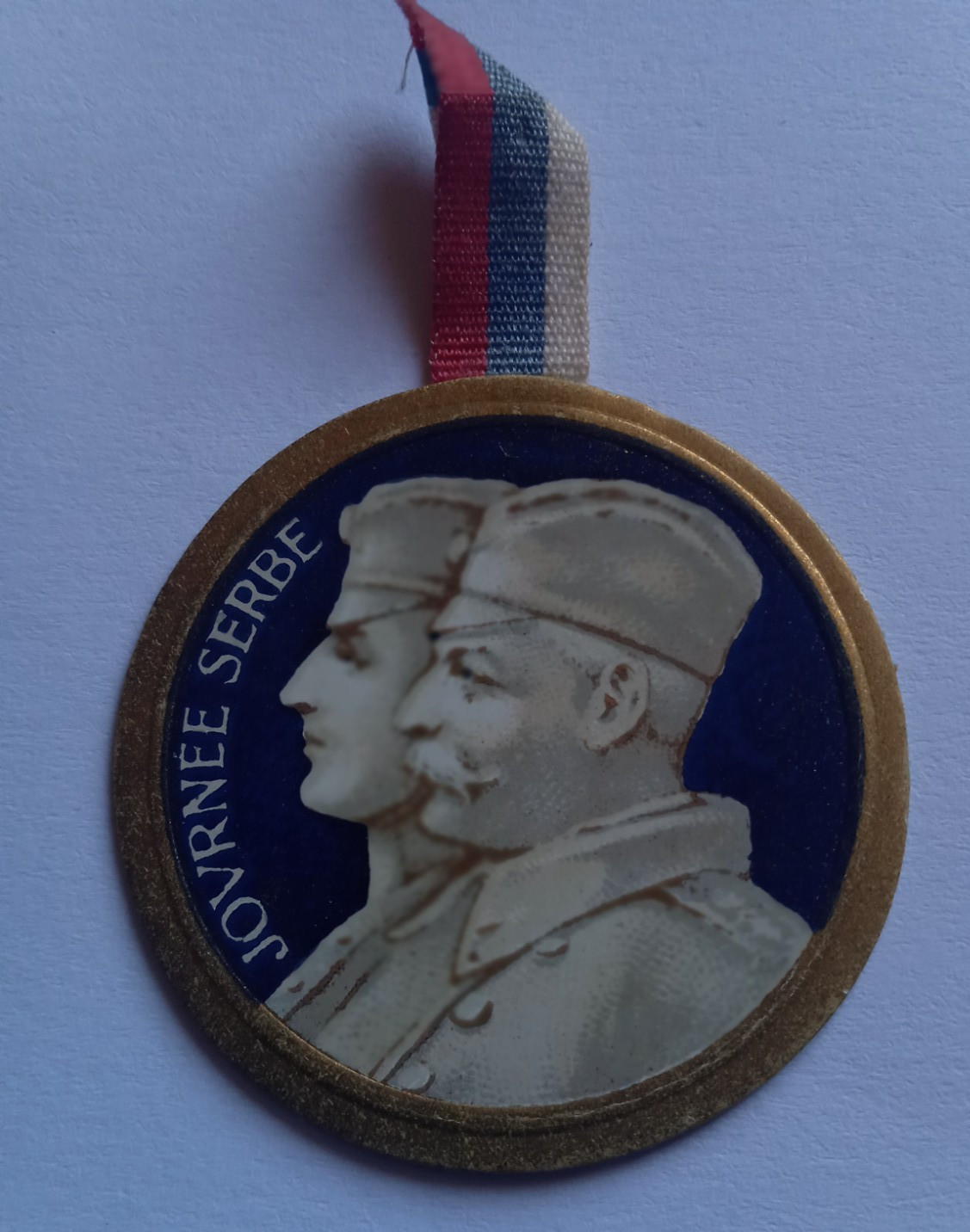
Obverse : conjoined busts of king peter I of Serbia and his son Alexander (who will succed him as Alexander I of Yugoslavia) in military dress & legend \"Journée Serbe\"
Peter I (1844 – 1921) was King of Serbia from 15 June 1903 to 1 December 1918. On 1 December 1918, he became King of the Serbs, Croats and Slovenes, and he held that title until his death three years later. Since he was the king of Serbia during a period of great Serbian military success, he was remembered by Serbians as King Peter the Liberator and also as the Old King.
Reverse : \"comité du secours national / 25 juin 1916\", printed by Devambez, Paris
Size: 36 mm or 1,35 x 1,4 inch.
These WW1 \"charity day\" fundraising souvenirs (cardboard insignia, thin stamped medals, pin badges,more rarely bronze or silver medals) were sold during the Great War to raise money for a variety of causes : mainly supporting the troops fighting on the various fronts, supporting the war effort, supporting wounded soldiers (or having caught tuberculosis), soldier\'s widows, orphans, thanking allied countries, etc...
During the first world war (1914-1918) and after the Victory until around 1920, numerous public collection days (\"journée\" in french language) were organized throughout France and its colonies to benefit soldiers, prisoners of war, orphans, disaster victims, the blind, for fight against tuberculosis, alcoholism, large families support, etc... During these national and local events, volunteer vendors offered passsersby small metal, cardboard or celluloid badges in exchange for a small donation. These modest items have been overlooked by collectors and have often disappeared. There were major national events, departments, cities, little towns and various private organizations who held their own collections throughout France, often offering simple flowers made of paper, celluloid or fabric and badge with or without any inscription. All these documents represent an indisputable value and represent a patriotic manifestation that would be called \"conditioning\" today but which, in this difficult period, was intended to maintain the morale of people on the home front and help sustain hope for Victory.