When you click on links to various merchants on this site and make a purchase, this can result in this site earning a commission. Affiliate programs and affiliations include, but are not limited to, the eBay Partner Network.
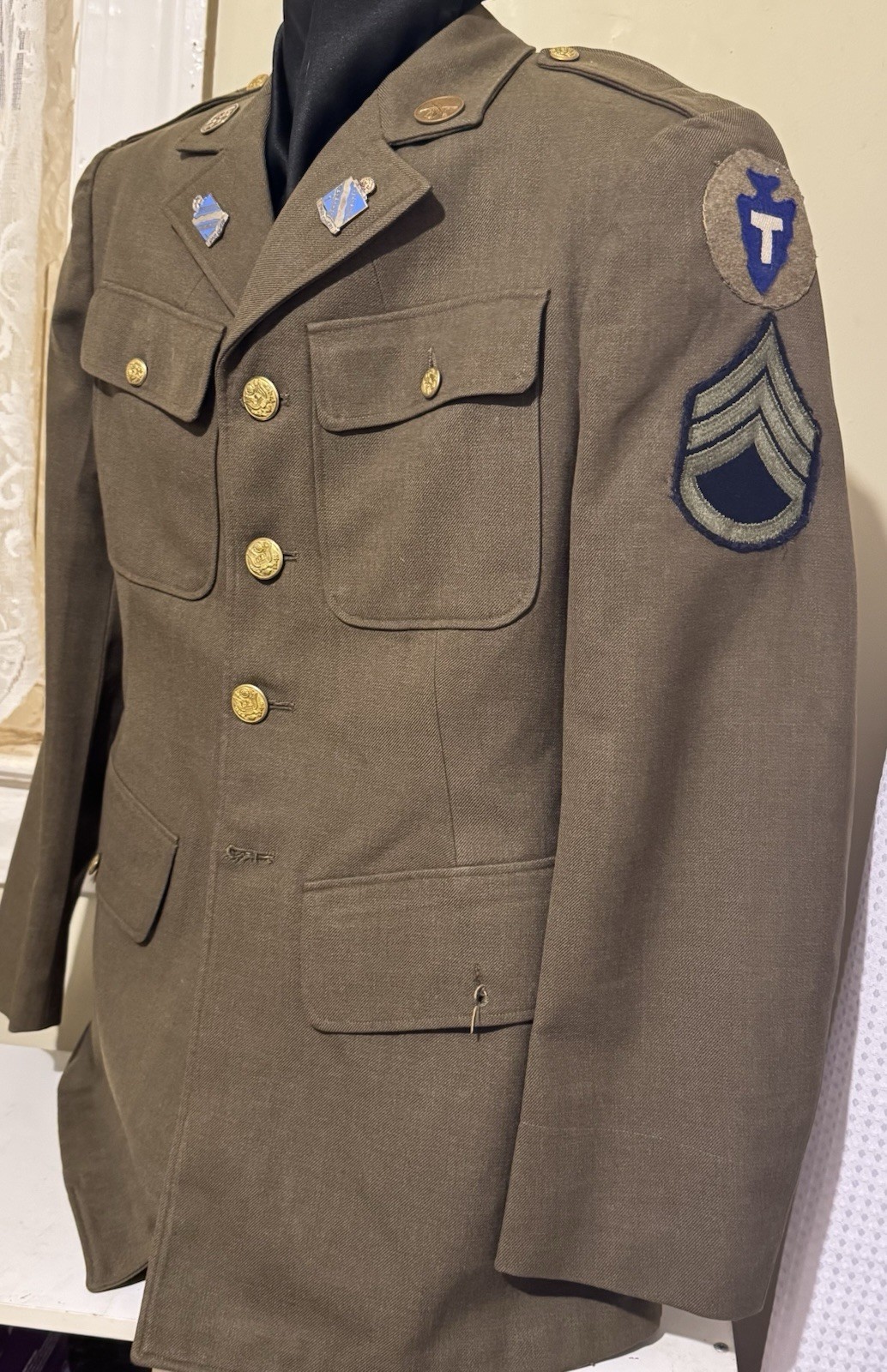
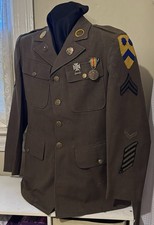
For your consideration is this Interwar Period;M1926 Spec 8-31B Enlisted “Whipcord” Wool Service Coat 144th Infantry Regiment, (4th TEXAS)
36th Infantry Division
Texas Army National Guard Description:
This particular coat is in great shape being a near mint specimen. 2 of it’s buttons have fallen off, but are in its pocket. I will reattach within the next day or two.The coat is made of a near mustard colored OD whipcord wool with a thicker OD, handkerchief material. It’s literally the exact same material of the inner lining of guidon sleeves manufactured by the PQMD.Condition:
0 through 10 with 0 being rags and 10 being museum-quality, this coat is a 9.5. It will be a 10 once I reattach the 2 buttons.The PQMD tag has fallen off, but it does not affect the quality of the coat.You can see where the tag was. You can tell by the stitch outline at the inside lining at the bottom right side of the coat.This coat doesn’t have any pinholes or mothing holes that I have noticed.HISTORY OF THE 144th Infantry Regiment
(4th TEXAS)
1921-1939The history of the 144th Infantry Regiment (historically known as the 4th Texas Infantry) spans from its militia roots in 1880 through World War II and its immediate postwar reorganization:Origins & Early Service (1880–1917)• April 1880: Formed from six initial companies of the Texas Volunteer Guard (later designated the 4th Texas Infantry).• Spanish-American War: Briefly redesignated as the 2nd Infantry before returning to state service in 1898 and reverting to the 4th Infantry in 1903.• Mexican Border Service (1916): Mobilized in May 1916 for border patrol duties covering a 600-mile stretch across the Big Bend region before mustering out in early 1917.1) World War I (1917–1919)• October 1917: Reconstituted and consolidated with the 6th Texas Infantry to formally create the 144th Infantry Regiment, assigned to the 36th Division.• Service in France: Deployed to France with the 36th Division and saw heavy combat during the Meuse-Argonne Offensive, suffering 369 casualties.• Demobilization: Mustered out and demobilized in June 1919.2) Reorganization and LeadershipFollowing its demobilization after WWI, the regiment was officially reconstituted in the National Guard on December 3, 1920.• Federal Recognition: Reorganization began in 1921, and all units achieved full Federal recognition by May 1922.• Headquarters: The regimental headquarters was initially established at Fort Worth in 1922, but was later relocated to Dallas on March 16, 1937.• Commanders: Colonel Holman Taylor commanded the regiment for the vast majority of this era (1921–1936). Following his promotion to Brigadier General, leadership eventually passed to Colonel William E. Lake in 1938, who guided the unit through the end of the interwar period.3) State Guard and Disaster Relief DutiesBecause the United States was at peace, the 144th Infantry spent these years answering the call of the Governor of Texas for emergency response, strike management, and civil unrest:• Riot Control (Dallas & Sherman): Deployed to handle localized riots in Dallas (May 1925) and crowd control during severe civil unrest in Sherman, Texas (May 1930).• Tornado Relief (Oak Cliff & Frost): Dispatched to provide emergency aid, security, and storm relief after devastating tornadoes tore through areas like Oak Cliff (1933) and Frost, Texas.• New London School Explosion (1937): Provided critical disaster assistance and security following the catastrophic natural gas explosion at the New London High School, which killed over 300 students and teachers.• Oil Field Fires (Kilgore): Deployed in January 1938 to assist with firefighting efforts and crowd control during major oil field fires.• Labor Strike Duty (Texarkana): Deployed in June 1939 for riot control during a turbulent workers' strike on the Missouri–Kansas–Texas Railroad.4) Interwar TrainingThe regiment maintained high readiness levels throughout the 1920s and 1930s, attending every single annual field training encampment.• Summer Encampments: The 144th conducted its annual summer training at Camp Mabry in Austin (1922–1925) before shifting its annual training grounds to Camp Hulen in Palacios, Texas, from 1926 through 1939.5) WWII• Mobilization (November 1940): Inducted into federal service under Colonel William E. Lake.• Coastal Defense & Separation: Detached from the 36th Infantry Division (which became a triangular division), serving as a separate regiment on the U.S. West Coast (California and Washington) for coastal defense.• Training & Inactivation: Relocated to the Eastern Defense Command, then transferred to Mississippi (1944) and Alabama (1945) to function as an infantry training and replacement unit. It was inactivated on September 20, 1945.