When you click on links to various merchants on this site and make a purchase, this can result in this site earning a commission. Affiliate programs and affiliations include, but are not limited to, the eBay Partner Network.
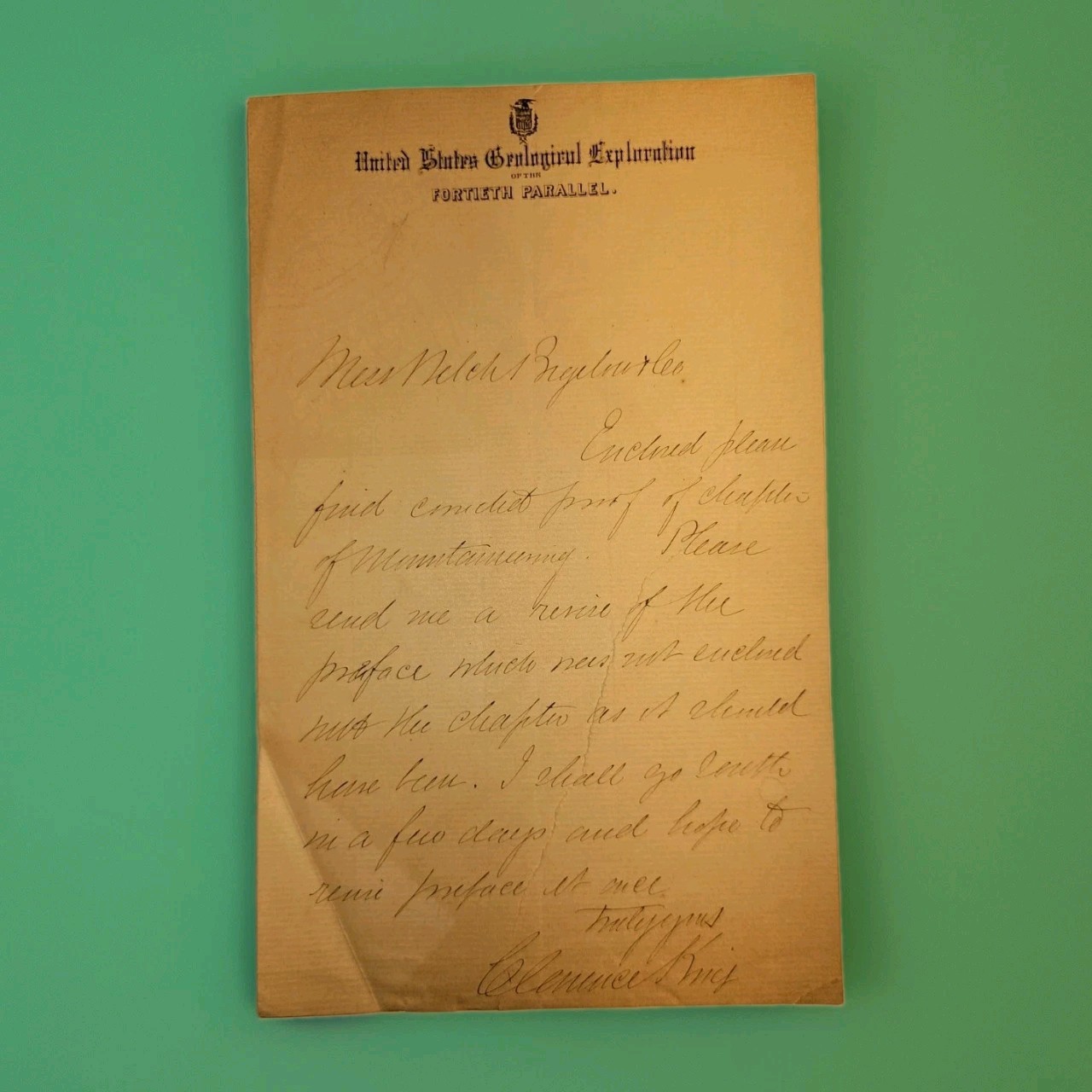
Rare original handwritten letter by Clarence King (1842–1901), pioneering American geologist, explorer, mountaineer, author, and the future first Director of the United States Geological Survey, concerning corrected proofs and the preface to his celebrated book Mountaineering in the Sierra Nevada.
Written on striking official letterhead of the United States Geological Exploration of the Fortieth Parallel, the government expedition King personally led through the American West, this letter was addressed to Welch & Bigelow, the Cambridge printing firm responsible for printing the first edition of King\'s Mountaineering in the Sierra Nevada.
The letter can therefore be placed directly within the production and proof-correction process for King\'s landmark 1872 book.
King writes that he is returning a corrected proof of a chapter of Mountaineering, requests a revised proof of the preface that had inadvertently not been enclosed, and explains that he expects to travel south shortly but hopes to revise the preface immediately.
This is an unusually evocative association piece connecting three major aspects of Clarence King\'s career in a single document:
- his exploration of the American West;
- his leadership of the Fortieth Parallel Survey;
- and the creation of Mountaineering in the Sierra Nevada, the literary work for which he remains best known.
The official survey stationery makes the association particularly compelling. King\'s mountaineering adventures and geological exploration in California and the Sierra Nevada supplied much of the substance of the book whose proofs he is discussing here.
Transcription
United States Geological Exploration
OF THE
FORTIETH PARALLEL.
Messrs. Welch & Bigelow
Enclosed please
find corrected proof of Chapter
of Mountaineering. Please
send me a revise of the
preface which was not enclosed
with the Chapter as it should
have been. I shall go South
in a few days and hope to
revise preface at once.
Truly yours
Clarence King
Historical Importance
This letter appears to document the final editorial and printing process surrounding Mountaineering in the Sierra Nevada.
The book was first published in 1872 by James R. Osgood & Co. of Boston, with Welch, Bigelow & Co. of Cambridge responsible for its printing. King\'s direct address to the printers, his reference to a returned “corrected proof,” and his request for a “revise of the preface” place the document within the practical preparation of the book for publication.
Unlike a simple autograph or social letter, the content relates directly to the creation of King\'s most famous literary work.
It is particularly notable that King wrote the letter on stationery headed:
“United States Geological Exploration of the Fortieth Parallel.”
The celebrated Fortieth Parallel Survey, commonly called the King Survey, was one of the great scientific explorations of the post-Civil War American West. Its fieldwork began in 1867 and examined a broad corridor across the western territories, producing important geological, topographical, mineralogical, paleontological, and photographic records.
King\'s experiences exploring the mountains of the West simultaneously established his scientific reputation and provided the experiences that became Mountaineering in the Sierra Nevada.
The result is a document in which American science, Western exploration, mountaineering history, and literary history intersect.
Clarence King Biography
Clarence King (1842–1901) was one of the most important American geologists and explorers of the nineteenth century.
Born in Newport, Rhode Island, King graduated from Yale\'s Sheffield Scientific School and became fascinated with the largely unmapped geology of the American West.
In 1867 he was selected to lead the United States Geological Exploration of the Fortieth Parallel, an ambitious federally sponsored survey extending across portions of the western United States along the general route of the newly constructed transcontinental railroad.
King and his team explored some of the most difficult terrain in the West, studying mountain ranges, mines, geological formations, fossils, natural resources, and the physical geography of the region. The expedition also produced extraordinary photographic documentation of the western landscape.
King himself became an accomplished mountaineer. His adventures in California\'s Sierra Nevada—including dangerous climbs, exploration of remote peaks, encounters with severe weather, and observations of the landscape—formed the basis for his literary masterpiece:
Mountaineering in the Sierra Nevada.
Published in 1872, the book combined adventure writing, natural history, geology, humor, and vivid descriptions of the American wilderness. It became an important early classic of American mountaineering literature.
King later played a central role in the creation of the United States Geological Survey.
When the USGS was established in 1879, Clarence King became its first Director, helping establish the institutional foundations of what would become one of the country\'s most important scientific agencies.
He resigned in 1881 and continued geological, mining, and scientific work privately.
Today King is remembered as a major figure in the history of:
American geology • Western exploration • mountaineering • scientific surveying • and the development of the USGS.
Welch, Bigelow & Co. Biography
Welch, Bigelow & Co. was an important nineteenth-century printing establishment associated with the University Press in Cambridge, Massachusetts.
The firm printed books for major Boston publishing houses and authors during a period when Boston and Cambridge were among the intellectual and literary centers of the United States.
Most importantly for this document, Welch, Bigelow & Co. printed Clarence King\'s 1872 Mountaineering in the Sierra Nevada.
King\'s letter is therefore not simply addressed to an unrelated publishing firm. It is correspondence sent directly to the printers while dealing with corrected chapter proofs and the revision of the book\'s preface.
The surviving letter provides tangible evidence of the normally invisible editorial work that occurred between King\'s manuscript and the completed published book.
United States Geological Exploration of the Fortieth Parallel
Authorized during the great period of post-Civil War western expansion, the Fortieth Parallel Survey began under King\'s leadership in 1867.
The survey investigated an enormous region of the American West and became one of the major government scientific expeditions preceding the establishment of the USGS.
Its work helped document the geology and mineral resources of the western territories at the very moment that railroads, mining, settlement, and federal exploration were transforming the region.
King\'s survey was particularly influential because it combined rigorous geological science with mapping, photography, natural history, and practical investigation of mineral resources.
The official Fortieth Parallel Survey letterhead on this letter creates a particularly strong association between the expedition and King\'s literary career.
Collector Significance
This is much more desirable than a routine Clarence King autograph.
It combines:
Clarence King autograph material
Fortieth Parallel Survey stationery
American Western exploration
early American mountaineering history
USGS history
publishing history
and direct content concerning Mountaineering in the Sierra Nevada
Most importantly, the letter records King actively correcting the proofs of the book and requesting a revised proof of its preface.
An excellent primary-source document for a collection focused on Western Americana, geology, exploration, mountaineering, the Sierra Nevada, American literature, or the history of the United States Geological Survey.
Condition
Original handwritten letter exhibiting expected age toning, folds/creases and handling consistent with a nineteenth-century document. There is a tear, with vintage repairing that was previously done. The writing and Clarence King signature remain clearly visible. Please examine the photographs carefully for the most complete assessment of condition.
Original manuscript material — not a reproduction.