When you click on links to various merchants on this site and make a purchase, this can result in this site earning a commission. Affiliate programs and affiliations include, but are not limited to, the eBay Partner Network.
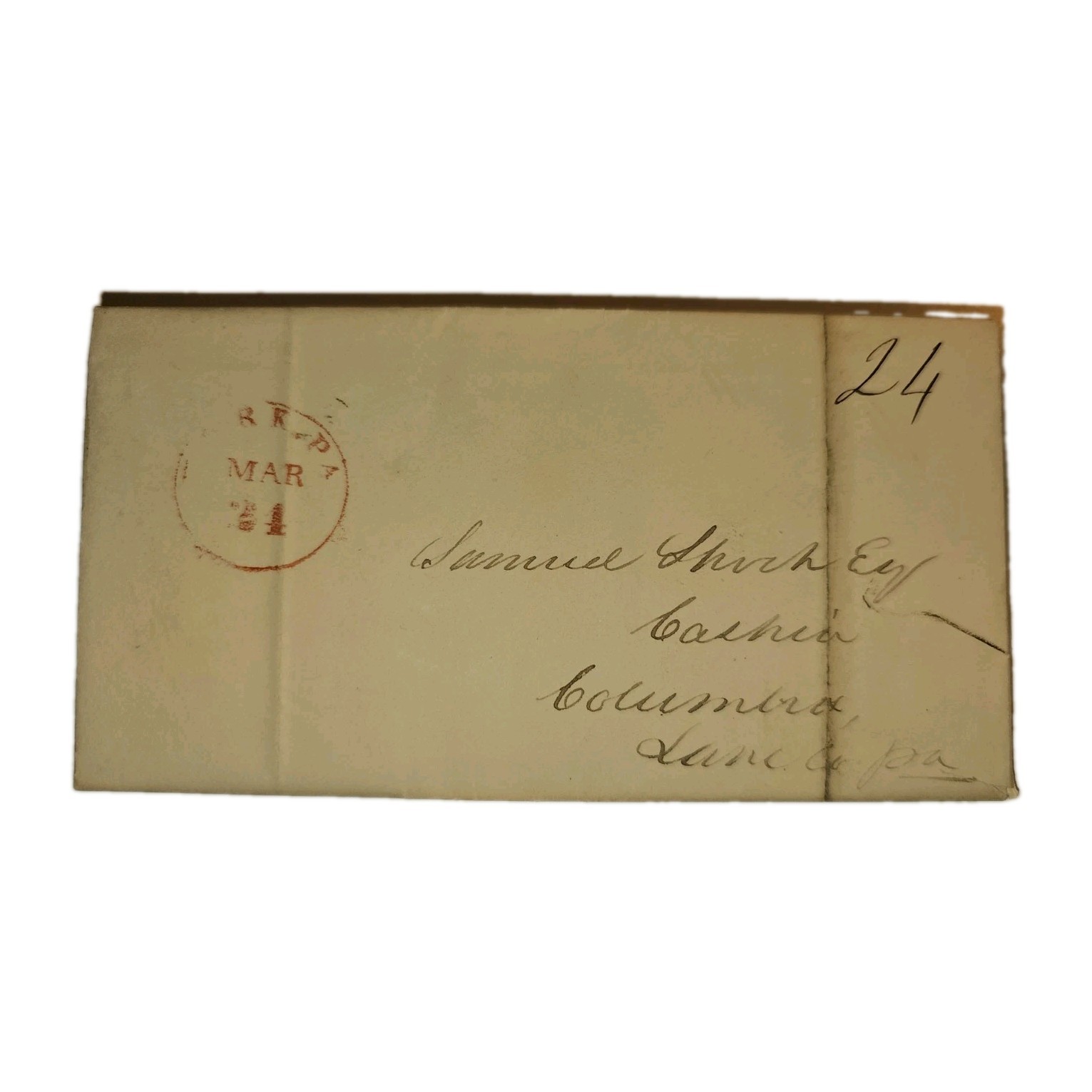
Offered here is an original March 23, 1841 Pennsylvania banking letter and stampless folded cover, sent from the York Bank in York, Pennsylvania, by longtime cashier Samuel Wagner to the cashier at Columbia, Lancaster County, Pennsylvania.
The letter documents the transmission of two checks totaling $172 between early Pennsylvania banking institutions: a $160 Hiestand check drawn on the Columbia cashier and a $12 A. G. Bell check on the Bank of Chester County.
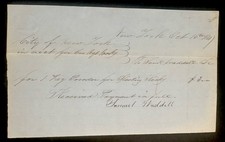
The folded letter retains its original address panel and a strong red “YORK PA / MAR 24” circular postmark. It was docketed upon receipt March 25, 1841.
This is an interesting surviving example of antebellum interbank correspondence and check collection, dating more than twenty years before the creation of the National Banking System.
Transcription
Address panel:
YORK PA / MAR 24
[manuscript “24”]
Samuel [Shoch/Shirk] Esq.
Cashier
Columbia
Lanc. Co. Pa.
Docket:
March 25, 1841
Wagner Encl.
Letter:
York Bank
March 23, 1841
Saml. [Shoch] Esq Cashr—
Dr Sir,
I enclose
[J.A./S.F.] Hiestand’s Ck. on you — $160.—
A. G. Bell’s " [Ck.] Bk Chester Co — 12.—
Very respectfully
Yours &c
Saml. Wagner
Cash
Some names/initials are difficult to read and are presented conservatively rather than asserting uncertain identifications.
Historical Importance
Although brief, the letter provides a remarkably direct look at how money moved between Pennsylvania banks in the 1840s. Before electronic transfers, modern clearinghouses, and the federal National Banking System, banks routinely forwarded checks, drafts, and other negotiable paper to correspondent institutions for collection and settlement.
Here, York Bank cashier Samuel Wagner personally forwards two pieces of commercial paper: one for $160 involving the Columbia institution and another for $12 drawn on the Bank of Chester County at West Chester.
The letter therefore connects three important early Pennsylvania banking centers: York, Columbia, and West Chester.
It was written during a particularly interesting period for York Bank. In 1841 its capital was increased to $210,000, and it remained the only chartered bank in York until 1850.
Samuel Wagner — Author & York Bank Cashier
Samuel Wagner was the longtime cashier of the York Bank, serving from 1835 until 1862.
Wagner came from a prominent Pennsylvania family. He was a son of Rev. Daniel Wagner, a German Reformed minister, and Anna Marie Reitzel Wagner. His older brother George Wagner was a York merchant and veteran of the War of 1812. Samuel was involved in trade with George before George's death in 1823.
Before entering banking, Samuel Wagner had an important career in Pennsylvania publishing. He edited the Lancaster Examiner and subsequently published newspapers in York, including the English-language York Recorder and German-language Der Republicanische Herald.
After leaving newspaper publishing, Wagner entered banking and became cashier of the historic York Bank, York's first banking institution. His tenure of approximately 27 years placed him at the center of the community's antebellum financial affairs.
Wagner's brother William Wagner (1800–1869) was an engraver who designed York Bank currency, including a five-dollar bank note depicting the institution's building on West Market Street.
Samuel Wagner retired as cashier in 1862. Two years later, York Bank became the York National Bank under the new federal banking system.
The signature at the bottom of this letter is Wagner's as cashier.
Samuel Shoch — Columbia Banker & Probable Addressee
The contemporary Columbia cashier corresponding with Wagner was Samuel Shoch (1797–1889).
The handwriting on the address panel has also been interpreted as “Samuel Shirk,” so the identification should be approached carefully. However, Shoch was the documented cashier of the Columbia Bank and Bridge Company beginning in 1839, and the interior salutation also appears consistent with his name.
Samuel Shoch was born in Harrisburg, Pennsylvania, on May 29, 1797, the son of John Shoch and Salome Gilbert. He was educated at Nottingham Academy in Maryland.
His public career began remarkably early. As a teenager he worked as recorder of patents in the Pennsylvania Surveyor General's office and served with the Harrisburg Artillerists during the War of 1812.
Shoch was admitted to the Dauphin County bar in 1820. His subsequent Pennsylvania government service included acting as chief clerk of the Pennsylvania House of Representatives in 1835–1836 and secretary of the important Pennsylvania Constitutional Convention of 1837–1838.
In 1839, Shoch moved to Columbia, Lancaster County, to become cashier of the Columbia Bank and Bridge Company.
He remained associated with the institution through its conversion into the Columbia National Bank in 1865 and became its president in December 1878, remaining in that position until 1884.
Shoch's activities extended far beyond banking. He served as treasurer of the Reading and Columbia Railroad from 1840 to 1862, Lancaster County auditor, a Columbia school-board director, director of the Columbia Water Company, president of the Columbia Gas Company, and trustee of Millersville Normal School.
He was also a delegate to the 1860 Republican National Convention. Governor William F. Johnston appointed him an aide-de-camp in 1848, giving rise to his later title of “Colonel” Shoch.
He died at Columbia on May 24, 1889, five days before his 92nd birthday, and was buried in Mount Bethel Cemetery.
Charles A. Barnitz — President of York Bank
Although he did not sign this letter, Charles Augustus Barnitz (1780–1850) was president of York Bank when Wagner wrote it and therefore provides important institutional context.
Born in York on September 11, 1780, Barnitz attended the York County Academy and was admitted to the bar in 1811.
His political career included service in the Pennsylvania State Senate from 1815 to 1819. Beginning in 1820, he also served as agent for the heirs of William Penn in connection with Springettsbury Manor.
Barnitz represented Pennsylvania in the United States House of Representatives from 1833 to 1835 as an Anti-Masonic congressman. He subsequently participated in the Pennsylvania Constitutional Convention of 1838 and attended the Whig national conventions of 1840 and 1844.
Barnitz served as president of York Bank from 1826 through 1842, meaning he was president at the exact time of this March 1841 transaction.
He died in York on March 8, 1850.
David Townsend — Bank of Chester County Cashier
The letter's second enclosure was a $12 check drawn on the Bank of Chester County.
At the time, that institution's cashier was David Townsend (1787–1858). Townsend was born at Pughtown, Chester County, on December 13, 1787, to Quaker parents Samuel Townsend and Priscilla Yarnell Townsend.
He held several public offices, including Chester County commissioner and county treasurer, and was involved with the Bank of Chester County as both a founder/director and longtime officer.
Townsend became cashier in 1817 and continued in that capacity until 1849.
He also had important connections with early American natural history. The flowering-plant genus Townsendia was named in his honor.
Townsend reportedly left his banking position following a head injury and died on December 6, 1858.
Townsend did not sign this letter; he is included because he was cashier of the bank upon which the enclosed $12 check was drawn.
Dr. William Darlington — President of the Bank of Chester County
The Bank of Chester County's president in 1841 was the distinguished physician, botanist, and politician Dr. William Darlington (1782–1863).
Born April 28, 1782, Darlington trained as a physician but developed a national reputation for his botanical work.
He also represented Pennsylvania in the United States Congress and became one of Chester County's most significant early scientific figures.
Darlington served as president of the Bank of Chester County from 1830 until his death in 1863.
His botanical publications included the important Flora Cestrica, published in 1837, a study of the plants of Chester County.
The Bank of Chester County itself had been chartered in 1814 as Chester County's first bank. By the time of this letter, it occupied its impressive High Street building in West Chester, designed by noted American architect Thomas U. Walter and completed in 1837.
Darlington did not sign or receive this letter; his connection is as the contemporary president of the bank on which the Bell check was drawn.
The Hiestand Check — $160
The largest item mentioned is a $160 Hiestand check, apparently drawn on the Columbia cashier.
The initials are difficult to read and may be J. A. or S. F. Hiestand.
The drawer has not been positively identified.
Importantly, this should not be attributed to later Congressman John Andrew Hiestand (1824–1890) without additional evidence. John Andrew Hiestand was born October 2, 1824 and would have been only sixteen years old when this transaction occurred.
The Hiestand surname was well established in Lancaster County, but the evidence presently available does not establish which member of the family drew this particular check.
A. G. Bell — $12 Check Drawer
The second enclosed item was a $12 check drawn by “A. G. Bell” on the Bank of Chester County.
Bell's precise identity remains unknown. The document nevertheless establishes that an individual using those initials maintained or utilized banking arrangements through the Bank of Chester County.
There is presently insufficient evidence to attach the name to a particular Chester County merchant or landowner.
For obvious chronological reasons, this person has no connection with Alexander Graham Bell, who was not born until 1847.
Columbia Bank and Bridge Company
The Columbia Bank and Bridge Company occupied an unusual place in Pennsylvania's early financial and transportation history because banking and Susquehanna River infrastructure were intertwined.
The company had suffered a major setback when the 1832 ice freshet destroyed its bridge across the Susquehanna River. Its effective capital was consequently substantially below its nominal capitalization during the following period.
Samuel Shoch arrived as cashier in 1839 and subsequently became one of the institution's defining figures.
The bank ultimately survived the volatile antebellum banking era and was reorganized under the National Banking Acts as the Columbia National Bank in 1865.
Bank of Chester County
Chartered in 1814, the Bank of Chester County was the county's first bank and an important financial institution for the agricultural and commercial economy surrounding West Chester.
By 1841 it was operating from the notable High Street bank building designed by Thomas U. Walter, who would later become one of America's most important architects and serve as Architect of the Capitol.
Thus even the small $12 check mentioned in this letter connects York and Columbia banking activity with one of southeastern Pennsylvania's principal early financial institutions.
Condition
Original 1841 stampless folded letter, showing expected age toning, folds, handling, minor staining/soiling and wear consistent with an approximately 185-year-old piece of correspondence. The red YORK PA / MAR 24 postmark remains readily visible. Original address, docketing, manuscript postal/accounting notation, letter text and Samuel Wagner signature are present.
Please examine all photographs carefully for exact condition.
Collector Interest
An excellent piece for collections relating to:
Pennsylvania banking history; York, Pennsylvania; Columbia and Lancaster County history; Chester County banking; Samuel Wagner; Samuel Shoch; Charles A. Barnitz; antebellum finance; early American checks and negotiable instruments; stampless postal history; Pennsylvania political history; War of 1812 figures; early railroads; or 19th-century American financial ephemera.
The principal significance is that this is not simply a blank banking form or later historical account—it is an original 1841 working communication between Pennsylvania bankers documenting the actual transmission of financial instruments for collection during the antebellum era.